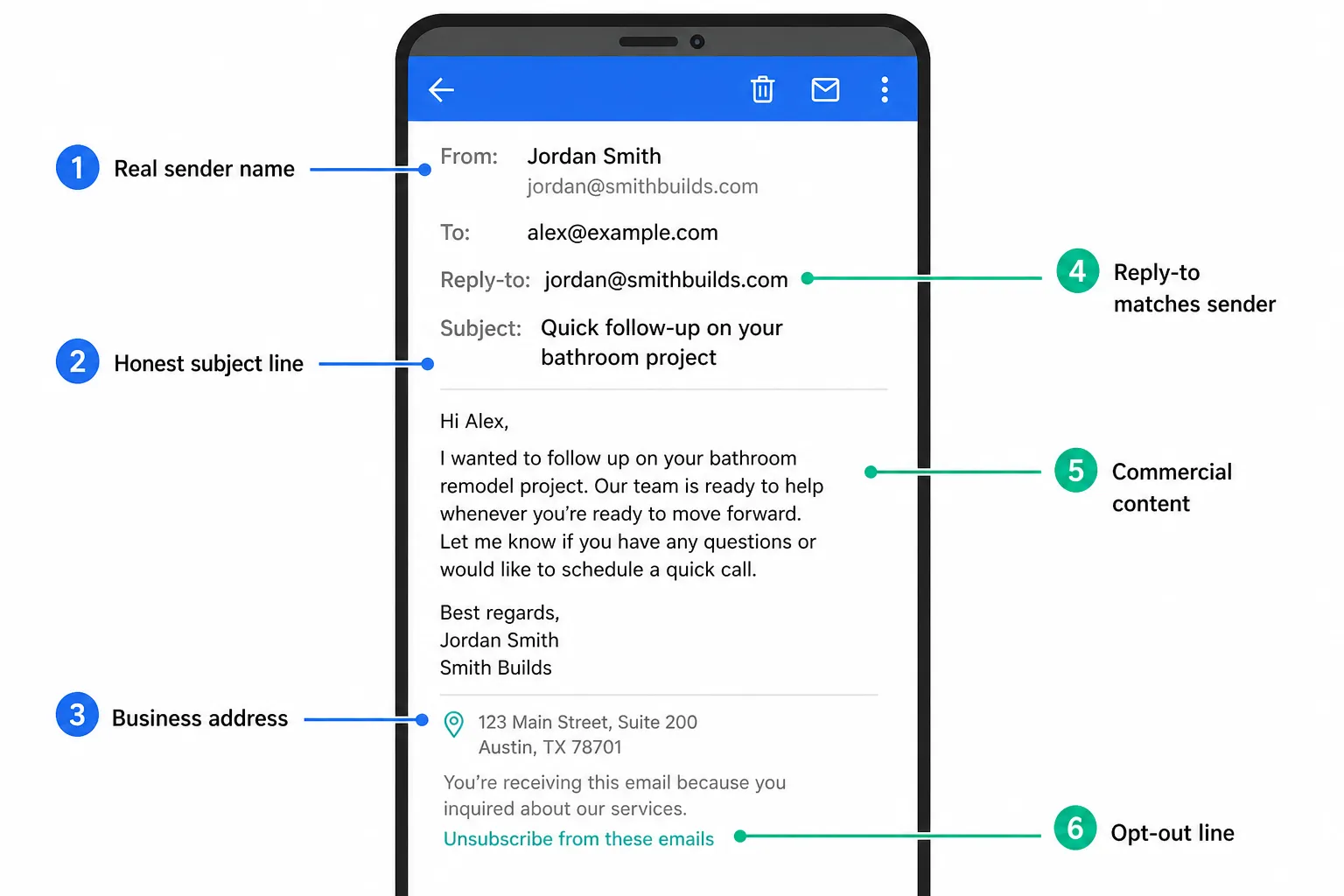
TLDR: CAN-SPAM is a federal law that governs commercial email in the United States. If you send follow-up emails to homeowners or property managers, four basic rules keep you on the right side of it. You do not need a lawyer to understand this.
What CAN-SPAM Actually Covers
CAN-SPAM stands for Controlling the Assault of Non-Solicited Pornography And Marketing. Congress passed it to regulate commercial email. Any email whose primary purpose is commercial, meaning you are promoting a service or a business relationship, falls under it.
That covers a lot of what contractors send. Follow-ups on unanswered estimates. Seasonal reminders to past customers. Requests for a Google review tied to a recent job. All of it qualifies.
What does NOT fall under CAN-SPAM the same way: a purely transactional email. If you are sending an invoice to someone who just hired you, that is transactional. The rules are lighter there. But the moment you are nudging someone toward new work, the commercial rules apply.
The key thing people get wrong is assuming CAN-SPAM only applies to mass email blasts. It applies to individual commercial emails too. One email to one past customer asking if they want a new quote is still covered.
Rule One: Be Honest About Who You Are
Your 'From' name, your 'Reply-To' address, and your subject line must not be deceptive. That is it.
Do not send from a fake name. Do not write a subject line that has nothing to do with the email body. Pretty obvious, but people slip up when they try to get clever with open rates.
A subject like 'Quick question about your property' is fine if you actually have a question. A subject like 'Your invoice is ready' when there is no invoice is a violation. Keep it accurate and you have nothing to worry about.
Practical tip: use your real business name in the From field. Homeowners recognize it. And if they do not recognize it, that is actually useful information. It means your branding is inconsistent, which is a different problem to fix.
Rule Two: Include a Real Physical Address
Every commercial email must include a valid physical postal address. This can be your business address, a P.O. box, or a private mailbox registered with a commercial mail service.
Most contractors forget this entirely, and it is probably the most common CAN-SPAM slip in the trades.
You do not need a fancy footer. A simple line at the bottom of the email works fine. Something like your company name, your city and state, and a mailing address. Four lines at most.
If you work out of your home and do not want that address public, a P.O. box is a clean solution. Many contractors already have one for billing. Use it here too.
Rule Three: Give People a Way to Opt Out
Every commercial email must include a clear, easy way for the recipient to say 'stop emailing me.' This is the opt-out requirement, and it is non-negotiable.
The opt-out mechanism does not have to be a fancy unsubscribe link. It can be as simple as 'Reply to this email with STOP and I will remove you from my list.' What matters is that it is visible and that it actually works.
The law also sets a deadline for honoring opt-out requests. The deadline is short. Once someone asks to be removed, you need to stop emailing them promptly. Do not drag your feet on this.
And no, you cannot charge someone to opt out. You cannot require them to give you personal information just to unsubscribe. The process must be free and simple.
If you are running follow-up sequences on past customers or on unanswered estimates through an email campaign, make sure your opt-out handling is built into the process, not an afterthought.
Rule Four: Label Solicited Content Honestly
If your email is an advertisement, it cannot disguise itself as something else. CAN-SPAM requires that commercial emails be identifiable as advertising when that is what they are.
In practice, most follow-up emails from contractors are not pure ads. You are following up on a job quote the homeowner requested, or reaching out to a customer you already worked with. That context matters and generally makes the 'identify as ad' requirement much less rigid.
Where people get into trouble is when they buy or rent email lists and blast strangers. That is where the 'this is an advertisement' label becomes critical, and where CAN-SPAM violations pile up fast.
Stick to people who asked for a quote, hired you, or gave you their contact information directly. You are on solid ground. Cold lists bought from third parties are a different situation entirely, and worth discussing with an attorney before you use them.
My Take
My advice: do not overthink this. CAN-SPAM was not written to trap honest contractors. It was written to stop spammers hiding behind fake identities and fake addresses.
If you put your real name on the email, include your business address at the bottom, give people a way to opt out, and do not lie in your subject line, you are doing what the law asks. That covers the overwhelming majority of what small contractors actually send.
The headache is not compliance. The headache is consistency. Remembering to include that footer on every single email. Actually removing people when they ask. Those are process problems, not legal ones.
A lot of contractors send follow-up emails manually and simply forget the footer half the time. Building a consistent template helps. Whether you send manually or use a tool to automate the sequence, the rules are the same. Apply them once in your template and you are done.
Common Questions
Does CAN-SPAM apply to texts and voicemails? No. CAN-SPAM covers email only. Text messages fall under a different federal law, the TCPA. Voicemails have their own rules. If you are doing multi-channel outreach, treat each channel separately.
Do I need permission before emailing a past customer? CAN-SPAM does not require prior permission the way some other countries' laws do. But some states have started passing their own privacy laws that add requirements on top of CAN-SPAM. Rules vary by state, so if you are doing high-volume outreach, it is worth a quick check on your state's current rules.
What happens if I get a complaint? The FTC enforces CAN-SPAM at the federal level, and state attorneys general can act too. Penalties can be significant. In practice, a single accidental violation from an honest business is a different situation than a pattern of intentional abuse. But you do not want to find out the hard way. Honor every opt-out request immediately and keep your templates clean.