Estimates
Build estimates as PDFs, and dictate them from the job site
The estimate you write on the spot is the one that actually goes out. Describe the work out loud from the truck and Lienzor turns it into clean line items. You set every price yourself, because nobody can price your work but you. The PDF is ready before you get home.

The estimate you write tonight is the one you lose
You measure the job, you say you will send something over, and then the evening happens. Two days later the customer has called someone else. It is almost never the price that loses the job. It is the wait.
Writing it up at 9pm after a full day is the last thing you want to do
The details blur, so the description gets vague, so the customer hesitates
The competitor who answered the same day already has the job
A rushed document looks rushed, and people read that as how you work
How it works
You describe the work out loud
From the truck, in your own words, the way you would explain it to a coworker.
It comes back as line items
Structured, in plain language, ready to adjust. Nothing invented.
You set the prices
Every price is blank until you fill it in. Lienzor never guesses what your work is worth, and never quietly inserts a number.
The PDF goes out
Your letterhead, your terms, ready to send. And once it is out, the follow-up sequence takes over on its own.
Try it: build an estimate
Add line items or simulate dictating from the job site. Totals, sales tax and the deposit recalculate as you type.
| Description | Qty | P.U. | Total | |
|---|---|---|---|---|
| $440 |
Totals recalculate as you type. On site, dictation fills the line items and you only check the prices. Nothing is saved from this page.
What dictation actually turns into
Here is roughly what you say standing in the driveway, and what comes back.
Objet
Spoken on site
"Alright, master bath. Tear out the existing tub and surround, haul it off. Rough-in stays where it is. New sixty inch tub, tile the surround to the ceiling, that is about eighty square feet. Replace the vanity, customer is supplying it. Paint the whole room. Two days of demo and prep, three days tile, one day finish."
→ Comes back as: demolition and disposal, tub install, tile surround at 80 sq ft, vanity install with customer-supplied unit, paint, and a six day timeline. Every price field empty, waiting for you.
Why it works. The prices are blank on purpose. Software that guesses what your labor is worth produces confident, wrong numbers on a document that carries your name and your license.
The principle is the same everywhere
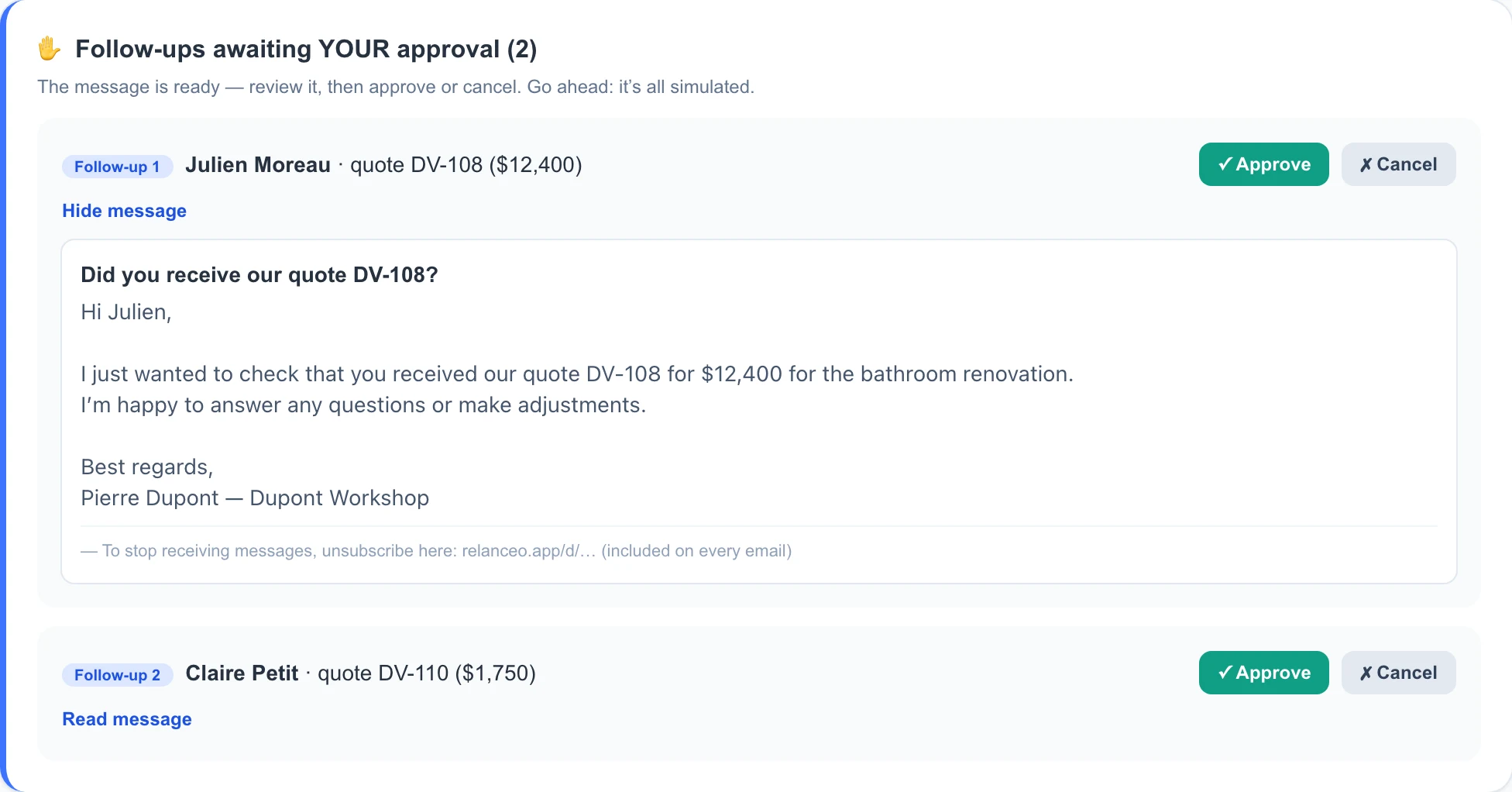
Whatever the service, Lienzor prepares and you decide. The message is written, dated and ready. You read it, you edit it, you approve it. Or you let it run on its own, once you trust it.
The public demo shows this on estimate follow-ups, but the approval mechanism is identical for reviews, campaigns and referrals.
Four things that lose you the job
Sending it two days later
It is almost never price that loses the job. It is being second. The estimate that arrives same day wins an unfair share of the time.
One line that says "bathroom remodel"
A single vague line invites the customer to compare on price alone, because you have given them nothing else to compare.
Leaving out what is not included
Every fight about scope traces back to something nobody wrote down. Say what is excluded, plainly.
Sending it and forgetting it
Most estimates die from silence, not rejection. Which is the entire reason the follow-up starts automatically.
When to build estimates in Lienzor
As soon as writing them up in the evening has become the thing you dread. The tool exists so the estimate leaves while you are still standing on the job.
- You estimate on site and write it up at home, hours later
- You have lost work to someone who simply answered faster
- Your current estimates are typed into a document from scratch every time
- You want the follow-up to start on its own the moment it is sent
Quand ce n'est pas utile. If you already run estimating software you are happy with, keep it. Connect Lienzor for the follow-up and leave the estimating where it is.
What stays under your control
No price is ever invented. A field you did not fill stays empty
You read the document before it goes anywhere
The dictation is used to write the estimate, and for nothing else
Sales tax is yours to apply: US rates are set state by state, and we will not guess yours
Frequently asked questions
Does the voice dictation actually work on a noisy site?
It handles normal working conditions. Standing next to a running saw, no. Nothing does. Step away for thirty seconds and it is fine.
Will it price the job for me?
No, and that is deliberate. Lienzor structures what you said into line items and leaves every price empty. Guessing your rates would produce confident, wrong numbers in a document with your name on it.
Can I use my own template?
Your business details, your logo, and your terms all appear on the document. The layout stays consistent so it reads as professional rather than improvised.
What about sales tax?
You apply it. Sales tax in the US is set state by state, and for contractors it often depends on the type of work and where it happens. Software that guesses that on your behalf is doing you a disservice.
What happens after I send it?
The follow-up starts on its own. That is the part most people never get around to, and it is the whole reason Lienzor exists.
Works well alongside
Lienzor services all work off the same customer list, so switching this one on makes the next one more useful.



The first job you win back pays for years of Lienzor.
Gratuit pendant le lancement, sans carte bancaire. Rien ne part sans votre accord.