Google reviews
Google reviews, asked for automatically after every job
A happy customer almost never thinks to leave a review. You have to ask, and you have to ask fast. Lienzor drafts the request the moment the job is marked done, with your direct Google link, and you approve it before it sends. Only the people who did not respond get a reminder.

Why your happiest customers never leave a review
It is not a satisfaction problem, it is a timing and friction problem. They were thrilled the day you finished. Three weeks later they have moved on. And even when they are glad to help, they are not going to hunt down your Google profile on their own.
Nobody asks, because asking feels awkward
By the time you remember, the enthusiasm is gone
The customer does not know where to go, so you have to hand them the link
Unhappy customers write on their own. Without asking, your rating drifts down by itself
How it works
The job is marked complete
From a signed estimate or with one click, Lienzor knows the work is finished and starts the clock.
The request is drafted
A short message in your voice, with the direct link to your Google profile. No canned template that reads like a mass mailing.
You approve it
Read it, edit it, send it. Or let it run on its own once you trust it.
One reminder, then it stops
A single reminder to the people who did not respond. Not two. Chase someone three times for a review and you just have an annoyed customer.
Try it: ask for a review
A job just wrapped up. Draft the request, read it over, send it, or decide not to. Go ahead and click: everything here is simulated.
The job is marked complete. Lienzor offers to draft the review request.
A finished job triggers the draft. You read it, you send it, or you leave the customer out if the job went badly. One reminder after that, never two.
The message exactly as it goes out
Short, specific, one possible action. A review request that asks for feedback, a recommendation and a share all at once gets none of the three.
Objet
Mind leaving a quick review?
Hi Julie,
Hope the bathroom is treating you well. If you were happy with how it went, a Google review would genuinely help me out. It is what people look at when they are searching for someone around here.
Takes about thirty seconds: [direct link to your profile]
And if anything is not right, tell me first and I will come back out.
Thanks, Mike — Dupont Remodeling
Why it works. That last line matters as much as the link. It gives an unhappy customer somewhere to go other than your public profile, and it is the difference between hearing about a problem and reading about it in a one-star review.
The principle is the same everywhere
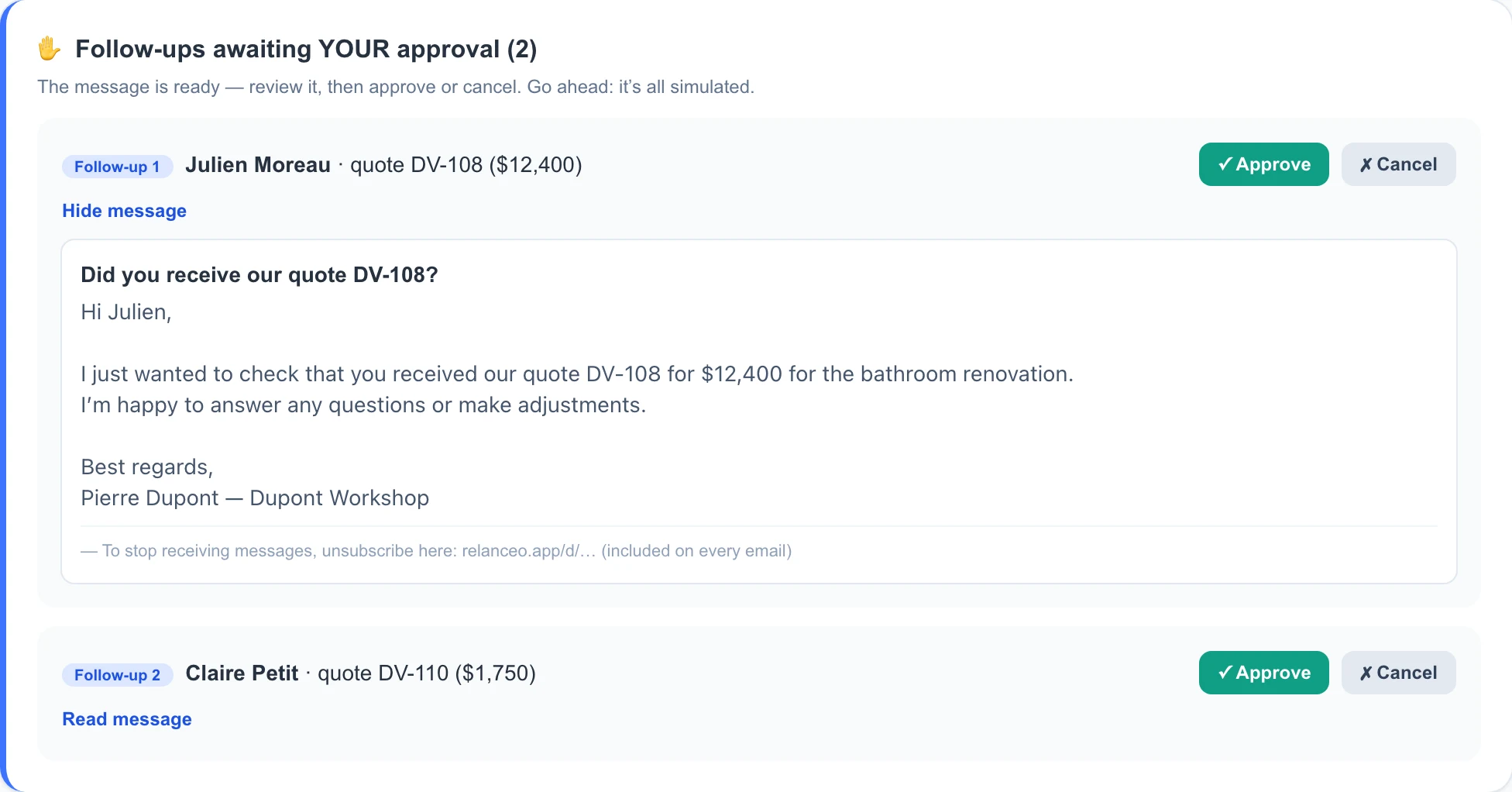
Whatever the service, Lienzor prepares and you decide. The message is written, dated and ready. You read it, you edit it, you approve it. Or you let it run on its own, once you trust it.
The public demo shows this on estimate follow-ups, but the approval mechanism is identical for reviews, campaigns and referrals.
Four things that kill a review request
Asking three weeks later
The enthusiasm is gone and the job is no longer on their mind. The request needs to go out within days of finishing.
Not giving the direct link
"Leave us a review on Google" makes the customer go find your profile. Half of them give up right there. The link should open the form itself.
Offering something in return
Paying for reviews with a discount or a gift card violates Google's policies and can cost you the profile. You ask; you do not buy.
Following up three times
One reminder, no more. By the second, the customer feels harassed over a favor they were doing you for free.
When to switch reviews on
This is the module to turn on right after estimate follow-ups, because the effect shows up within weeks: your Google profile climbs, and inbound calls go up without spending anything on ads.
- You have fewer reviews than the competitors showing up next to you in local results
- Your rating is good but old, and recent reviews carry more weight
- You finish several jobs a month and nobody ever asks
- You have just claimed or rebuilt your Google Business Profile
Quand ce n'est pas utile. If you work purely as a sub for other contractors, Google reviews will barely move your business. Put the effort into estimate follow-ups instead.
What stays under your control
You pick who gets asked. A job that went badly never enters the sequence
The message goes out from your address, signed with your name
One reminder maximum, then the sequence ends for good
Your do-not-contact list applies to review requests too
Frequently asked questions
When should you ask for a Google review?
As soon as possible after the work is done, while the job is still fresh in their mind. After two or three weeks, response rates drop off sharply.
Can you filter out unhappy customers?
You decide who gets the request, so a job that went badly never enters the sequence. What Lienzor will not do is screen the reviews themselves. Selectively soliciting only happy customers to inflate a rating is against Google's policies and puts your profile at risk. Choosing not to ask is your call; filtering by star rating after the fact is not something we will build.
How many times should you follow up for a review?
Once. Someone who has not left a review after one reminder will not leave one after a third message, and pushing on this damages the relationship you just built.
Does it work without connecting my email?
Yes. Like estimate follow-ups, a spreadsheet import or manual entry is enough to trigger review requests.
Can I use it for something other than Google?
The link is yours to set, so you can point it anywhere you collect reviews. Google is simply where most local searches end up, which is why it is the default.
Works well alongside
Lienzor services all work off the same customer list, so switching this one on makes the next one more useful.


The first job you win back pays for years of Lienzor.
Gratuit pendant le lancement, sans carte bancaire. Rien ne part sans votre accord.