TLDR: A change order form is a written agreement that documents any work added to or removed from the original scope, along with the new price and timeline. Without one, you are doing extra work on a handshake, and handshakes lose in court. Fill it out before you touch the new work, get a signature, and keep a copy.
What a Change Order Form Actually Does
A lot of contractors treat change orders as paperwork they do after the fact. That is the wrong way to think about it. The form is not a receipt. It is a mini-contract that modifies the original one.
When a homeowner asks you to add a bathroom exhaust fan, move a wall two feet, or swap the countertop material, that is a scope change. The moment you agree to do extra work without a signed change order, you have given that work away for free if the client disputes it later.
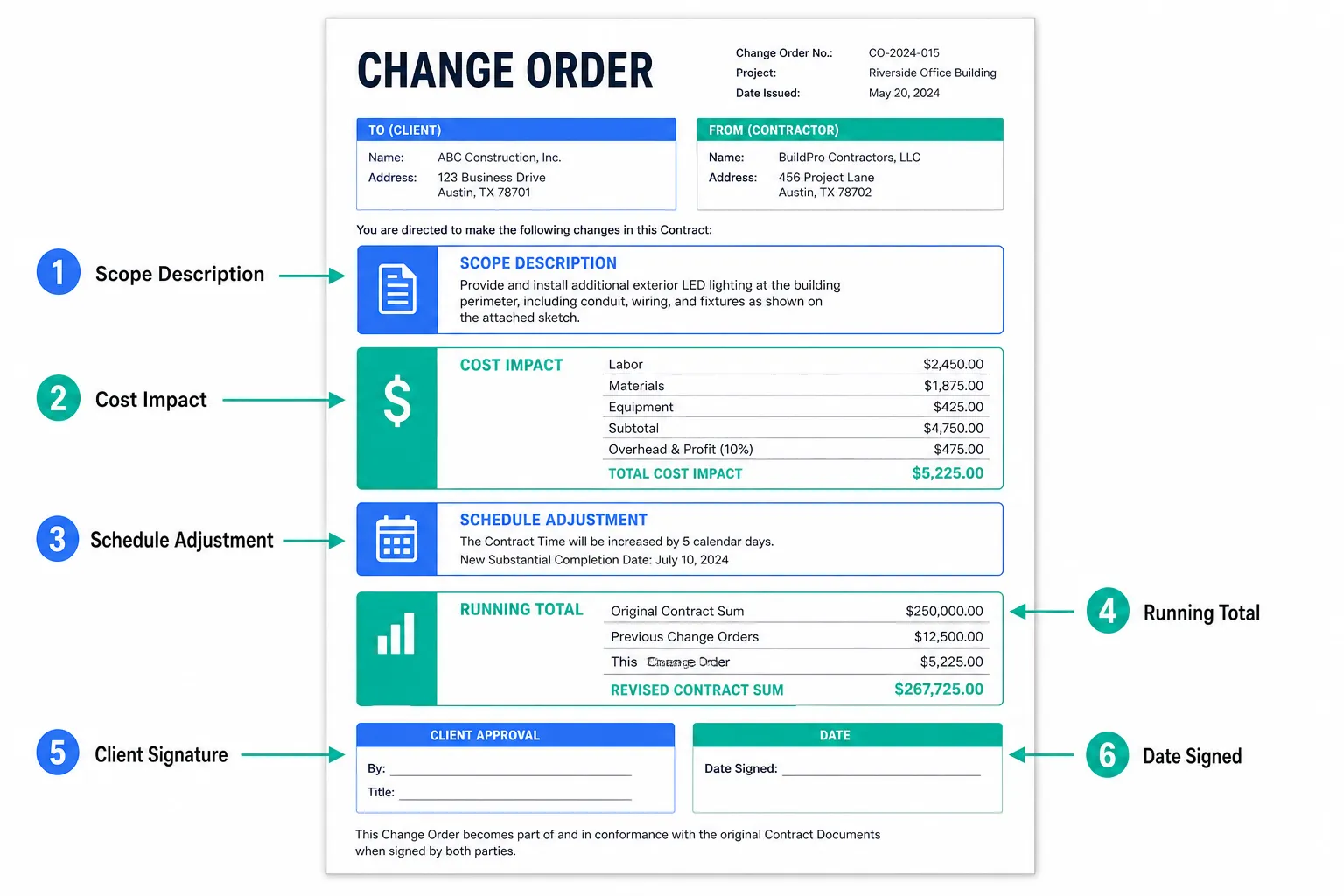
The document does three things at once. It records what changed. It locks in the new price. And it adjusts the completion date if the change affects your schedule. All three matter.
What Every Change Order Form Must Include
The form does not need to be fancy. But it does need to be complete. A vague description will not protect you.
Here is what belongs on every change order form:
- Project name and address
- Client name and your business name
- The date the change is agreed to
- A clear description of what is being added, removed, or changed
- The cost impact, broken down if possible (labor, materials)
- The schedule impact in days
- A new running total for the contract
- Signature lines for both parties, with a date field next to each
If any of those items are missing, the form can be read two different ways, and the client will always pick the reading that costs them less.
Some contractors also add a line that says work will not begin until the form is signed. That sentence alone has saved jobs from turning into payment fights.
The Classic Mistake Contractors Make with Change Orders
The mistake is not skipping the form entirely. Most contractors know they should use one. The mistake is doing the work first and writing it up later.
You are on the job site. The homeowner is standing next to you. They ask for something extra, you say sure, you keep moving. At the end of the job, you hand them a final invoice that is three thousand dollars higher than expected. They are shocked. They say they never agreed to that price.
The argument is not really about the money. It is about the fact that there is no document proving what was agreed and when.
That is when relationships break down. That is also when reviews go south. Get the signature before the work starts, even if it slows the conversation by ten minutes. Ten minutes now beats a collections call later.
The same principle applies at the estimate stage. If your original estimate is clear and detailed, scope creep is easier to catch because you have a clean baseline to point to. A tool like building estimates by voice helps you build that baseline fast, even from a truck.
Digital vs. Paper: Which One Actually Gets Signed
Paper forms work fine. The problem is no one has a printer on a job site. So the paper form turns into a note in a text thread, which is better than nothing but much harder to enforce.
Digital change orders, sent to a client's phone and signed with a finger tap, actually get done. They come back faster than you expect. And they create a timestamp you did not have to add yourself.
Whatever format you choose, the rule is the same: signed before the work starts, stored somewhere you can find it in six months.
Email confirmations can work in a pinch. A text that says 'ok go ahead' is weak but not worthless. A signed document is always stronger. Do not let convenience become a habit that costs you.
Change Orders and Your Legal Standing
Construction law varies a lot by state. What counts as an enforceable change order in one state may need specific language in another. Some states require that any modification to a home improvement contract be in writing to be enforceable. Others follow the general contract law principle that oral agreements can be binding but are very hard to prove.
A few things are true almost everywhere. A signed document beats a verbal agreement. A detailed document beats a vague one. And a document signed before the work beats one signed after.
Talk to a contractor attorney in your state if you want to know what your change order form legally needs to say where you work.
Some states also regulate home improvement contracts specifically, including how changes must be handled. If you work across state lines, the rules may shift from one job to the next. Do not assume what worked in one state applies in another.
Once you have completed change-order work and are ready to bill, your final invoice needs to reflect the updated contract total clearly. A free tool like the voice invoice generator can help you pull that together quickly without the math errors that come from updating numbers by hand.
My Take
My advice: treat the change order form the same way you treat the original contract. You would not start a new job without a signed agreement. Extra work is a new agreement. Treat it that way.
The contractors who skip change orders are usually not lazy. They are people-pleasers. They do not want to slow down the relationship or make the homeowner feel like they are being difficult. I understand that. But you cannot deposit goodwill.
The form protects both of you. When you frame it that way to the client, most of them do not push back. They get it. It is proof of what they asked for, too.
Build a template that takes you two minutes to fill out. Keep it in your phone. Send it the same way you send a text. That is all it takes to stop ninety percent of the arguments before they start.
Common Questions
Can a text message count as a change order? Sometimes, depending on your state and the wording. A text that clearly states the added work, the price, and gets a clear 'yes' in response is better than nothing. But it is not as strong as a signed document and much harder to use if you end up in a dispute. Use a proper form whenever you can.
What if the client refuses to sign before the work starts? That is a red flag. A client who pushes back on signing a simple change order is often a client who will push back on the invoice later. You can offer to explain the form, but do not let pressure move you into starting work you cannot prove was authorized.
Do I need a change order for small stuff? That depends on your original contract. Some contracts include a de minimis clause that covers minor changes under a certain dollar amount without a formal amendment. If yours does not, or if you are unsure, write it up. The form takes two minutes. The argument can take months.