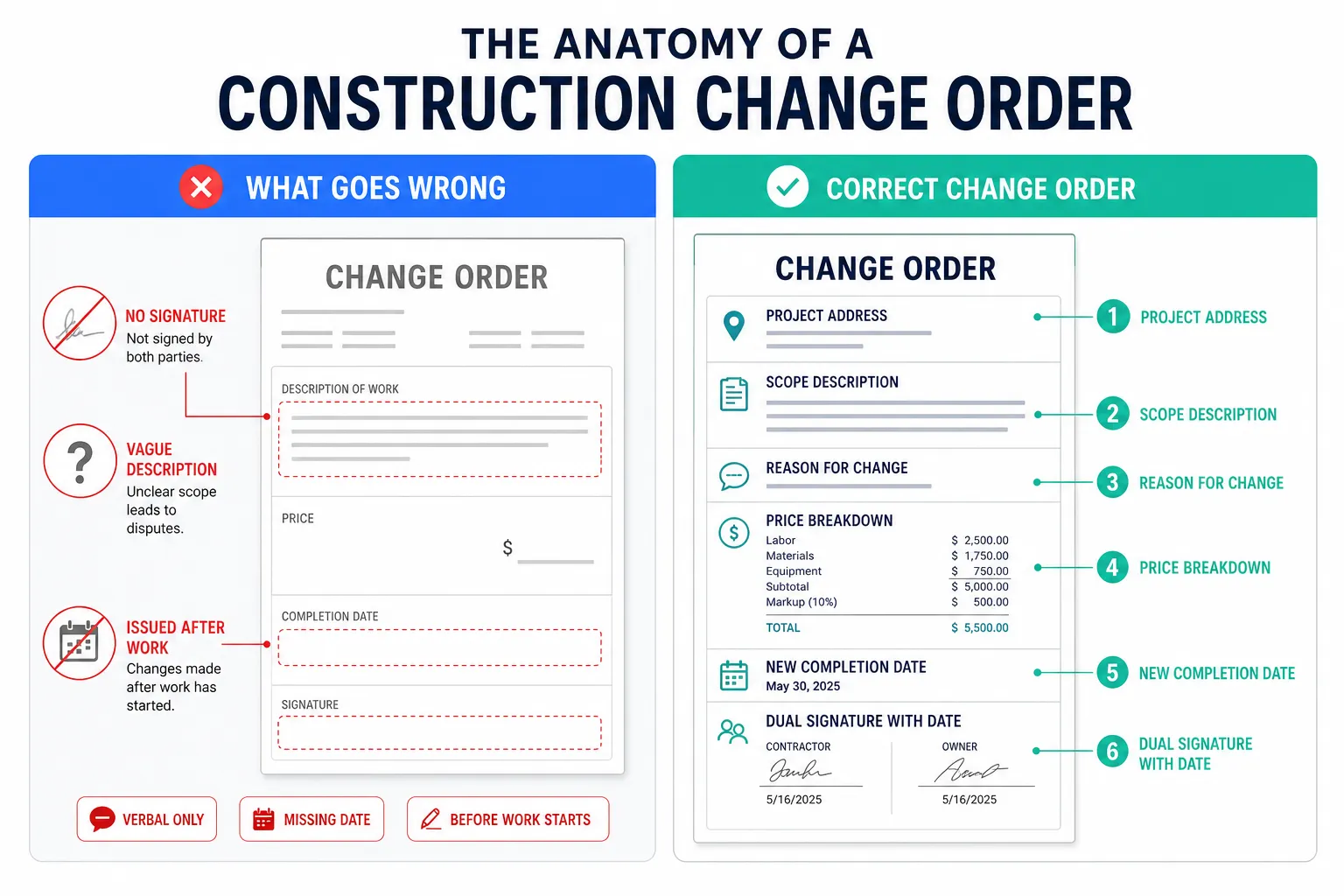
TLDR: A construction change order is a written amendment to your original contract that documents added scope, removed scope, or a change in timeline. Without one, you are doing extra work on a handshake, and that handshake will not hold up when a homeowner disputes the final bill. Get it signed before you touch the new work.
What a Construction Change Order Actually Is
A change order is not a new contract. It is an amendment. It references the original agreement, describes exactly what changed, and sets a new price or timeline to go with it.
Think of it this way. You quoted a bathroom remodel. Midway through demo, the homeowner wants to move the toilet three feet and add a heated floor. That is two scope changes, not one. Each change to scope, cost, or schedule deserves its own documented amendment, signed by both parties, before the work starts.
Most contractors understand this in theory. In practice, they say yes to a small addition, figure they will sort it out on the final invoice, and then get into an argument when the customer sees a number they never approved. That is the classic mistake, and it is completely avoidable.
What to Put in Every Change Order
Keep it simple but complete. A change order that takes ten minutes to fill out is one a customer will actually read and sign.
Here is what belongs in every one:
- Project name, address, and original contract date
- A clear description of what is being added, removed, or changed
- The reason for the change (owner request, hidden condition, design revision)
- The adjusted price, broken out if possible: labor, materials, markup
- Any change to the completion date
- Signature lines for both you and the customer, with a date field
Leave out the legal jargon. Plain English works better. If the customer can read it in two minutes and understand exactly what they are approving, you will get that signature faster.
Why Same Day Matters More Than You Think
Contractors lose money on change orders in two ways. The first is not issuing them at all. The second is waiting.
You agree to the change on a Tuesday. You plan to write it up Friday. By Friday, the work is half done and the customer has mentally moved on. Now getting a signature feels awkward, almost like you are asking for something you were not supposed to ask for. The customer's memory of what was agreed has also started to shift.
Issue the change order the same day the scope changes. Send it before your crew starts the new work. A signature before the work begins is worth ten arguments after it.
If you are building estimates by voice on a job site, you can get a draft change order turned around in minutes. No going back to the office. No forgetting what was said.
Change Orders and Your Legal Standing
This is where it gets real. Construction contract law varies from state to state, so do not take anything here as legal advice for your specific situation. That said, some consistent truths apply almost everywhere.
An unsigned change order is worth very little in a dispute. A verbal approval followed by work performed is a gray area at best. Courts and arbitrators look for written evidence that the customer knew what they were agreeing to and agreed to it.
Some states have specific requirements around home improvement contracts, including change orders. Penalties for non-compliance vary and can be significant. If you work in residential, look up your state's home improvement contractor rules, or ask a local construction attorney, because the rules are stricter than most people expect.
Lien rights are also tied to this. If you plan to file a mechanics lien for unpaid work, the documentation around scope and price will matter. Again, lien law is state-specific and deadlines are often short.
The Conversations That Kill Change Orders
Three situations kill more change orders than anything else.
First: the customer pushes back with 'I thought that was included.' This happens when your original estimate was vague. Tight scope descriptions in your original contract make change orders easier to defend. If you want to tighten how you write estimates, a faster estimate workflow helps you add the detail that prevents ambiguity.
Second: you feel bad charging for something small. A small addition today becomes an assumption tomorrow. The next customer hears you did it for free. Bill for what you do, every time.
Third: the homeowner is in a hurry and wants you to just start. This is the most dangerous one. 'I trust you, just go ahead' is not a signed change order. Write it up, hand them a phone or a tablet, get the signature. It takes three minutes.
My Take
My advice: treat every change order with the same seriousness you treat the original contract. No exceptions for small amounts. No exceptions for longtime customers.
The contractors who are cleanest on this do not make it a big deal. They make it routine. They have a simple template. They send it immediately. The customer never feels like they are being nickel-and-dimed because the change order arrives before the work, not after the invoice.
If your process makes it hard to write things up on the fly, that is the real problem to fix. Anything that slows down documentation will eventually cost you money. The free voice invoice generator can help you capture job details fast when you are on site and short on time.
Get the system simple enough that you actually use it every single time. That is the whole job.
Common Questions
Do I need a change order for work under a certain dollar amount? There is no universal threshold. Some states have rules around written authorization for home improvement work regardless of amount. When in doubt, document it. The paperwork costs you nothing.
What if the customer refuses to sign before I start? Stop the new work. Explain that your contract requires written approval before scope changes begin. Most customers sign when they realize you mean it. If they will not sign, you have learned something important about how the rest of that job will go.
Can a text message count as a signed change order? In some situations, written digital communication has been treated as evidence of agreement. But a text is not a signed contract amendment. It may support your case, but it is not a substitute. Use a proper change order form with a signature field, even if you send and sign it digitally.