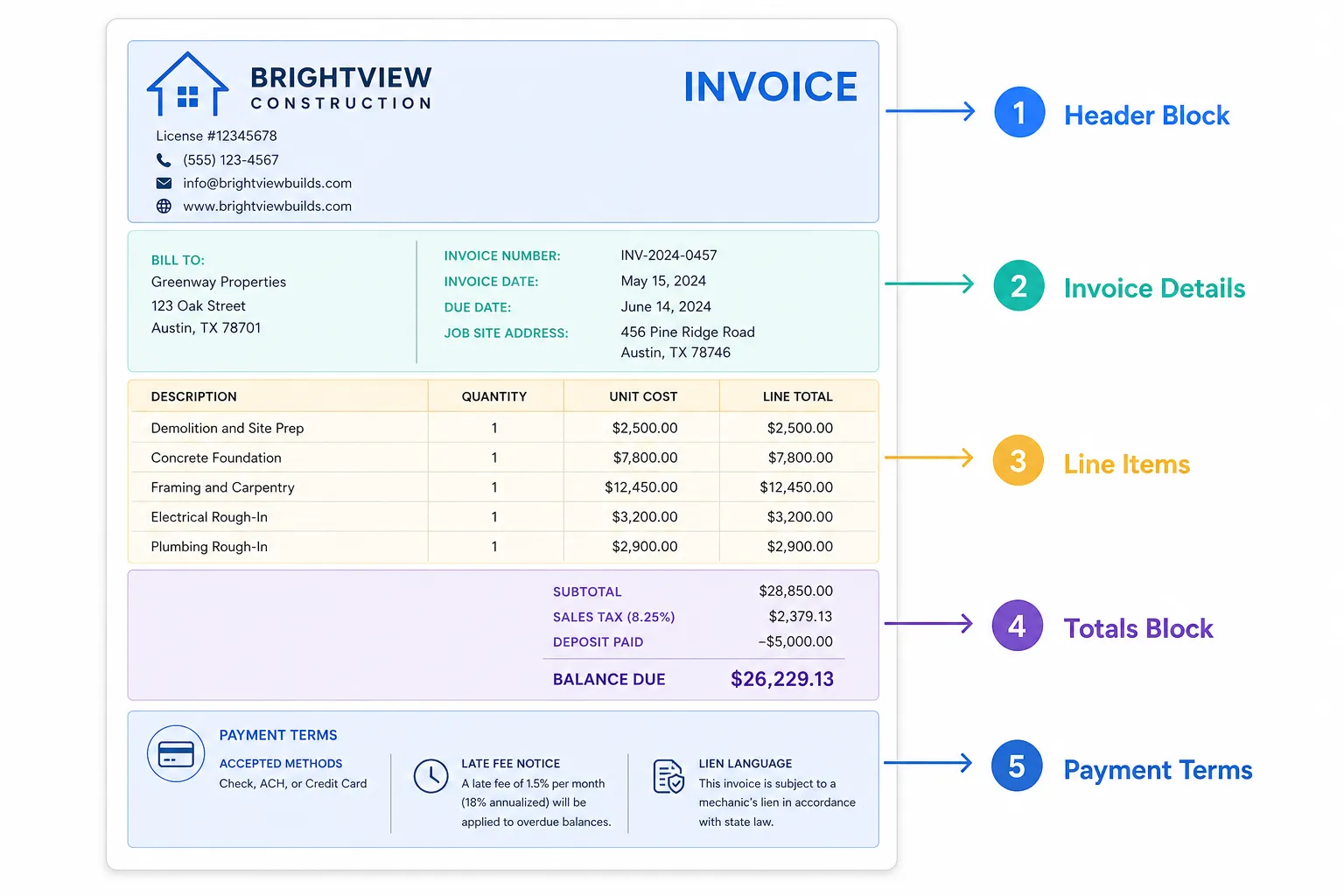
TLDR: A solid contractor invoice template includes your business info, a clear scope breakdown, your license number where required, and payment terms spelled out in plain language. Missing any of these lines can slow down payment or create legal headaches. Here's what to put on each line, and why.
Why the Invoice Template Matters More Than You Think
Most contractors underestimate what an invoice actually does. It is not just a bill. It is a legal record of what work was performed, when, and at what agreed scope.
If a customer disputes the job six months later, your invoice is exhibit one. A vague invoice with 'labor and materials' written across one line leaves you exposed. A detailed one protects you.
The invoice is also the document that triggers your right to file a mechanics lien in most states if you go unpaid. Getting the format right from day one is not paperwork busywork. It is risk management.
The Header: Your Business Identity at the Top
Start with your legal business name, exactly as it appears on your contractor license. Then add your physical or mailing address, phone number, and email.
Many contractors forget to include their contractor license number on the invoice. Some states actually require it on all customer-facing documents. Even where it is not required, it adds credibility and helps customers verify you quickly.
Include your insurance carrier and policy number if you want to look buttoned-up. Not required everywhere, but property managers often ask for it anyway. Put it in the header so you never get that call.
- Legal business name (matches your license)
- Physical or mailing address
- Phone and email
- Contractor license number
- Optional: insurance info
The Invoice Details Block: Numbers That Track Your Business
Every contractor invoice template needs a unique invoice number. This sounds obvious, but a lot of small shops skip it or reuse numbers. Your accountant will hate you for it at tax time.
Add the invoice date and a due date. The due date is not optional. 'Payment due upon receipt' is vague and often ignored. A specific date, like net 15 or net 30 from the invoice date, sets a clear expectation.
When the due date is missing, customers default to paying whenever, and you lose any leverage to follow up professionally.
Also include the job site address. This is separate from your business address. It matters for lien purposes, insurance claims, and warranty disputes.
The Line Items: The Core of Any Contractor Invoice Template
This is where most templates fall apart. A single line that says 'complete bathroom remodel, $4,800' is not a line item. It is an invitation to a dispute.
Break the work into real components. Labor and materials should be separate. Each trade phase should have its own line. If you subbed out electrical, call it out.
- Description of work performed (specific, not generic)
- Quantity or hours
- Unit cost
- Line total
- Materials itemized or grouped by phase
- Subcontractor costs if applicable
The description matters most. Write what was done, not just what category it falls into. 'Remove and replace 40 sq ft of tile, master bath floor' is better than 'tile work.' Specific descriptions are harder to dispute and faster to approve for payment.
If you gave the customer a written estimate before the job, your invoice line items should mirror that estimate closely. Any additions should appear as change order lines, clearly labeled as such.
Taxes, Retainage, and the Totals Block
Sales tax on labor versus materials varies by state. Some states tax materials only. Some tax the whole contract. A few depend on the type of contract. Do not guess. Check with your state's department of revenue or a local accountant.
If your contract includes a retainage clause, show the retainage amount held back as a line item. Show the gross total, the retainage deduction, and the amount due now. This avoids confusion on large jobs.
The totals block should show subtotal, tax (if applicable), any deposits already paid, retainage held, and the final balance due. Keep it readable. A customer who has to squint at the math is a customer who delays payment.
If you want to see how a clean totals block comes together before you build your own, the free invoice generator walks through it field by field.
Payment Terms and Late Fees: Say It in Writing
Your payment terms belong on every single invoice, not just the contract. People forget the contract. They read the invoice.
State your accepted payment methods clearly. Check, ACH, credit card, Zelle, whatever you take. If you charge a fee for credit card processing, say so here and make sure your state allows it.
Late fees are worth including, but the rules vary by state. Some states cap late fee percentages. Others have specific notice requirements before you can collect them. Do not invent a late fee rate you cannot legally enforce. Get local guidance on what your state allows, then put it in writing on every invoice.
A late fee clause only protects you if the customer saw it before they paid late, which means it must be on the invoice itself, not buried in a contract they signed months earlier.
Also include any lien notice language your state requires on invoices or payment requests. Several states have mandatory preliminary notice or invoice disclosure requirements. The rules and deadlines are short and differ state to state, so look up what applies where you work.
My Take
My advice: treat your invoice template as a living document, not something you set once and forget. Every time a customer disputes a line, or a payment gets delayed over something unclear, update the template.
The contractors who get paid fastest are not always the fastest workers. They are the ones whose paperwork is clean enough that approving the invoice takes thirty seconds.
If you build estimates and invoices separately, make sure they talk to each other. A customer who sees different line descriptions on the invoice than on the estimate will start asking questions. Keeping the language consistent across both documents, from the estimate software stage through to the final invoice, removes friction at the worst possible moment.
Common Questions
Do I have to put my license number on the invoice? It depends on your state. Some require it on all customer-facing documents. Others only require it on contracts. Check your state contractor board's rules.
What if I do not charge sales tax on labor? Still show a tax line and write 'N/A' or 'labor exempt' so the customer knows it was considered. It prevents questions and looks more professional.
How detailed do the line items need to be? Detailed enough that a stranger reading the invoice could tell exactly what was done, where, and using what materials. If you could not explain a line in court, rewrite it.