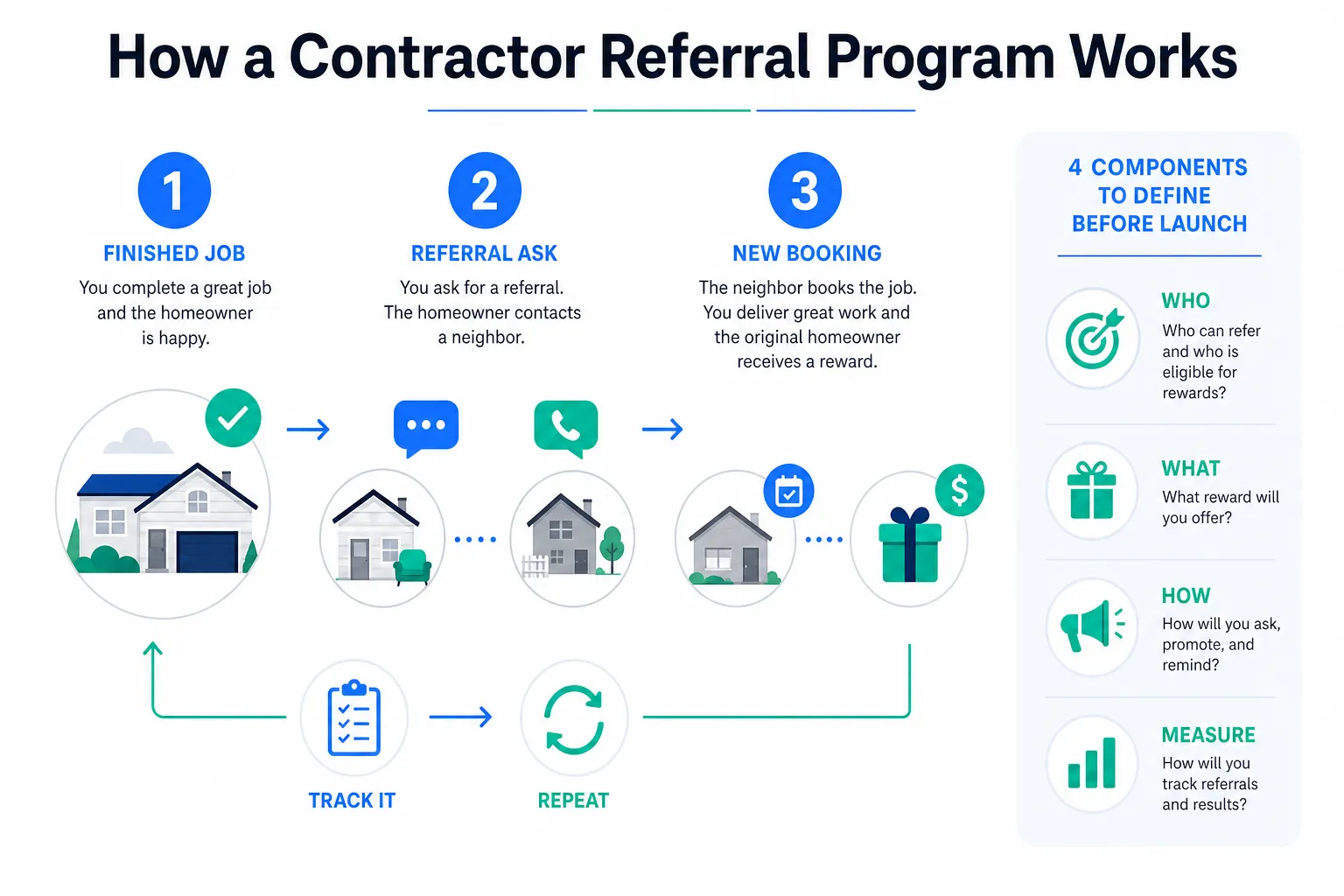
TLDR: A customer referral program is a simple agreement where you reward existing customers for sending you new business. For small trades companies, it is one of the cheapest and most reliable ways to grow, because a referred lead already trusts you before you ever pick up the phone.
If you run a roofing company, a plumbing outfit, an HVAC shop, or any kind of contracting business, you already get referrals. You just probably are not doing anything deliberate about them. That is the gap this article closes.
What a customer referral program actually is
A referral program is a documented, repeatable system. It is not just hoping your customers mention your name at a neighborhood barbecue. You define who qualifies, what the reward is, when it gets paid out, and how you track it.
The core components are simple:
- A clear trigger (a new customer books and pays, for example)
- A reward for the referring customer
- A way to track who sent who
- A process to actually pay or deliver the reward
The difference between a referral program and random word-of-mouth is that a program is something you can repeat and improve. Random word-of-mouth is something that happens to you. A program is something you run.
Why referral programs work especially well in the trades
Homeowners and property managers are nervous handing strangers keys to their house or access to their roof. Trust is the main thing they are buying. A referral from a neighbor short-circuits that anxiety completely.
Think about your own sales cycle. A cold lead calls, asks for three quotes, negotiates hard, and ghosts you half the time. A referred lead calls and says 'my neighbor Mike used you last spring, can you come out Thursday?' That is a different conversation entirely.
There is also a practical advantage. Referral leads tend to be closer geographically. If you service one neighborhood well, referrals cluster you there. Tighter geography means less windshield time, lower fuel costs, and faster scheduling.
Referred customers also tend to complain less and pay faster, because they came in with a positive frame already set by someone they trust.
How to structure your customer referral program
Start with the reward. Cash works. Gift cards work. A credit toward a future service works. What does not work as well is a reward so small it feels insulting, or a process so complicated that your customer forgets about it before the check ever arrives.
A few things worth thinking through:
- When exactly does the reward trigger? At estimate, at signed contract, or at final payment? Final payment is usually safest.
- Is there a cap? If someone sends you ten jobs in a year, are you still paying the same per referral?
- Do you reward the referring customer, the new customer, or both? Some contractors do both and find conversion goes up.
- How do you track it? A simple spreadsheet works at first. A field in your CRM works better.
On the legal and tax side, rewards paid to non-employees can have reporting requirements depending on the amount and your state. Talk to your accountant before you launch, because the rules vary by state and the IRS has its own thresholds for when a reward becomes reportable income. Do not skip that step.
If you want a ready-made structure to follow rather than building from scratch, the referral program for contractors that Lienzor runs is worth a look as a reference point.
The classic mistake contractors make with referral programs
They announce it once and forget it. They put it on a flyer, hand it to a few customers in June, and by September they have no idea who referred whom and nobody has been paid.
The program dies not because customers do not want to refer. It dies because there was no follow-up system. Your customers are busy. They think about your program for about forty-eight hours after you mention it, then life takes over.
The fix is to bring it up at the right moment, not just once at the start. The right moment is right after you finish a job the customer is clearly happy with. That is when they are most likely to think of someone. Ask directly. 'Do you know anyone else in the neighborhood who might need this work done?' Most contractors never ask.
A second classic mistake is making the referral hard to send. If your customer has to fill out a form, remember a code, or navigate a portal, most of them will not bother. Make it as simple as possible. 'Just tell them to mention your name when they call' is a perfectly functional system when you are starting out.
Waking up past customers is part of the strategy
Your best referrers are not always your most recent customers. Sometimes it is the client from three years ago whose deck you built and who has since told four neighbors about you but never got any acknowledgment from you.
Past customer outreach and your referral program should work together. When you reach back out to a past customer to check in or offer a seasonal service, that is also a natural moment to remind them that you have a referral program and that you appreciate introductions.
A short, personal message to a past customer costs almost nothing and can unlock a referral that a paid ad never would have reached. It does not have to be elaborate. A quick text or a handwritten note goes a long way in an industry where most contractors disappear after the final invoice.
You can read more about how following up with past customers connects directly to driving referrals, because the two habits reinforce each other.
My take
My advice: start smaller than you think you need to. Pick one reward, define one trigger event, and tell your next ten finished customers about it. That is your pilot. See how many of them actually refer someone within sixty days.
Do not wait until you have a perfect system. A referral program that is live and imperfect beats a polished one you are still planning six months from now. You can adjust the reward, the timing, and the tracking once you have real data.
The contractors who grow steadily are almost always the ones who have turned their happy customers into an informal sales force, and a referral program is how you formalize that. It is not complicated. It just requires consistency.
Common questions
Do I need a written agreement for my referral program? You do not legally need one in most cases, but having something in writing protects you if a dispute comes up about who referred whom or whether a reward was earned. Keep it simple, even a one-page document helps.
Should I offer cash or a service credit? Cash is universally understood and tends to motivate action. A service credit only has value if your customer plans to hire you again. If your work is one-time (a new roof, for example), cash or a gift card usually makes more sense.
What if two customers both claim they referred the same new lead? This happens occasionally. The cleanest policy is 'first mention wins,' and you track it by asking every new caller or contact how they heard about you and logging it immediately. Decide your tiebreaker rule before you launch, not after the dispute comes up.