TLDR: Customer retention for a small business that sells one-time jobs means staying memorable between projects, reaching out before the customer forgets you, and making it easy for happy clients to send you referrals. You do not need a subscription to have repeat business. You need a system.
Most contractors think retention is a problem for gyms and software companies. Pay monthly, stay or cancel. Clean math. But if you replace a roof, remodel a kitchen, or service an HVAC system, the customer does not pay you every month. They pay you once, maybe every few years. So the question becomes: how do you make sure they call YOU when the need comes back, not whoever shows up first on Google?
Why customer retention for a small business looks different without a subscription
A subscription business knows exactly when a customer churns. The card declines. You see it instantly. A project-based business has no such alarm. The customer just... never calls again. You may not notice for two years.
The silent churn is the dangerous one, because you never know it happened until you look at your old invoice list and realize half those people used someone else last time.
That is the real enemy. Not the customer who complained and left. The one who was happy, life happened, they forgot your name, and they called the first number they found. You lost that job without a single bad review.
The three moments that actually determine whether a customer comes back
People remember the beginning and the end of an experience. The middle fades. So three moments carry almost all the weight.
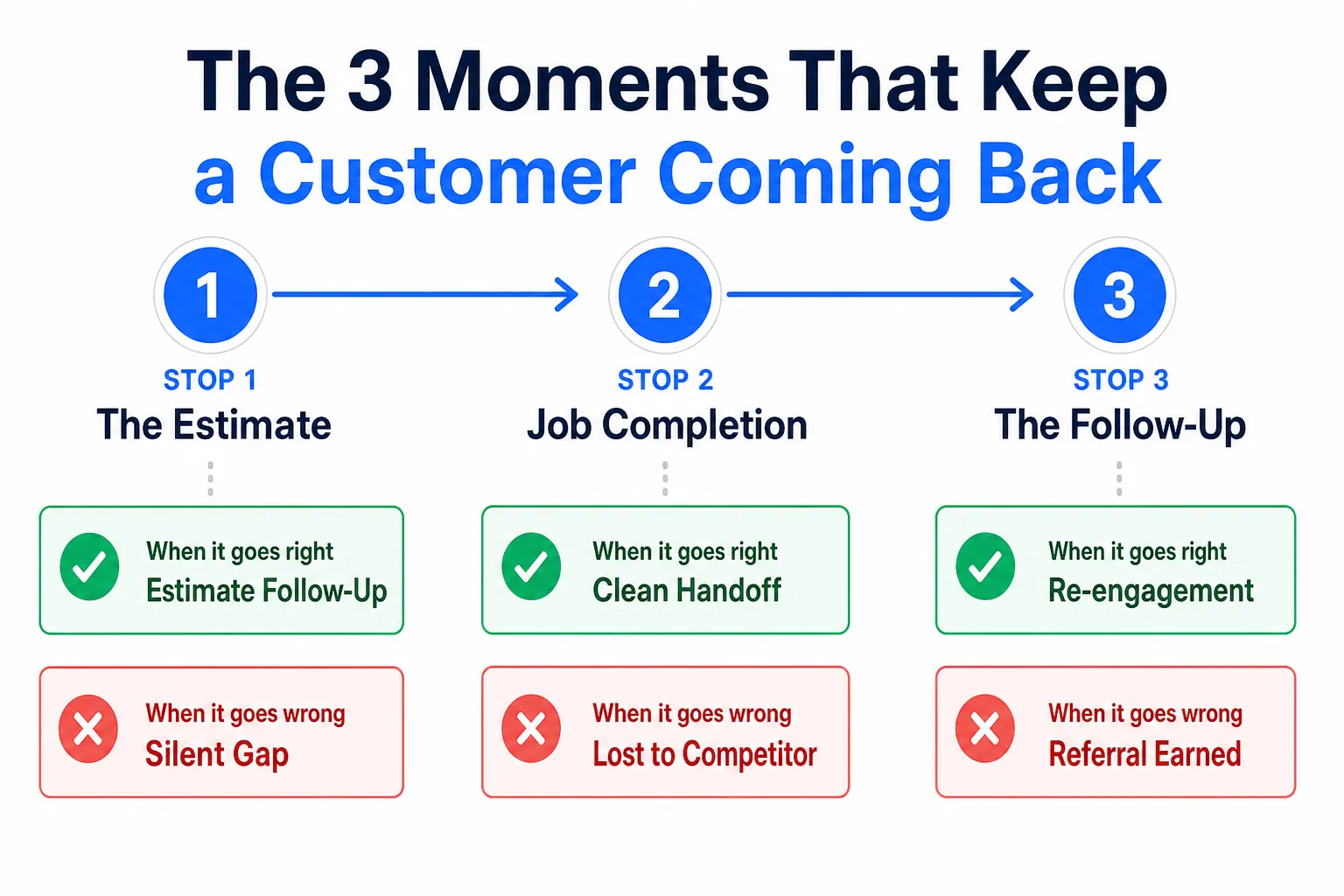
First, the estimate. If you follow up on it and they feel taken care of before they even hire you, that sets a tone. Second, the final walkthrough. Whether you leave the job site clean, whether you point out what you did and why, whether you hand them something in writing. Third, the silence after. Most contractors disappear the day the check clears. That silence is your competitor's opening.
A few things that consistently matter at each stage:
- On the estimate: respond fast, explain your numbers, follow up if you hear nothing
- On the job: show up when you said you would, communicate delays the same day
- After the job: send a thank-you, ask for a review, check in months later
None of this requires software. All of it requires intention.
What actually brings a past customer back
The number one driver is simply being remembered. Not being the cheapest. Not having the most reviews. Being the name that comes to mind when the need shows up.
Customers who had a good experience are already warm. They want to call you again. They just need a reason to remember you exist.
This is where most small contractors leave money on the table. They have a list of past customers going back years. People who were happy. People who paid on time. People who said 'we'll definitely call you for the deck next spring.' And then nobody followed up, spring came, and a neighbor recommended someone else.
A direct outreach to past customers, even a simple one, works better than most advertising because you are not starting from zero. You already have trust. That list of past customers you already have is one of the most valuable things in your business, and most contractors treat it like an old spreadsheet.
Seasonal timing helps. A roofer checking in before winter. An electrician reaching out when a new code takes effect in the area. A landscaper at the start of spring. The message does not have to be complicated. It just has to be relevant and timely.
Referrals are retention in disguise
When a past customer refers you to their neighbor, two things happen. The neighbor gets a warm lead on a good contractor. And the past customer mentally re-commits to you. They just told someone you are great. Now they really believe it.
Referrals and retention feed each other. A customer who refers you is far more likely to call you again themselves. So making it easy to refer you is not just a growth strategy. It is a retention strategy.
A few practical ways to get more referrals without it feeling transactional:
- Ask at the right moment, right after a successful walkthrough, not weeks later
- Make it easy, give them something to forward or a direct link to your Google profile
- Acknowledge it when it happens, a quick thank-you call goes a long way
- Do not wait for them to think of you, remind them you appreciate referrals
The ask does not have to be awkward. 'If you know anyone who needs this, I'd appreciate the word' said while packing your tools is completely natural.
Google reviews and why they are part of your retention loop
Most contractors think of reviews as a way to attract new customers. That is true. But reviews also close a loop with existing ones.
When you ask a customer to leave a review, you give them an action to take. An action that reinforces their own positive opinion of you. People who write positive reviews are more likely to book you again, not less. The act of writing it cements the relationship in their mind.
Asking for a review is not just marketing. It is the last step of a job well done, and skipping it leaves the relationship half-finished.
Timing matters. Asking two days after the job is finished consistently outperforms asking a month later. People still feel the good feeling. The details are fresh. The response rate is higher and the reviews tend to be more specific and useful.
My take
My advice: stop thinking about customer retention as something that happens automatically after a good job. It does not. Good work earns you the right to stay in touch. Staying in touch is what actually keeps the customer.
The contractors I see struggle with retention are usually the ones who are great on the job site and invisible everywhere else. They do not follow up on estimates. They do not reach back out after six months. They do not ask for referrals. And then they wonder why they are always chasing new leads instead of getting calls from people they already know.
Your past customers are not gone. They are just quiet. And quiet is fixable. Waking up past customers with a simple, non-pushy message is one of the highest-return things you can do in a slow week. It costs almost nothing. You are not cold-calling strangers. You are reminding people who already like you that you exist.
Build the habit. After every job, ask for a review. After every estimate you send, follow up at least once. Every six months, go through your old invoice list and send a quick message to anyone you have not heard from. That is a retention system. It does not require a subscription model. It requires showing up after the work is done.
Common questions
How long should I wait before reaching out to a past customer? It depends on your trade. For a painter or a roofer, six months to a year is natural. For an HVAC tech or a plumber, a seasonal check-in makes sense. The goal is to reach out before they have a new need, not after they have already called someone else.
What do I say when I reach out to a customer I have not spoken to in over a year? Keep it short. Mention the job you did for them, ask how things are holding up, and let them know you are available. You are not selling anything. You are maintaining a relationship. Most people appreciate it.
Is it worth offering a discount to bring back past customers? Usually not. Discounts attract price-shoppers. Your past customers already chose you. They did not choose you because you were cheap. Reach out with a personal message, not a coupon. If they need work done, they will book you without a discount. If they do not need work done, the discount does not help anyway.