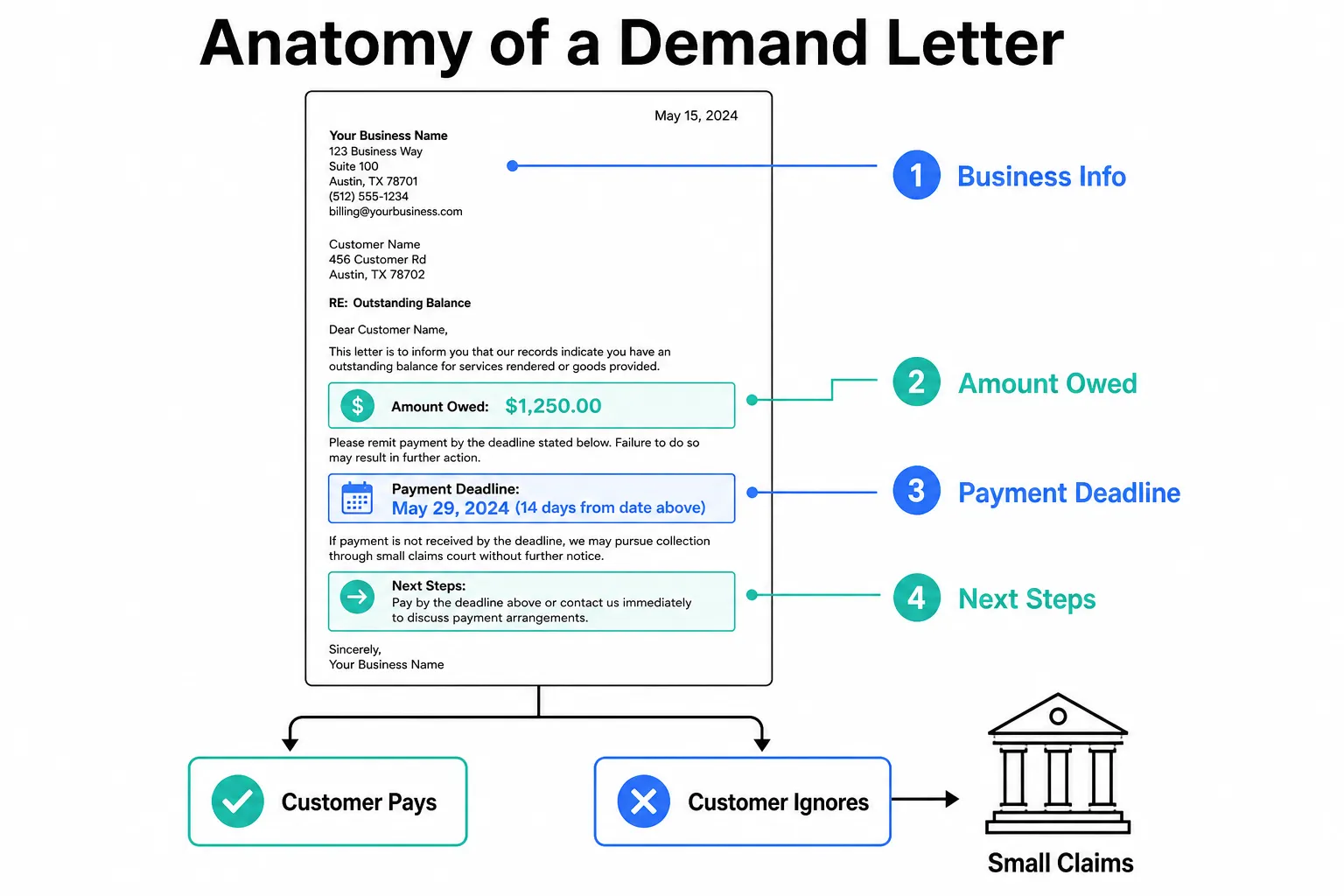
TLDR: A demand letter for payment is a formal written notice telling a customer they owe you money and must pay by a set date or face legal action. It costs almost nothing, it often works, and it documents your good faith before any court ever sees your case. Most contractors skip straight to frustration or skip straight to an attorney. The step in between is this letter.
What a demand letter for payment actually is
A demand letter is a written notice from you, the contractor or business owner, to the person who owes you money. It states what they owe, why they owe it, and what happens if they ignore it. That's the whole thing.
It is not a court filing. It is not a lawsuit. It's a formal letter, sent in a way you can prove, that puts the customer on notice. The act of sending it signals that you are serious and that you have your paperwork in order. That alone changes how some people respond.
You do not need a lawyer to write one. You can absolutely hire one, and sometimes that's the right move. But for most unpaid invoices in the contractor world, you don't have to.
When to send one (and when you've waited too long)
The right moment is after your normal follow-up has failed. You sent the invoice. You called once or twice. Maybe you sent a polite reminder. The customer has gone quiet or keeps stalling. That's when the demand letter goes out.
Waiting too long is the classic mistake. Every state has a statute of limitations on contract claims. The deadlines vary, and some are shorter than contractors expect. If you wait years while hoping the customer comes around, you can lose your legal right to collect entirely.
A few situations where a demand letter is the right move:
- A homeowner accepted the job, you finished the work, and the final payment never came.
- A property manager owes you for multiple invoices and keeps promising to 'process it next week.'
- A general contractor hasn't paid you for a subcontracted phase that wrapped up months ago.
- A customer disputed part of the bill, you negotiated in good faith, and they still haven't paid the agreed amount.
One situation where you need a lawyer instead: when the amount is large, the customer has already retained counsel, or the dispute involves something more than a simple unpaid invoice, like claims of defective work or property damage.
What to put in your demand letter for payment
Keep it factual and keep it short. Anger and long paragraphs make you look less credible, not more. Courts and mediators have seen every kind of letter, and the calm, documented ones land better.
Every effective demand letter covers the same core elements: who you are, what work was done, what was agreed, what is unpaid, and what happens next.
Here's what to include:
- Your full business name and contact information at the top.
- The customer's full name and address.
- The date of the letter.
- A clear reference to the contract, estimate or agreement, by date if possible.
- A plain description of the work you completed.
- The exact amount owed, broken down if there are multiple invoices.
- A specific payment deadline, a real date, not 'within a reasonable time.'
- A statement of what you will do if payment is not received by that date, typically filing in small claims court or pursuing legal action.
- A request that they contact you if they believe there is an error.
Do not threaten anything you are not actually prepared to do. If you say you will file in small claims court by a certain date, mean it.
How to send it so it actually counts
How you deliver the letter matters almost as much as what's in it. You need proof it was received, or at least that it was sent.
Certified mail with return receipt is the standard approach. The post office gives you a record that it was mailed, and the green card that comes back shows someone signed for it. Keep that card with your copies.
Some contractors also send a regular email on the same day, with read receipts turned on if their email client allows it. That creates a second paper trail. The point is that 'I never got it' becomes very hard to claim.
Keep a copy of everything you send, along with your invoices, your original estimate, any signed contract, and any text or email threads that show the customer acknowledged the work.
If you have been following up on estimates and invoices consistently, your records are probably already in better shape than most. Disorganized paperwork is the number one thing that undermines a legitimate collection case.
What happens after you send it
Three things can happen. The customer pays. The customer responds with a dispute or a partial payment offer. Or the customer ignores it completely.
If they pay, great. Get it in writing if any negotiation happened, keep the record, move on. If they dispute the amount, decide whether the dispute has merit. Sometimes it does. Sometimes a customer is stalling. A response in writing, even a bad-faith one, at least gives you more documentation.
If they ignore it entirely, the demand letter becomes part of your evidence package when you file a claim. Small claims courts in every state allow individuals and businesses to file without an attorney, up to a dollar limit that varies by state. The limit is sometimes higher than contractors expect. Check your own state's rules.
Ignoring a demand letter is not a legal defense. A judge who sees that you sent a formal notice and gave the customer a fair chance to respond before filing, that works in your favor.
My take
My advice: send the letter earlier than feels comfortable. Most contractors hesitate because they don't want to damage the relationship. But a customer who hasn't paid after several reminders has already made their choice about the relationship. The letter is not an attack. It's you being professional about your own business.
The contractors I see recover unpaid invoices most consistently are the ones who have tight records from the beginning. A signed estimate, a clear scope, follow-up messages that document the timeline. The demand letter only works as well as the paperwork behind it. If your estimate and invoice process is informal or scattered, fixing that is the real leverage here, not the letter itself.
A lot of unpaid balances start with a job that was never properly confirmed in writing. The customer thought the price was different. The scope was vague. Nobody signed anything. Tightening up that front end, from estimate to signed agreement to documented follow-up, is what keeps you out of collection situations in the first place.
Common questions
Do I need a lawyer to write a demand letter? No. For most unpaid contractor invoices, you can write one yourself. A lawyer can help if the amount is large, the situation is complicated, or the customer has already lawyered up.
Does a demand letter hurt my chances of getting paid? Rarely. A customer who was going to pay you eventually usually pays faster once a formal letter arrives. A customer who was never going to pay you doesn't get worse. And now you have documentation.
What if the customer responds with their own complaints about my work? Don't panic, and don't respond emotionally. Write back calmly, address specific factual claims, and keep copies of everything. If the complaints seem designed to avoid payment rather than resolve a real issue, that pattern of behavior is itself useful evidence if you end up in court.