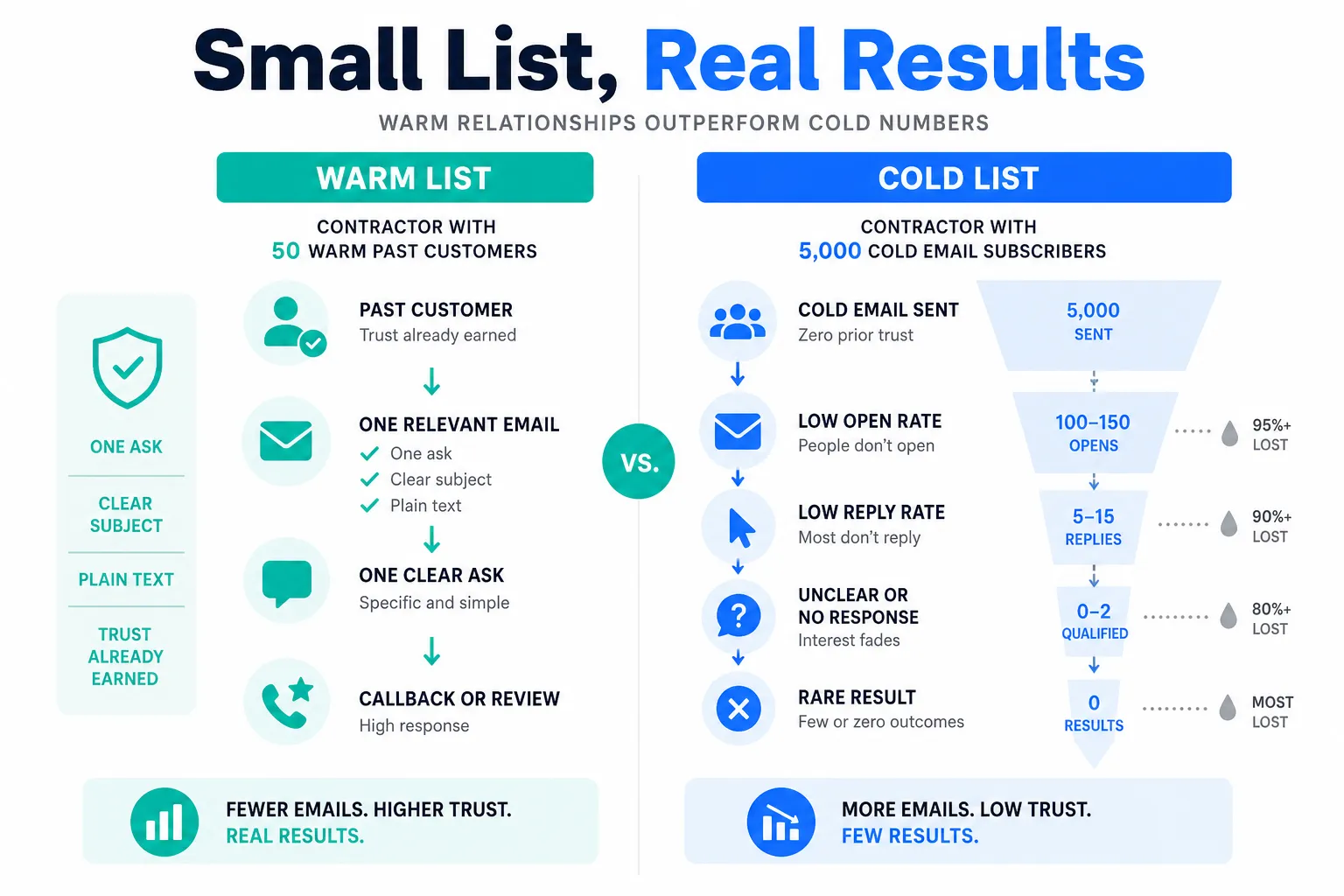
TLDR: Email marketing for small business does not require a big list. If you have fifty past customers and their email addresses, you have enough to run campaigns that bring real work back in. You do not need a newsletter. You need a plan for the right message at the right moment.
Most contractors assume email marketing is for companies with thousands of subscribers. That assumption costs them work every slow season. A small, warm list of people who already hired you once is worth far more than a cold list of strangers.
Why a Small List Is Actually an Advantage
Think about what your fifty customers already know. They hired you. They paid you. They watched you work. That is a level of trust no ad can buy. A stranger clicking on a Facebook ad has zero relationship with you. Your past customer remembers you showed up on time.
A small, warm list converts at a much higher rate than a large cold one. You are not fighting for attention against ten other contractors. You are a familiar name in the inbox of someone who already approved your work. That is a very different conversation.
The other advantage is simplicity. You do not need automation sequences, A/B testing, or a marketing team. You need one good email, sent to the right people, at the right time. That is something any contractor can manage.
What Email Marketing for Small Business Actually Looks Like
Forget the idea of a monthly newsletter. Nobody on your list signed up because they want roofing industry news. They hired you to fix something. Your emails should match that reality.
The emails that actually work for contractors fall into a few categories:
- A seasonal reminder (gutter cleaning before winter, AC tune-up before summer)
- A check-in after a job is a year or two old (how is that water heater holding up?)
- A direct ask for a referral or a Google review
- A note about a service they have not tried yet but probably need
Short, specific, and personal beats polished and generic every single time. A two-paragraph email that sounds like it came from you personally will outperform a designed HTML newsletter that looks like it came from a corporation. Write it the way you would text a good customer.
Building Your List When You Only Have Fifty Names
Start with what you have. Go through your invoices, your texts, your old estimates. Pull every email address you collected. Most contractors are sitting on more contacts than they realize, just scattered across different tools.
Then make a habit of collecting email at every touchpoint. When you write an estimate, ask for it. When you finish a job, confirm you have it right. Most customers will give it without hesitation if you tell them you occasionally send seasonal maintenance reminders. That is a reason they can understand.
A few things that help over time:
- Ask for it on your estimate form, not as an afterthought
- Add a line to your invoice confirmation asking if they want reminders
- Train anyone who answers the phone to collect it naturally
- When a customer texts you, reply and ask for their email for your records
Fifty becomes a hundred faster than you expect once you are intentional about it. And a well-timed email campaign on even fifty names can generate real callbacks.
The Classic Mistake Contractors Make With Email
The biggest mistake is waiting until you are desperate. A lot of contractors only think about emailing their list when the schedule goes quiet. By then, it feels like begging for work, and the message shows it.
Email your list when you are busy, not just when you need the work. That sounds counterintuitive. But sending a message in May, when you already have a full calendar, feels generous. You are giving people a heads-up, not a sales pitch. The tone is completely different, and customers feel it.
The second mistake is sending the same generic message to everyone. The customer who hired you for a full kitchen remodel and the one who called you for a leaky faucet are not the same person. They may have different needs, different budgets, and different reasons to hire you again. Segmenting even loosely, by job type, by neighborhood, by time since last job, makes every email more relevant.
The third mistake is forgetting the ask. An email that says 'hope you are well' and then stops is a missed opportunity. Every email should have one clear action for the reader. Book a call. Reply to this message. Leave a review. One ask, not three.
What to Actually Write
Use their first name. Open with something specific to the season or to the job you did. Keep the body under a hundred and fifty words. End with one clear ask.
A real example structure for a past customer email:
- Subject line: Quick question about your [roof / HVAC / plumbing]
- Opening: Reference the job you did and when
- Body: One relevant tip or reminder tied to the season
- Ask: A single, simple next step (reply, book, review)
Avoid attachments, avoid images, and avoid anything that triggers spam filters. Plain text emails from a real email address land in inboxes. Heavily designed HTML emails from a bulk-mail domain land in promotions or spam. For a list of fifty people, plain text is not just acceptable, it is better.
If writing the email yourself feels hard, draft it out loud first. Imagine you are leaving a voicemail for a good customer you did work for two years ago. That tone, that directness, is exactly what you want on paper.
My Take
My advice: stop waiting until your list is bigger. The contractors who get the most out of email are not the ones with the largest lists. They are the ones who actually send.
A sent email to fifty real past customers beats a perfect email strategy that never launches. Pick one reason to reach out this month. Write three sentences. Send it. See what comes back. You will adjust from there.
The contractors I have seen struggle with this usually have one of two problems. Either they overthink the message until they never send it, or they send once, get no response from one person, and decide it does not work. Email is repetition over time. One send is a sample. A rhythm is a strategy.
If writing and timing these emails is taking time you do not have, there are tools built specifically for contractor email campaigns that handle the follow-up without you having to remember to do it. But even without a tool, the manual version works. Just send.
Common Questions
Can I email past customers without their permission? This is a real legal question and the rules vary by state and by how you collected the contact. Generally, a business relationship where the customer gave you their email is considered a legitimate basis for contact, but you should always include an easy way to unsubscribe. When in doubt, check with someone who knows your state's rules. Do not assume you are covered.
How often should I email a list this small? Once a month is plenty for most contractors. Some go to once a quarter and still get callbacks. The goal is to stay in their memory without becoming noise. If every email is relevant to that customer's situation, frequency matters less.
What if most of my past customers hired me for a one-time job? That is common. But even one-time jobs come with ongoing needs. The deck you built needs sealing. The HVAC you installed needs a filter change reminder. And every past customer can refer you. An email does not have to sell a repeat job to be worth sending.