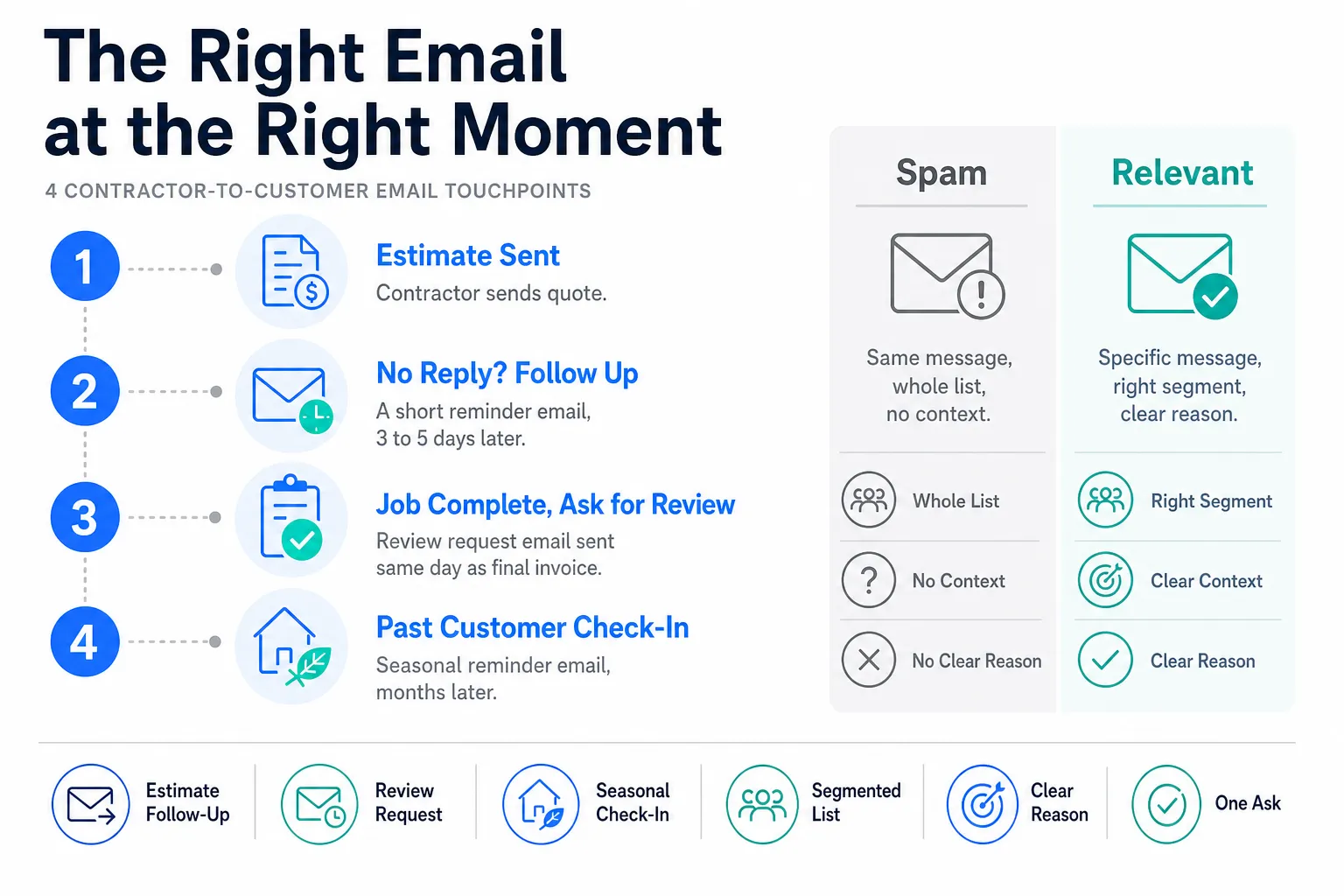
TLDR: Email marketing for contractors is worth doing, but only if you send the right message to the right person at the right moment. Blasting everyone on your list with a generic promo is what turns customers off and gets you marked as spam. The version that works is quieter, more targeted, and closer to a reminder from a trusted pro than an ad.
Why Most Contractor Emails Go Nowhere
Most contractors who try email marketing do it once, get almost no response, and quit. The problem is rarely the channel. It's the approach.
They send the same message to every contact on their list. A homeowner who got a roof replacement two years ago gets the same email as someone who never accepted an estimate. That makes no sense, and recipients feel it immediately.
The real failure is treating a customer list like a broadcast audience instead of a set of real relationships. People who already hired you once respond to very different messages than people who ghosted your last estimate. Mixing them together makes both groups tune out.
What Email Marketing for Contractors Actually Looks Like
Good contractor email marketing is almost invisible. The recipient doesn't feel like they got a marketing email. They feel like you remembered them.
Think about the messages that work in real life. A plumber who texts a homeowner, 'Hey, just checking, did that pressure issue come back after winter?' That's not spam. That's service. Email can do the same thing at scale, if you write it that way.
The emails worth sending fall into a few clear buckets:
- A follow-up to an unanswered estimate, sent a few days after you sent the quote
- A check-in to a past customer, timed around when they might need your service again
- A request for a Google review, sent right after a job wraps up while the experience is fresh
- A seasonal heads-up for customers who had related work done before
None of those need to be long. Two or three sentences, a clear reason for reaching out, and a single ask. That's it.
The Spam Line, and How Not to Cross It
The CAN-SPAM Act sets the federal floor for commercial email in the US. You need a real physical address in the email, an honest subject line, and a working unsubscribe mechanism. Those are not optional.
Beyond the federal rules, most email platforms have their own policies. And some states have passed their own privacy laws that go further than federal law, particularly around consent and data handling. Rules vary by state, so if you're unsure whether your list was built with proper opt-in, it's worth checking with someone who knows your state's rules before you start sending.
The practical risk isn't just legal, it's reputational. Getting marked as spam by enough recipients tanks your deliverability across the board. Your future emails, even the good ones, end up in junk folders.
Build your list from real contacts only. People who called you, got a quote, or hired you. Never buy a list. Never scrape addresses from directories. The smaller, cleaner list outperforms the big dirty one every time.
Segmenting Your List So Emails Feel Relevant
Segmentation sounds like a marketing-school word. In practice it just means: don't send the same thing to everyone.
A few simple splits make a big difference. Customers who already hired you get different emails than leads who never converted. Customers who had a specific service done (say, a new HVAC installation) are a natural audience for a tune-up reminder the following season. Leads who went quiet after an estimate are a different group entirely.
Knowing which bucket each contact belongs to is the whole game. If your contact list is just one undifferentiated blob, your emails will feel random. If you know who hired you, when, and for what, every email you send can feel like it was meant for that specific person.
The customer segments page on this site goes deeper into how to think about splitting your contact list by behavior and history, which is worth reading before you build out any campaign.
Writing Emails That Sound Like You, Not a Template
The biggest mistake after sending to the wrong people is writing like a corporation. You are not Lowe's. You don't need a designed header, a hero image, and three calls to action.
Write the way you'd talk. Short sentences. Real reason for reaching out. One clear ask at the end. If someone who knows you read it, they should hear your voice.
A few things that help:
- Use the customer's first name in the opening line
- Reference the actual job if you can ('We replaced your water heater last spring')
- Be specific about why you're reaching out now, not just 'checking in'
- Make the ask obvious and easy, one link, one question, one next step
For follow-ups on unanswered estimates especially, tone matters a lot. You're not nagging. You're giving them an easy way to either move forward or tell you they went another direction. Most people appreciate that. Automated email campaigns can handle the timing and sending, but the words still need to sound human.
Subject lines deserve their own attention. The open rate lives and dies there. Short, specific, and honest beats clever every time. 'Following up on your deck estimate' will outperform 'Don't miss out on your summer project' almost always.
My Take
My advice: start with two emails before you build anything complicated.
First, a follow-up to every unanswered estimate you've sent in the past 90 days. Second, a review request to every customer whose job wrapped up in the past 60 days with no review. Those two alone will move the needle faster than any campaign you could design from scratch.
Email marketing for contractors works best when it replaces a task you were already supposed to do manually but kept forgetting. That's the honest pitch for automation. Not that it does something magic. It does the follow-up you meant to do from the truck at 6pm but didn't, every single time.
Skip the monthly newsletter. Skip the promotional blasts. Focus on the moments where an email from you is genuinely useful to the person receiving it. That's where the work is.
Common Questions
How often should I email my customer list? Only when you have a real reason. For most contractors, that means triggered emails tied to events (a new estimate, a completed job, a seasonal window) rather than a fixed monthly schedule. Frequency should follow relevance, not a calendar.
Do I need permission to email past customers? Federal law (CAN-SPAM) applies a different standard to existing business relationships than to cold contacts, but it still has requirements. State laws vary and some are stricter. When in doubt, include a clear unsubscribe option in every email and only contact people who genuinely chose to do business with you.
What's a realistic open rate for a contractor email? This varies a lot by list quality, subject line, and timing. A small, clean list of actual customers will almost always outperform a large, mixed list. Don't benchmark yourself against broad industry averages. Benchmark yourself against your own previous sends, and improve from there.