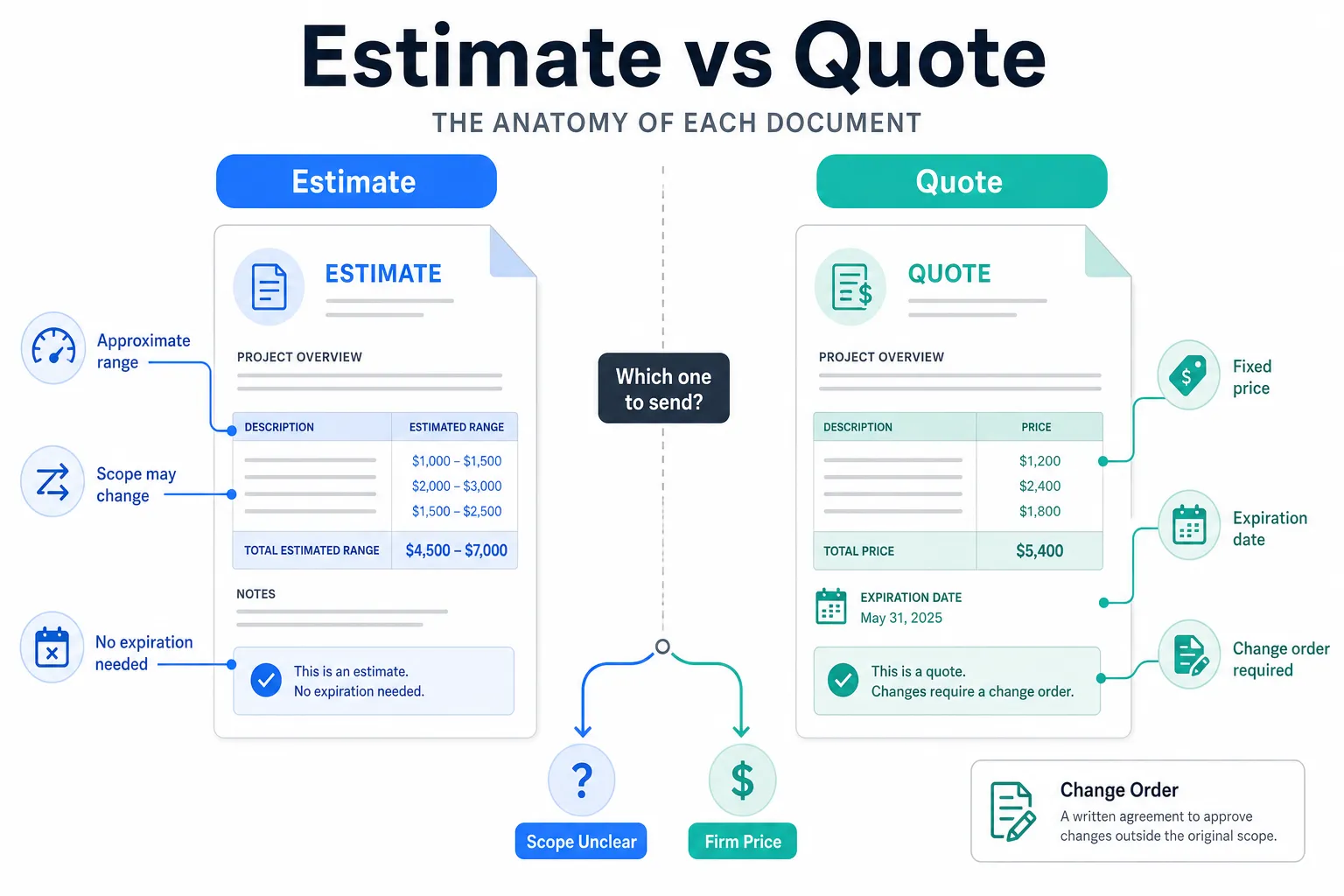
TLDR: An estimate is an approximation of cost, not a binding price. A quote is a fixed offer that, once accepted, locks you in. Using the wrong word on the wrong job can cost you real money and expose you to disputes you did not see coming.
Most contractors use estimate and quote interchangeably. That habit makes sense on the surface, because both documents say roughly the same thing: here is what I think this job will cost. But legally and commercially, they are not the same thing. And the difference matters the moment a homeowner calls you back to say your final invoice does not match what you sent over.
What an Estimate Actually Is
An estimate is your best professional judgment of what a job will cost. It is not a promise. The final bill can come in higher or lower, and that is understood by both sides, at least in theory.
Estimates make sense when the scope is genuinely uncertain. Think of a foundation repair where you do not know what you will find once you open the slab. Or a remodel where the homeowner has not finalized material choices. You are giving a number to help them plan, not committing to that exact number.
The problem is that most homeowners do not read it that way. They see a number, they tell their spouse, they budget for it, and they expect your invoice to match. That gap between your intent and their expectation is where disputes are born.
What a Quote Actually Is
A quote, sometimes called a fixed-price proposal or a firm quote, is a specific offer. If the customer accepts it, you are committed to that price. You take on the risk of underpricing.
Quotes work best when the scope is clear and the variables are under your control. Replacing a water heater with a specific unit. Painting a room with a known square footage. Installing a fence with an agreed post count and material.
Once a customer signs a quote, changing the price requires a written change order. Period. No change order, no additional charge, in most cases. Some states have specific rules about change orders in home improvement contracts, and those rules can vary quite a bit. If you work in residential contracting, it is worth knowing your state's requirements.
Why Mixing Them Up Costs You Money
Here is the classic mistake. You send over a rough estimate because you are busy, the job looks straightforward, and you want to give the customer a ballpark fast. You label it an estimate. The job turns out to be more complicated, your costs go up, and you invoice for the higher amount.
The customer pushes back. They say you gave them a price. You say you gave them an estimate, not a firm quote. And now you are having a conversation you do not have time for, on a job you may have already completed.
Using imprecise language on your documents is the single fastest way to create payment disputes. The other costly scenario runs in the opposite direction. You accidentally word something as a firm price, the job runs over, and you eat the difference because you cannot justify charging more.
Beyond disputes, there is a slower leak. Estimates that go unanswered simply die. A customer gets your number, thinks about it, and never responds. You never follow up. That job goes to someone else. Following up on unanswered estimates is where a lot of revenue quietly disappears.
Estimate vs Quote: How to Choose Which One to Send
The decision comes down to how much you know before the work starts.
Send an estimate when:
- The scope could change once you get into the job
- Material costs are volatile or not yet finalized
- You are doing a preliminary walk-through and have not measured everything
- The homeowner is still deciding on options
Send a quote when:
- You have a complete, detailed scope of work
- Materials are specified and priced
- You are confident the number will not move unless the customer changes something
- You want the customer to be able to sign and commit
Whatever you send, the document itself should clearly state whether it is an estimate or a firm quote, and what happens if the scope changes. A short line about change orders is not legal overkill. It is basic protection.
What to Put on Each Document
Both documents should have your business name, license number where required, the customer's name and address, the job address if different, and a date. That much is obvious.
On an estimate, include a clear statement that the final price may vary, and ideally a range or a cap. Something like 'this estimate may increase if X condition is found' does real work for you. It sets expectations. It reduces the shock when the final invoice is higher.
On a quote, include an expiration date. Material costs move. Labor availability changes. A quote that sits for three months and then gets accepted at the wrong time can put you upside down on a job. Most contractors set expiration windows somewhere between two and four weeks, though it depends on the trade and the current market.
On either document, spell out exactly what is and is not included. Disposal, permits, painting after drywall, cleanup. Leaving those out is how small arguments start about who owes what at the end.
My Take
My advice: stop treating the words estimate and quote as synonyms. Pick one based on what you actually know, and label your document accordingly.
The contractors who get burned most often are not the ones who underprice. They are the ones who send documents that mean different things to them and to their customers. A little clarity up front eliminates a lot of friction at invoice time.
And if you are already disciplined about what you send, the next thing worth fixing is what happens after you send it. A great estimate that gets ignored is wasted work. Building a habit of follow-up, whether manual or automated, turns more estimates into signed jobs. That is where the right estimate software can actually move the needle, not by writing documents for you, but by making sure they do not just disappear.
Common Questions
Is an estimate legally binding? Generally, no. An estimate signals that the final price may differ. But the exact legal weight depends on how your document is worded and your state's contract law. If a document looks like a firm offer, a court may treat it like one regardless of the label. When in doubt, add explicit language saying the price is approximate.
Can I charge more than my estimate? Usually yes, within reason, if it was genuinely an estimate and the scope changed. But the customer needs to understand that before the work starts, not after. Surprises on the final invoice are the leading cause of slow pay and bad reviews. Communicate cost changes as soon as you know about them, not on invoice day.
Do I need a written contract on top of a quote? A signed quote can function as a basic contract in many situations, but a separate contract gives you more room to spell out payment terms, dispute resolution, and project timelines. For larger jobs, a full contract is worth the extra step. Rules about what residential contracts must contain vary by state, so check what your state requires for your trade.