TLDR: Google Business Profile reviews influence how often your business appears in local search results and how much trust you earn before a homeowner ever calls. Volume matters, recency matters more, and how you respond matters too. Here is what actually moves the needle, based on how local search works for contractors and tradespeople.
Why Google Business Profile Reviews Hit Different for Local Contractors
When someone searches for a plumber or roofer near them, Google is not just looking at your website. It is looking at your Business Profile, and reviews are one of the strongest signals in that profile. Your star rating shows up before your phone number does.
Most homeowners make a decision fast. They scan the top three results, read a handful of reviews, and call. If your profile looks thin or stale, they keep scrolling.
The single biggest mistake contractors make is treating reviews as a bonus, not a system. They wait for happy customers to leave them voluntarily. Most never do, not because they were unhappy, but because life gets in the way and nobody asked.
What Google Actually Uses to Rank You Locally
Google has never published an exact formula. But based on how local search behaves consistently, a few things stand out for service businesses.
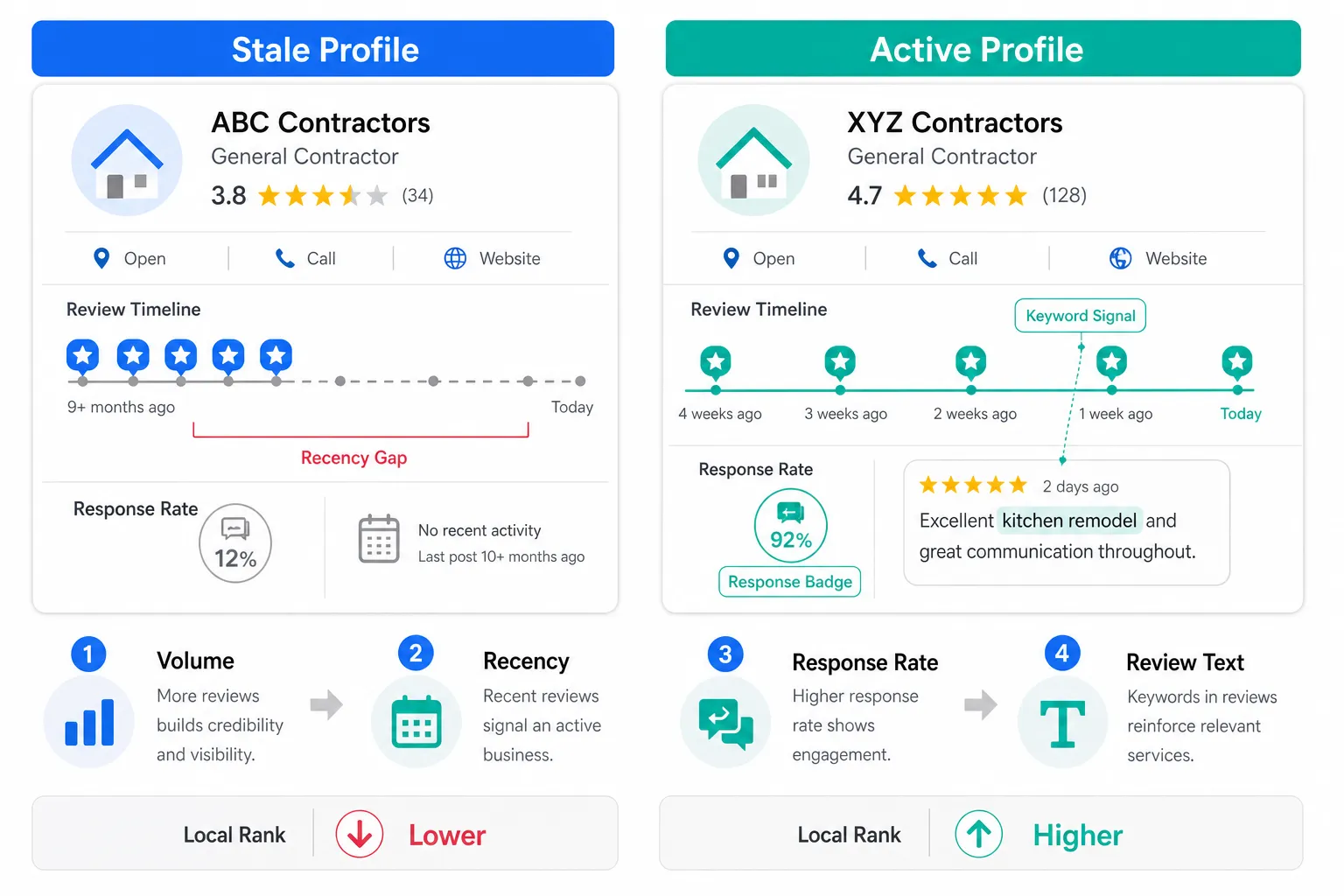
Review volume is one factor. More reviews generally help, especially early on when you are building from zero. But volume alone does not get you there.
Recency is the factor most contractors underestimate. A profile with fifty old reviews often loses ground to a competitor with twenty recent ones. Google treats fresh reviews as a sign you are still active, still serving customers, still relevant. A job you finished last week is worth more to your ranking than ten jobs from two years ago.
Keyword relevance in review text also plays a role. When a customer writes 'great HVAC tune-up in Phoenix,' that phrase signals to Google what you do and where. You cannot write their reviews for them, but you can make it easy for them to write detailed ones by reminding them what the job was.
- Review volume: helps establish credibility, especially early
- Recency: the most overlooked factor among contractors
- Star rating: needs to stay above a threshold that makes customers click
- Response rate: signals you are active and professional
- Review text: natural keywords in customer language carry weight
The Recency Problem Most Tradespeople Do Not See Coming
You do a great job in the spring. Customers leave reviews. Summer comes, you are slammed, and you stop asking. By fall, your reviews are six months old. A competitor who started asking in August now looks fresher, even with fewer reviews overall.
Recency decays faster than most contractors expect, and the only fix is a steady, consistent stream of new reviews. Not a burst every few months, a slow and regular flow.
This is where the process matters more than the effort. If asking for reviews depends on you remembering to do it after a long day on the job site, it will not happen consistently. The contractors who stay at the top of local results have either built a habit or automated the ask. If you want to see how automation works for this, the automatic Google review requests page explains the approach.
One more thing: do not ask for reviews in batches. A dozen reviews posted in one week followed by silence looks odd to Google and can trigger filters. Spread them out.
How You Respond to Reviews Changes How You Rank
Responding to reviews is not just good manners. It is a ranking signal. Google wants to see that a business is engaged with its customers. A profile where the owner responds regularly looks active.
Responding to negative reviews matters even more. A calm, professional reply to a bad review tells every future reader how you handle problems. That matters to homeowners more than a perfect five-star average. Nobody trusts a business with zero negative reviews, because it looks filtered.
Keep responses short, specific to the job, and never defensive. Thank them by name, mention what you did, and move on. Writing a three-paragraph defense of your work in a response to a one-star review helps nobody.
- Respond to every review, positive and negative
- Name the job or service type when you can
- Stay under a few sentences for positive reviews
- For negative reviews: acknowledge, apologize briefly, offer to talk offline
- Never argue publicly
What Kills Your Review Momentum Without You Noticing
Asking at the wrong moment is the most common timing mistake. Right after you hand over the invoice and ask for payment is not a great time. Customers are thinking about money, not Google reviews. A day or two after the job closes, when they have seen your work hold up and the stress is gone, that is the window.
Sending a review request to someone who had a frustrating experience is risky. Not every job goes perfectly. If you know a customer was unhappy, a direct conversation beats a review request. Fix the relationship first.
Verbal asks almost never work as well as a written follow-up with a direct link. Telling someone in person to 'leave us a review on Google' puts the work on them. They have to find your profile, navigate to the review section, and remember what you said. A text or email with a direct link removes every step except writing the review.
Also watch out for reviews that get filtered. Google removes reviews it suspects are fake or that violate its policies. If a customer leaves a review from your Wi-Fi or from a device associated with your account, it may never appear. Have customers post from their own phone, on their own network.
My Take
My advice: treat reviews like a line item in your process, not an afterthought. The contractors who dominate local search in their area are not necessarily the best at the trade. They are often the ones who built a repeatable habit around asking.
The ask has to be frictionless, timely, and consistent, and that is hard to pull off manually when you are running a crew and chasing estimates. That is the honest reason most tradespeople fall behind on this.
If you are curious how others handle the timing and follow-up without adding it to your mental load, take a look at how automatic Google review requests can fit into the close of a job. No pressure, just worth understanding how the process works before you decide whether to build it yourself or hand it off.
Common Questions
Can I ask every customer for a review? Yes, as long as you are not incentivizing them, paying them, or coaching them on what to say. Google's guidelines prohibit offering anything in exchange for a review. Just ask, and let them write what they want.
Does my star rating matter more than the number of reviews? Both matter, but differently. A very low star rating will stop clicks no matter how many reviews you have. Above a certain threshold, volume and recency take over as the differentiating factors between you and a competitor with a similar rating.
What if a competitor is leaving fake reviews on their own profile? You can flag reviews that violate Google's policies directly through the Business Profile interface. Google does investigate, but enforcement is not instant and outcomes vary. Focus more on building your own volume than worrying about theirs.