TLDR: Asking for payment politely means being direct, timely, and consistent, without apologizing for the money you are owed. Most contractors lose money not because they never ask, but because they ask too late, too vaguely, or only once. Here is how to fix that without turning every invoice into an awkward conversation.
You finished the job. The work is solid. And now you are sitting in your truck refreshing your bank account hoping the payment just... shows up. It does not, of course. It rarely does on its own. Asking for payment politely is one of those skills nobody teaches you in the trades, but it ends up being the difference between a business that breathes and one that slowly suffocates on unpaid invoices.
Why 'polite' does not mean 'weak'
A lot of contractors confuse being professional with being passive. They send one invoice, wait three weeks, feel awkward, and either never follow up or come in hot when they finally do. Both extremes cost you money.
The most effective tone is calm, confident, and matter-of-fact, like a business talking to another adult. You are not begging. You are not threatening. You are simply treating your invoice the way any legitimate business does.
Think about how a supplier talks to you when your account is past due. They are not emotional about it. They just remind you clearly, give you a way to pay, and follow up on a schedule. That is the energy you want.
How to ask for payment politely: the actual words
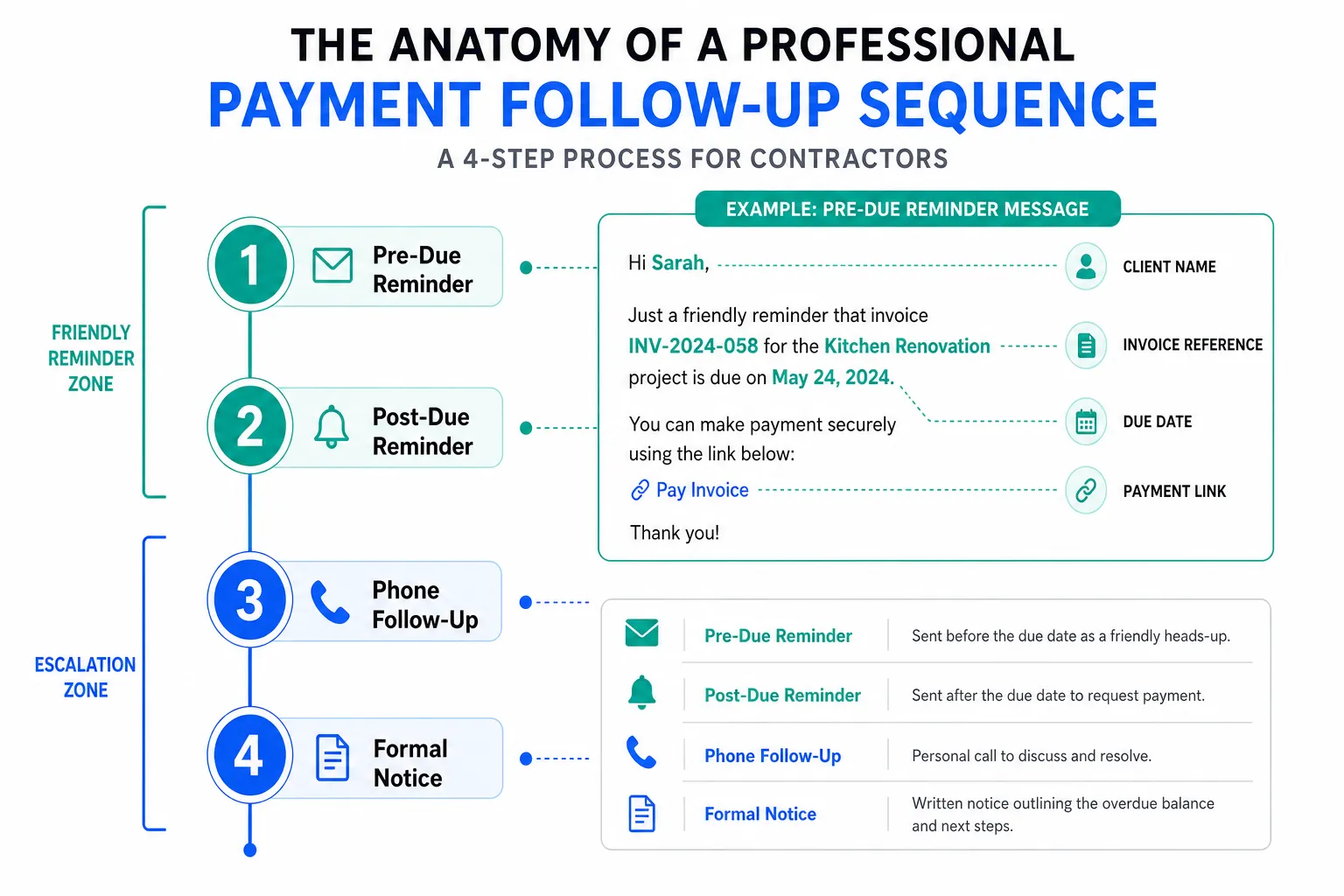
The structure of a good payment request is simple. Start with a reference (the job, the invoice number, the amount), state what you need, give a deadline, and make it easy to act. That is it.
A first message might read: 'Hi [Name], just a reminder that invoice #142 for the kitchen remodel, $X, is due on [date]. You can pay by check, Venmo, or I can send a card link. Let me know if you have any questions.' Short. Clear. No guilt, no pressure.
- Use the client's name. It is not a mass email.
- Reference the specific job, not just 'your invoice.'
- State the due date, not just 'soon' or 'when you get a chance.'
- Give them a way to pay right now, in that same message.
- Keep it under five sentences.
What you do not want is a message that opens with an apology. 'Sorry to bother you' or 'I hate to ask but...' signals that you think asking for money is shameful. It is not. You did the work. The payment is part of the deal.
Timing matters more than wording
Most contractors ask for payment too late. They wait until it is awkward, or until they are frustrated, and then the message comes out wrong. The fix is to build follow-up into your process from the start.
Send a payment reminder before the due date, not after. A heads-up a few days before the due date is friendly and professional. It also removes any 'I forgot' excuse before it happens.
After the due date, follow up quickly. Not after two weeks. A few business days at most. The longer you wait, the harder the conversation gets, and the more it feels like a confrontation instead of a normal business follow-up.
If you send a lot of estimates and invoices, keeping track of who has responded and who has not is where things fall apart. That is exactly the kind of tracking problem that automated estimate follow-up is designed to solve, so you never have to remember who to chase.
What to do when they still do not pay
One unanswered reminder does not mean they are refusing to pay. People get busy. Emails land in spam. The homeowner meant to do it and forgot. A second follow-up is normal and expected.
Try a different channel on the second attempt. If you emailed, try a text. If you texted, try calling. Sometimes the medium is the problem, not the client.
- First reminder: a day or two before the due date.
- Second reminder: a few business days after the due date.
- Third contact: a direct phone call, friendly but firm.
- Fourth step: a formal written notice, depending on your state's requirements.
Do not skip straight to threatening legal action on the second reminder. It burns the relationship and often is not even your next real option. Give the process a chance to work before escalating.
If an account goes seriously delinquent, the rules around collection, mechanics liens, and small claims court vary by state. Deadlines for filing a mechanics lien, for example, are short in most states and the requirements differ significantly. Talk to someone who knows your state before you assume you know the process.
Setting up the conversation before you even start the job
The easiest payment conversation is the one you never have to have, because you set expectations clearly at the beginning. Your contract or estimate should spell out your payment terms in plain language.
When a client signs an estimate that clearly states your deposit requirement, payment schedule, and due dates, you are not 'asking' for money later, you are just following the agreed plan. That reframe alone changes the whole dynamic.
A few things worth spelling out before work starts:
- Deposit amount and when it is due.
- Milestone payments if the job is long.
- Final payment due date (at completion, net 7, net 15, whatever your standard is).
- Accepted payment methods.
- What happens if payment is late.
If you use Gmail or Outlook to send estimates, keeping your follow-up connected to the same thread makes everything traceable. Connecting your email to a follow-up tool means the paper trail is automatic, not something you have to reconstruct when a dispute comes up.
My take
My advice: stop treating the payment conversation as something separate from the job. It is part of the job. A professional follows up on unpaid invoices the same way they show up to the site on time.
The contractors who get paid consistently are not more aggressive. They are more systematic. They have a process. They do not rely on memory or on hoping the client does the right thing. They follow up on a schedule, they make it easy to pay, and they do not apologize for any of it.
Learning how to ask for payment politely is not really about finding the perfect sentence. It is about building the habit of following up, early, often, and without drama. Most clients want to pay. They just need a clear, timely reminder to actually do it.
Common questions
Is it rude to follow up on an unpaid invoice? No. Following up is standard business practice. One invoice without a follow-up is not a system. Clients expect reminders, especially busy property managers or GCs who are tracking dozens of payments at once.
How many times should I follow up before giving up? Most contractors under-follow-up, not the other way around. Three to four touchpoints over a reasonable window is not harassment. After that, if there is genuine silence or refusal, it becomes a collections or legal question, which depends on your state and the amount owed.
What if the client disputes the invoice? Respond in writing. Ask them to be specific about what they are disputing. Do not get defensive in the first message. Often a dispute is a negotiating move, not a real objection. A paper trail of your original estimate, any change orders, and your follow-ups is what protects you if it escalates.