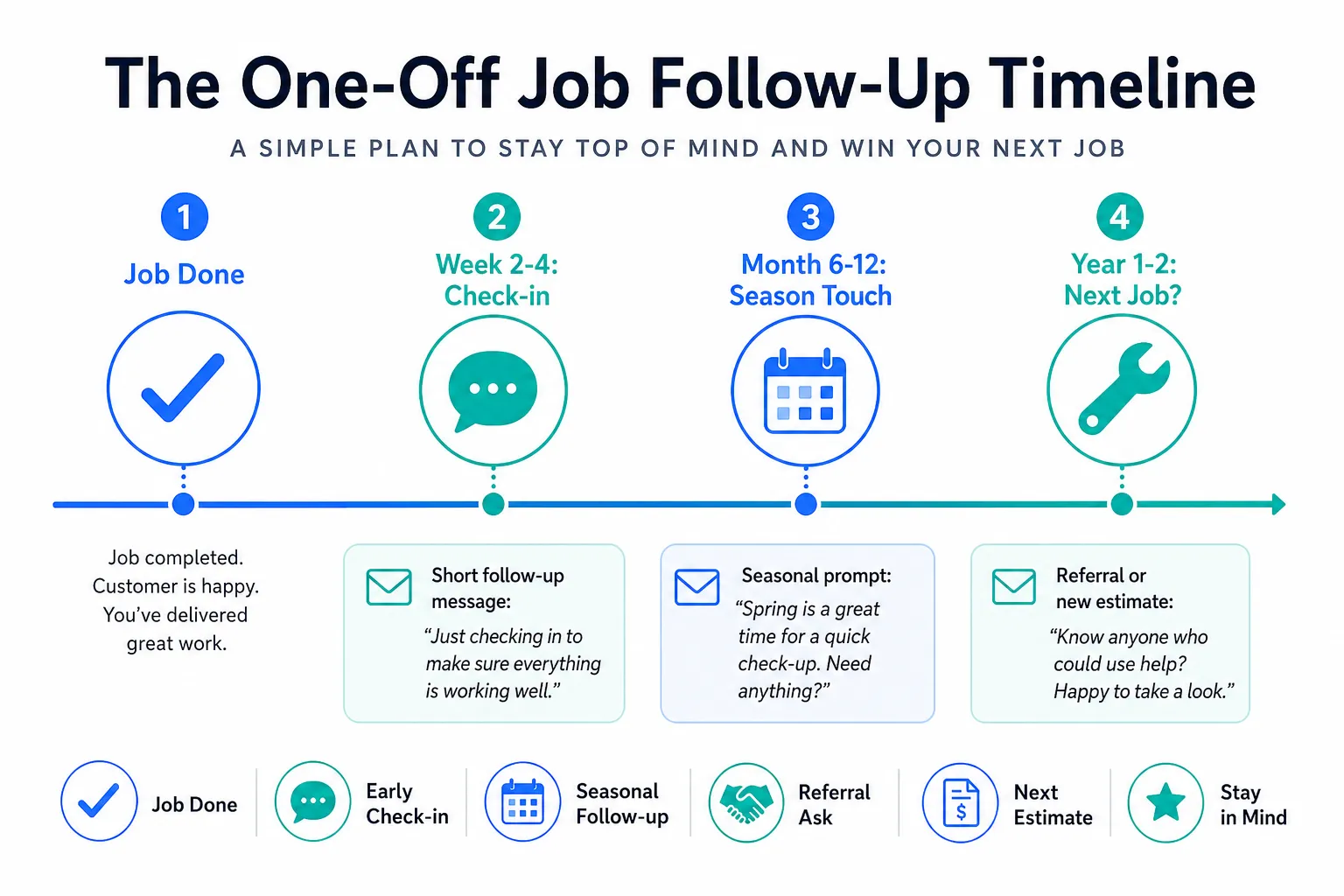
TLDR: Most contracting work is one-off by design, but repeat business is still very much available. The homeowner who hired you once will need work again, and so will their neighbor. The contractors who capture that business are not the ones who did the best tile work. They are the ones who stayed in touch. Here is how to do that without it feeling like spam or desperation.
Why 'one-off' work is not as one-off as it looks
A bathroom remodel happens once. A roof replacement happens once every couple of decades. So how exactly are you supposed to get repeat customers out of that?
The answer is to think wider than the single project. A homeowner who had their bathroom done will eventually want the kitchen. They will notice the gutters. They will have a neighbor who asks who did the tile. The relationship you built during that first job is the asset, not the job itself.
Most contractors walk off the job and move on. That is the gap. The ones who stay in the homeowner's mind, even gently, are the ones who get the call next time. And 'next time' does come, for most trades, more often than you might expect.
Timing is everything: when to reach back out
There is a right moment to reach back out to a past customer, and most contractors miss it completely. The instinct is to wait until you need work. That is the wrong trigger.
Reach out based on their timeline, not yours. Think about when the work you did is likely to need attention again, or when adjacent work tends to come up. A customer who had their HVAC serviced is likely to think about it again before the next season. Someone who had exterior painting done may start noticing the trim a couple of years later.
A few natural moments to reach back out:
-
Seasonal transitions, when your trade is top of mind anyway
-
One year after the original job, framed as a check-in
-
When a neighboring street or zip code sees heavy storm activity
-
Around the time a warranty or maintenance window would apply to your work
Reaching out before they have a problem is what separates a contractor they call from one they have to search for again.
How to get repeat customers: the follow-up most pros skip
The follow-up that actually works is not a coupon email. It is a message that sounds like it came from someone who remembers them. Short, personal in tone, useful.
A simple check-in after a job, asking if everything held up, does two things. It tells the customer you care past the invoice. And it opens a conversation where they might mention the next thing on their list.
Most contractors are too busy during the busy season to think about this, and too scattered in the slow season to act on it. That is exactly why a consistent system for waking up past customers pays off more than chasing new leads. The work is already done. The trust is already there. You just need to show back up.
What to avoid:
-
Generic 'hope you're doing well' emails with nothing useful in them
-
Reaching out only when you're slow and it's obvious
-
Asking for referrals before you've even said hello again
-
Waiting so long they have already hired someone else
Referrals are repeat business in disguise
A customer who refers you is not just giving you a lead. They are giving you a pre-sold customer who already trusts you by proxy. That is as close to a repeat customer as you can get from a one-off job.
Referrals do not happen automatically, even when the customer loved the work. People are busy. They forget. They do not think to mention your name unless something prompts them.
The contractors who get steady referrals are usually the ones who made it easy and memorable to pass their name along. That means leaving a few business cards, asking directly but without pressure, and making sure your Google reviews are strong enough that when someone searches your name, what they find matches what their friend said about you.
An email campaign that touches past customers a couple of times a year keeps you on their radar without being pushy. It does not need to be elaborate. It just needs to be consistent.
My take
My advice: stop thinking about repeat customers as something that only works for businesses with subscription models. Every contractor, in every trade, has a list of past customers who already know them and already trust them. That list is worth more than any ad.
The problem is almost never the quality of the work. It is the silence after the job is done. The customer moves on, you move on, and when they need work again, they search Google like a stranger.
Breaking that cycle does not require a marketing budget or a complicated CRM. It requires a simple habit: stay in touch, at the right time, in a way that feels human. That is the whole game for one-off trades.
The contractors I have seen build genuinely loyal customer bases are not the cheapest or even always the most skilled. They are the ones who followed up. Every time.
Common questions
How long after a job should I wait before reaching back out? For most trades, reaching out within a few weeks of completion, just to confirm everything is holding up, is well received. After that, once or twice a year is enough to stay in mind without being annoying.
What if my trade genuinely only has work for a customer every ten or fifteen years? Focus even harder on referrals. If you did a roof and they will not need another one for years, ask them who in their neighborhood is due. That is where your repeat revenue actually comes from in long-cycle trades.
Is it worth following up with customers who only spent a small amount? Yes, for two reasons. Small jobs sometimes lead to bigger ones from the same customer. And small-job customers often have the widest social circles and the most time to talk about their house.