TLDR: A defensible estimate clearly describes the scope of work, lists what is and is not included, and sets expectations before anyone picks up a tool. It protects you from scope creep, payment disputes, and the classic 'that's not what I thought I was getting' conversation. Here is how to write an estimate that does all three.
Why Most Estimates Fall Apart
The problem is almost never the price. It is the description. A homeowner reads 'install new flooring, living room' and imagines something completely different from what you priced. You show up, do the work, and they say you did not move the furniture. Or they expected the old floor to be hauled away. Or they thought the price covered the stairs.
The estimate is the only document that defines reality before the job starts. If it is vague, every disagreement later is your fault, even when it is not. That is the real cost of a sloppy estimate.
How to Write an Estimate: The Core Structure
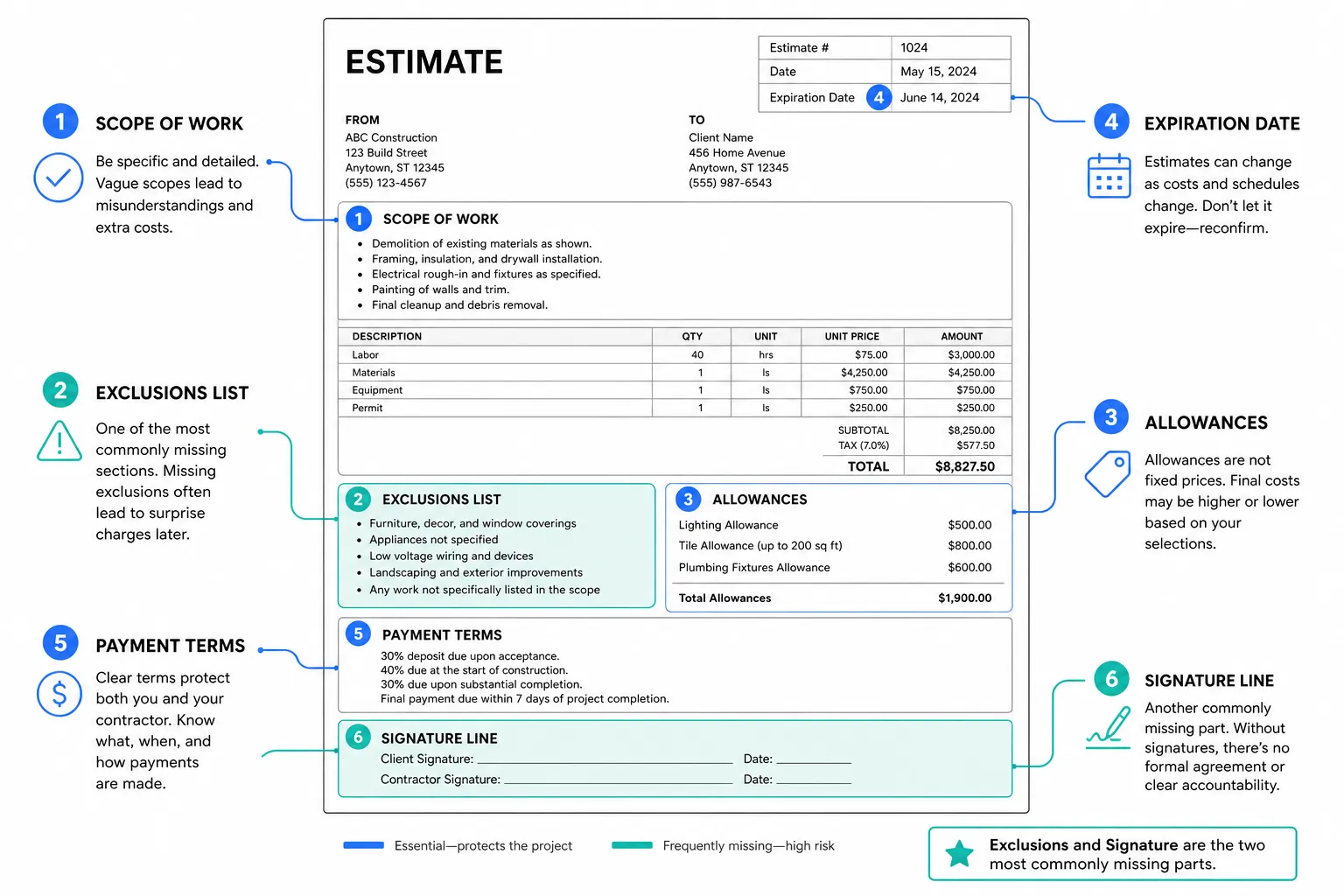
A solid estimate has a few non-negotiable parts. Not every job needs a ten-page document, but every estimate needs these elements:
- Your business name, license number (where your state requires it), and contact information.
- The customer's name and the property address, not just a phone number.
- The date the estimate was issued, and an expiration date. Material prices move. Give yourself a window, usually 30 days works, but that is your call.
- A clear description of the scope of work. Not 'paint interior.' Say which rooms, how many coats, what prep is included, and what paint grade you are pricing.
- A list of exclusions. This is the part most people skip, and it is the part that saves you.
- Payment terms. When is the deposit due, when is the balance due, what happens if payment is late.
- A signature line for the customer.
That last one matters more than people think. An unsigned estimate is a quote. A signed estimate is a contract. Know which one you are handing over.
Write the Exclusions First, Then the Scope
Most contractors write what they will do and never write what they will not do. That is backwards. The exclusions section is where you actually defend yourself when a dispute comes up.
Think about every job where a customer asked for something extra at the end. Hauling debris. Patching drywall after rough-in. Painting the new door after install. Coordinating with another trade. These are the things that eat your margin and create arguments. Put them in writing before the job, not after.
A short exclusions list looks like this:
- Removal and disposal of existing materials, unless noted above.
- Work behind walls or under slabs not visible at time of estimate.
- Permits and permit fees, unless noted above.
- Any work outside the rooms or areas listed in the scope. That list is not legal boilerplate. It is a conversation you are having with the customer before they sign.
Handle Allowances Honestly
An allowance is an estimated cost for something you cannot fully price yet, usually because the customer has not chosen a product. Tile, fixtures, hardware. Common on remodels.
The mistake is using allowances to make your number look lower. You set a $500 tile allowance, the customer picks $12-per-square-foot tile, and suddenly the job is $1,400 over. They blame you. And honestly, they have a point if you never explained the gap.
Write what the allowance covers and what happens when the actual cost is higher or lower. Be specific about the unit cost, not just the total. 'Allowance for customer-selected tile: $X per square foot, installed, up to Y square feet.' If they go over, the difference is billed. Say that in writing.
The Legal Reality Contractors Ignore
Rules around contractor estimates and contracts vary significantly by state. Some states require written contracts above a certain dollar amount. Some require specific language about cancellation rights. Some require your license number on every document. A few regulate how deposits are structured, especially on home improvement work.
This is not the place to get the details wrong. Talk to a contractor-focused attorney or your state licensing board to understand what your estimate actually needs to include in your state. The cost of that conversation is a fraction of one disputed invoice.
One thing that is consistent everywhere: a written, signed estimate is always better than a verbal agreement. Courts and arbitrators work with documents. They cannot subpoena a phone call.
My Take
My advice: treat the estimate like it will be read by a judge who has never met you and does not know your trade. Would that judge understand exactly what you agreed to do, what you did not agree to do, and what the customer was supposed to pay? If the answer is no, rewrite it.
The contractors who lose disputes are almost always the ones with the shortest estimates. Three lines and a total. No scope detail, no exclusions, no payment terms. They did good work and they still lost because there was nothing to point to.
If you are spending too long writing estimates by hand, there are faster ways to get a clean, consistent document out the door. Building estimates by voice can cut the time down without cutting the detail. The goal is the same: a document you can stand behind.
Common Questions
Do I need a signed estimate to get paid? Not always, but unsigned estimates are much harder to enforce if a customer disputes the scope or the price. Get a signature before you start work.
What is the difference between an estimate and a quote? In everyday use, many contractors treat them the same. Technically, a quote is often a fixed price, while an estimate may vary. What matters more than the label is whether the document is signed and whether it defines the scope clearly.
How long should I keep my estimates? This varies by state and by the type of dispute that might come up. For home improvement work, keeping records for several years is a reasonable baseline. Ask your attorney what applies to your situation and your state.