TLDR: A clear invoice with the right details, a specific due date, and an obvious payment method gets paid faster than a vague one. Most slow payments come from invoices that are incomplete, not from customers who refuse to pay. Here is what to put on every invoice you send.
You finished the job. The truck is packed. You are already thinking about the next one. Writing the invoice feels like paperwork, not real work. So you rush it, or you copy the last one and change the number.
That is where the wait starts.
The basic structure every invoice needs
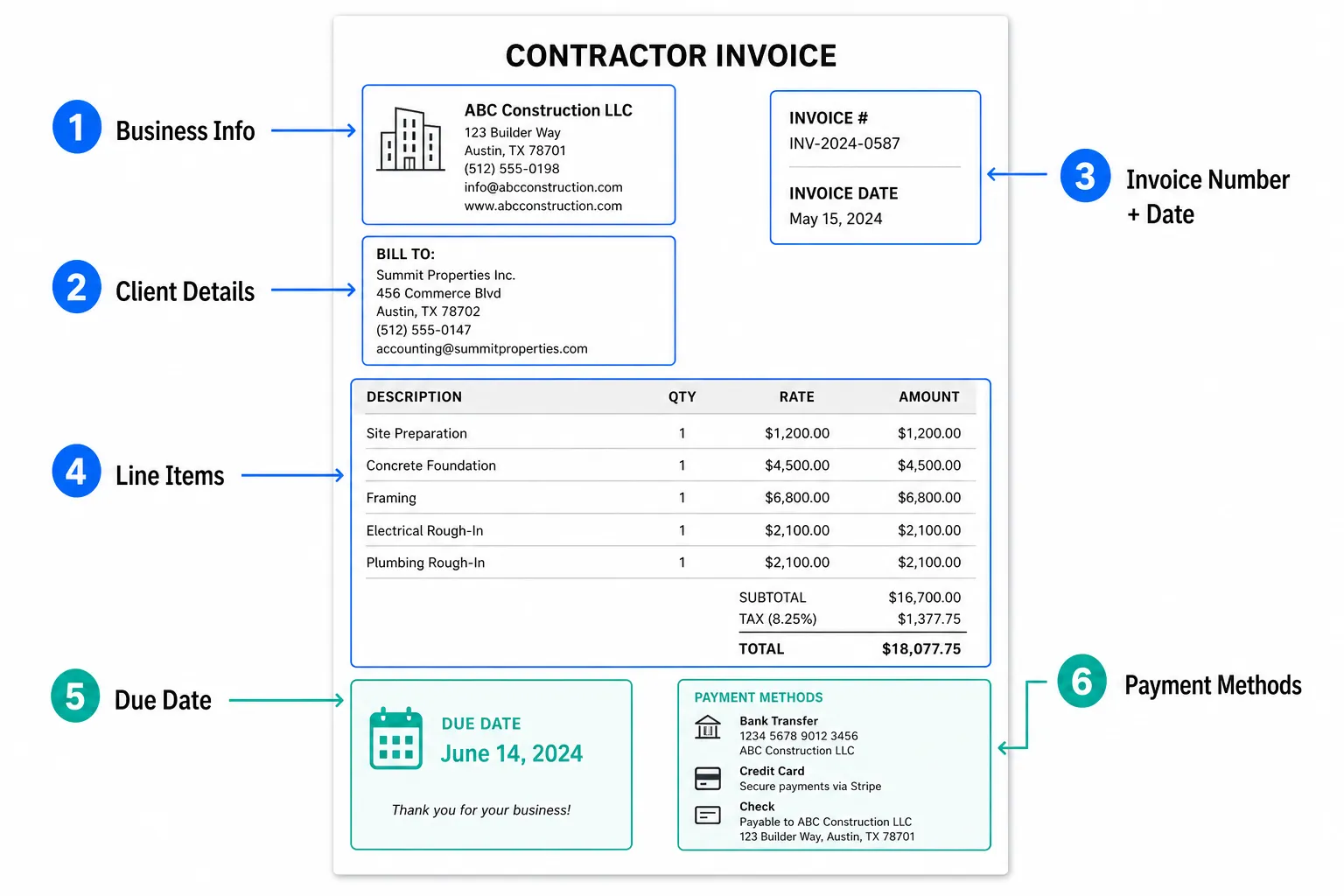
Knowing how to write an invoice starts with what belongs on it. Miss any of these and you give the customer a reason to delay, ask questions, or claim they never got it.
Every invoice needs:
- Your business name, address, phone, and email
- The customer's full name and billing address
- A unique invoice number
- The date you sent it
- A clear due date (not 'net 30' if the customer doesn't know what that means)
- A line-by-line breakdown of work done and materials used
- The total amount owed
- How to pay you
The due date is the most skipped field, and skipping it is why you end up chasing people two weeks after the job. Without a date, the customer decides when 'soon' means. And 'soon' has a way of stretching.
How to describe the work so there are no disputes
Line items are where most contractors get lazy. 'Labor' and 'materials' tell the customer almost nothing. When they can't remember what you did, they call you. That call delays payment.
Be specific. Write what you actually did, where you did it, and how long it took. 'Replaced master bedroom window, including frame and trim, two hours labor' is better than 'window work.' It sounds more professional, and it matches what the customer saw happen.
If your invoice matches what you said you would do in the estimate, disputes almost never happen. The customer compares the two documents. If they line up, there is nothing to argue about. If they don't, expect a phone call before a payment.
Payment terms that actually make sense to a homeowner
Most homeowners and property managers are not in trade. They do not know what 'net 15' means. Write it plain: 'Payment due by [date].' That is all it takes.
Late fees are legal in most states, but the rules on how much you can charge and what disclosure you need vary. Check what your state allows before you print 'late fee: 1.5% per month' on every invoice. What matters more is that you say it at all, not the exact number. If you never mention consequences, there are none.
Accepted payment methods deserve their own line. List all of them. Check, ACH, Zelle, credit card, whatever you take. A customer who wants to pay by card and sees no option may put it aside and forget it. Make it easy. Remove every excuse.
Sending the invoice the right way
Paper invoices get lost. An invoice left on the kitchen counter gets buried under mail. Email is better, but only if it actually lands in the inbox and not in spam.
Send from a business email address, not a personal Gmail. A message from yourbusiness.com looks legitimate. A message from randomemail47@gmail.com sometimes goes straight to junk, and the customer never even sees it. If you are sending invoices through email and having delivery issues, connecting a proper sending address is worth looking at.
Send a copy the day you finish the job, while the work is still fresh in the customer's mind. Waiting three days to 'write it up properly' costs you nothing in quality and everything in speed. The fastest-paid invoices go out the same day the work is done.
What to do when the invoice goes unanswered
Most contractors hate following up. It feels awkward, like you are begging for money you already earned. So they wait. One week, then two. Then they send a second invoice that looks exactly like the first one, and wonder why nothing changes.
A follow-up is not begging. It is running a business. Some customers genuinely forget. A quick, friendly reminder, sent a day or two after the due date, recovers most of those.
The problem is that following up by hand takes time you do not have. You are on a job, or under a truck, or picking up materials. The message never gets sent. Automating that first nudge is not about being pushy, it is about making sure the reminder actually goes out. That is exactly what automated invoice follow-up is built to handle, so you don't have to remember to do it.
If the invoice stays ignored after two or three reminders, you are no longer in invoice territory. You are in collections territory. That is a different conversation, and the rules vary a lot by state.
My take
My advice: treat the invoice like part of the job, not the paperwork after it. A sloppy invoice signals that the business behind it might be sloppy too. A clean, detailed invoice with a clear due date and an obvious way to pay tells the customer they are dealing with a professional.
The contractors who get paid fastest are not more aggressive, they are just more organized. They send the invoice the same day. They describe the work clearly. They make payment easy. And they follow up without waiting to feel comfortable about it.
Most of the delay you experience is self-inflicted. Fix the invoice, and most of the wait disappears.
Common questions
Do I need to include my license number on an invoice? It depends on your state and trade. Some states require it on all client-facing documents. Others don't. Check with your state licensing board. When in doubt, include it. It adds credibility anyway.
What if the customer says they never got the invoice? Send it again immediately, and use a format that gives you a delivery record. Email with read receipts, or a system that logs sends, helps you here. Keep a copy of everything you send with a timestamp.
How long should I give customers to pay? That is your call, and it varies by trade and project size. Smaller jobs often get shorter terms. Larger jobs with draws may have longer ones. Whatever you choose, put it in writing before you start, not just on the invoice after you finish.