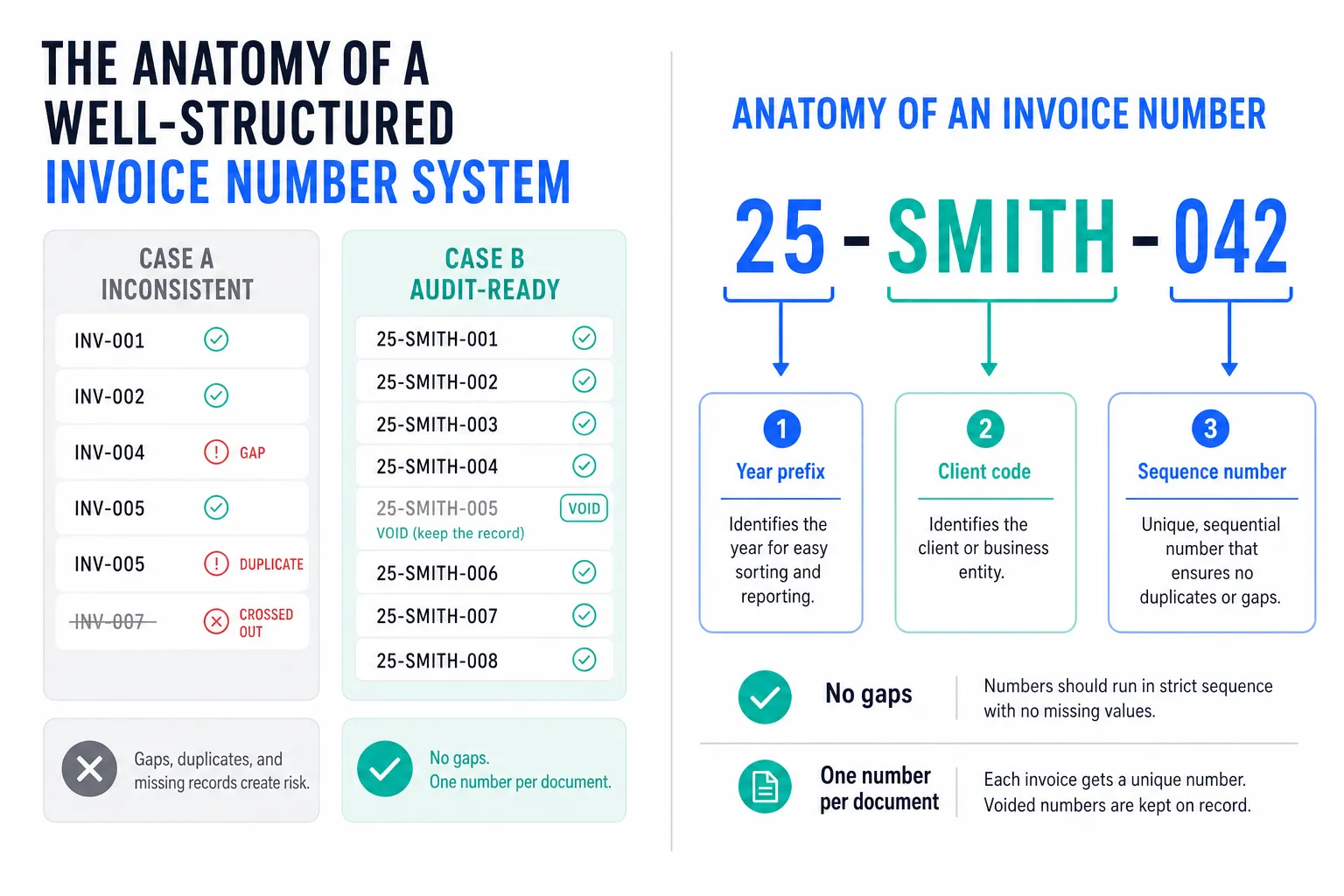
TLDR: An invoice number is a unique identifier you assign to every invoice you send. It keeps your records in order, satisfies most state and federal recordkeeping expectations, and is the first thing an auditor or accountant reaches for. You do not need fancy software. You need a consistent system you never break.
Most contractors set up their numbering on day one and never think about it again. That is fine, until a client disputes a payment, a lien deadline appears, or the IRS asks you to reconstruct a year of transactions. Then the gaps, the duplicates, and the hand-scribbled numbers on paper invoices become a real problem.
What an invoice number actually does
It is not decoration. The invoice number is the primary key that ties a piece of work to a payment, a contract, and a project file. When a property manager says they never received invoice for the June job, you pull up one number and you have the whole story.
Auditors and bookkeepers also use invoice numbers to spot missing transactions. A sequence that jumps from 1042 to 1045 raises a question. You want a clean, unbroken chain. The invoice number is how you prove a transaction existed, when it happened, and that it was recorded honestly.
For contractors who file taxes as a sole proprietor, an LLC, or an S-corp, clean invoice records are part of substantiating your income. No invented rules here. Just know that gaps and inconsistencies invite follow-up questions you do not want.
The formats that actually work in the field
There is no single required format in the United States. What matters is that the number is unique, sequential, and that you apply it without exception. Here are the formats that hold up in practice:
- Plain sequential: 001, 002, 003. Simple. Works for solo operators doing lower volume.
- Year-prefixed: 25-001, 25-002. Easy to filter by year at tax time.
- Client-coded: SMITH-001, SMITH-002. Useful if you do repeat work with the same clients.
- Project-coded: 25-BATH-001. Good for remodelers running multiple jobs at once.
Pick one and stick to it. Switching formats mid-year, or mid-business, is where most contractors create the gaps that come back to haunt them. If you want to change your system, start at a new fiscal year and note the transition in your records.
If you are just starting out or rebuilding after a messy stretch, a free invoice generator can help you apply a consistent number to every document from the first one.
The classic mistakes contractors actually make
These are not hypothetical. They come up constantly when a contractor tries to reconstruct records after the fact.
- Reusing a number because the first invoice "never got sent".
- Skipping numbers to look more established than you are (do not do this).
- Issuing invoice number 1 to three different clients in the same week.
- Using dates as invoice numbers, then issuing two invoices on the same day.
- Letting a helper or office person use a different numbering scheme without telling you.
The reuse problem is the worst one. Once you assign a number, that number is taken. Even if the job fell through, void the invoice and note it as void. Do not hand the same number to a new client. One number, one document, forever.
Skipping numbers intentionally to look busier is something auditors notice. It is not illegal on its own, but it creates suspicion and you will have to explain every gap.
What the IRS and state agencies actually want to see
The IRS does not mandate a specific invoice numbering format for small businesses. What they care about is that your records are consistent, complete, and match what you reported. Invoice numbers are the connective tissue of that record.
State requirements vary. Some states with contractor licensing boards have their own recordkeeping rules. Some states require you to keep business records for a specific number of years, but that number differs. Check with a CPA or your state's contractor licensing board for what applies to you.
The practical standard is simple: every job you billed should have a numbered invoice you can produce on request, matched to the payment you received. That is what survives scrutiny, whether it is an IRS audit, a contractor board inspection, or a client lawsuit.
How to keep your system clean without an accountant looking over your shoulder
Most of this is habit, not software. A few practices that actually work on a job site schedule:
- Assign the invoice number before you send anything, not after. Some guys write the invoice, send it, and add the number later. That is how numbers get lost.
- Keep a master log, even just a spreadsheet. Invoice number, client name, date sent, amount, date paid. Four columns. That is your audit file.
- Never let a text message or a verbal agreement stand in as an invoice. Write it up, number it, send it.
- If you use paper invoices, pre-number your books or pads before the season starts.
Knowing how to write a clean invoice matters just as much as the numbering. The number is useless if the document it sits on is missing line items, dates, or a description of work. If you handle estimate follow-ups and invoicing from the same workflow, you are less likely to let something fall through.
The goal is that six years from now, a stranger could pick up your records and reconstruct exactly what you billed, to whom, and when, without asking you a single question.
My take
My advice: keep it boring. The contractors who get into trouble with invoice records are almost always the ones who got creative. They used date-stamps, they recycled numbers from old clients, they had three different numbering schemes running at once because they switched software twice.
Pick a simple format on day one. Year prefix plus a three-digit sequence. Start at 001 every January. Never reuse, never skip, and when you void something, mark it void and keep the record.
If your current system is already messy, clean it up at the start of the next fiscal year and document the transition. A note in your files that says "New numbering system begins here" is not an admission of anything. It is just good recordkeeping.
Common questions
Does my invoice number have to start at 1? No. Starting at a higher number like 1001 is common and fine. What matters is that the sequence is consistent and unbroken from wherever you start.
What do I do if I issued two invoices with the same number by mistake? Void one of them immediately, note the reason in your records, and issue a new invoice with the correct next number in your sequence. Do not delete either document.
Do I need to include my invoice number on estimates too? Estimates and invoices are different documents, but keeping them on a connected numbering system makes life easier. Many contractors use the same job number across the estimate, the change orders, and the final invoice, so everything ties back to one file.