TLDR: Invoice terms tell your customer exactly when to pay, how to pay, and what happens if they don't. Getting them right is one of the cheapest things you can do to improve your cash flow. Most contractors either skip them entirely or copy something vague off the internet, and then wonder why checks arrive three weeks late.
If you send estimates and invoices for a living, this is for you.
What invoice terms actually are (and what they are not)
Invoice terms are the short conditions printed on your invoice that define the payment relationship. They are not a legal contract on their own. But they set expectations, and clear expectations get paid faster than vague ones.
There are two things people confuse here. First, payment terms: when the money is due. Second, payment conditions: how it can be paid, what deposits are required, and what happens when a customer is late. Both belong on your invoice.
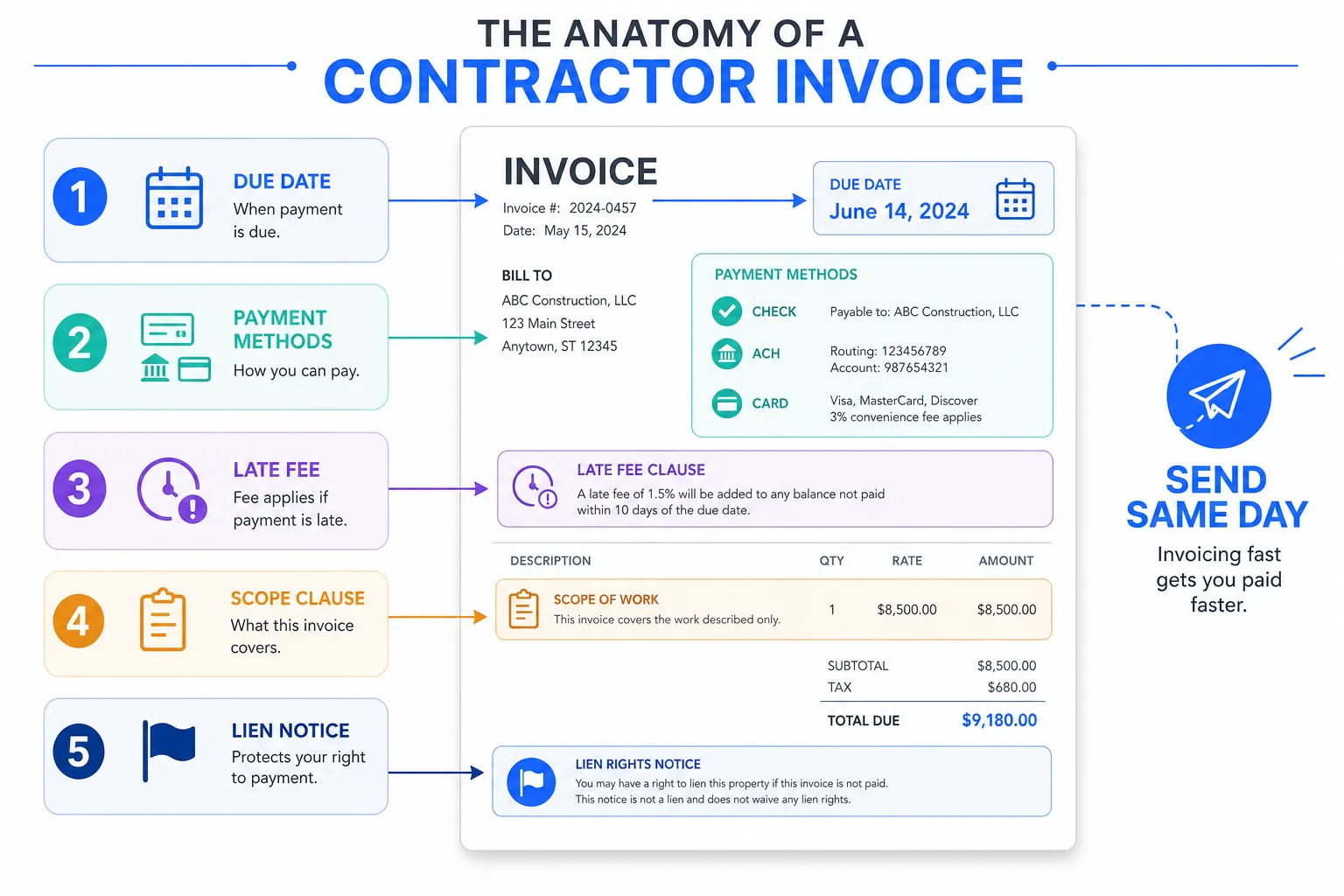
Here is what a complete set of terms covers:
- Due date or payment window (Net 7, Net 15, Net 30, due on receipt)
- Accepted payment methods (check, ACH, credit card, Zelle)
- Deposit or draw schedule, if the job has phases
- Late payment policy
- Who to contact for disputes
Choosing the right payment window for your trade
Net 30 is the default most contractors put on invoices without thinking. It is also the default most customers use as a reason to wait a full month before they even look at the invoice.
For residential work, due on receipt or Net 7 is almost always more appropriate than Net 30. You are not a bank. You paid for materials, you paid your labor, the job is done. There is no good reason a homeowner needs 30 days to write a check.
Commercial and property management clients are a different story. Some of them have accounts payable cycles locked into Net 30 or Net 45. You can negotiate, but you have less leverage there. Know who you are billing before you print a term.
A few things worth knowing:
- 'Due on receipt' is clear but sometimes feels aggressive to first-time customers. Net 7 or Net 10 lands softer and still protects you.
- For larger jobs, a draw schedule beats a single final invoice every time. You get paid as milestones are hit, not after you have finished everything.
- If you collect a deposit, spell out exactly what it covers and that it is non-refundable if the customer cancels after materials are ordered.
Late payment language that holds up
Most late payment clauses on contractor invoices are either empty threats or legally unenforceable in the state where the work was done. Rules on late fees, interest rates, and what you can actually charge vary by state. Do not invent a number you cannot back up.
What matters most is that your late payment policy is written on every invoice, acknowledged before work starts, and consistent. If you charge a late fee on one job and waive it on the next, you have no policy, you have a preference.
Practically speaking, write something like: 'Invoices unpaid after [X] days are subject to a late fee. Work may be paused on open jobs until the account is current.' That second sentence is often more motivating than any interest calculation.
If you are going to charge interest on overdue balances, check your state's rules first. Some states cap what you can charge. Some require the rate to be disclosed in writing before it applies. When in doubt, talk to a local attorney for one hour rather than guess.
The mechanics: where to put your terms and how to deliver them
Terms buried in 8-point font at the bottom of a PDF do not protect you in a dispute. If a customer claims they never saw them, you are in a weak position.
Put your key terms in the body of the invoice, not a footnote, and repeat them in the email you send with the invoice. Something like 'Payment of $X is due by [date] via check or ACH' in the message body removes any ambiguity.
A few habits that make a real difference:
- Send the invoice the same day the job is complete, not a week later when you finally get to the paperwork.
- Include the due date as a specific calendar date, not just 'Net 15.' People are bad at math when they owe money.
- Make sure your payment instructions are complete: your name, business name, mailing address for checks, and ACH or payment link details if you accept electronic payments.
- If you use email to send invoices, a connected email account means replies and receipts stay in one place instead of getting lost across three apps.
For the invoice itself, a clean, professional layout does quiet work. If you want a fast starting point, the free invoice generator at Lienzor lets you build one by voice in under a minute.
The terms most contractors forget entirely
Everyone thinks about the due date. Fewer people think about the stuff below.
A returned check or failed ACH clause is one of the most-forgotten terms, and one of the most useful. Write it in once, and you never have to have an awkward conversation about who covers the bank fee.
Here are the terms that regularly go missing from contractor invoices:
- Scope clarification: a one-line note that the invoice covers exactly the work described and that changes to scope require a written change order.
- Ownership of materials: on jobs where you supply materials, note that materials remain your property until the invoice is paid in full. This matters if a customer tries to stiff you mid-project.
- Lien rights notice: in many states, you have the right to file a mechanics lien if you are not paid. Some states require you to send a preliminary notice before you can exercise that right. Rules vary significantly by state, so verify the rules in the states where you work. Mentioning your lien rights on an invoice is not a threat, it is a professional reminder.
- Dispute window: give the customer a short window to raise a billing dispute in writing. After that window, the invoice is considered accepted.
My take
My advice: stop treating invoice terms as boilerplate you paste in and forget. They are a short conversation you have in writing with every customer, before any awkwardness happens.
The contractors who get paid fastest are not the ones who chase hardest. They are the ones who make the expectation clear from the start. The invoice is your last professional document on a job. It should read like it was written by someone who runs a real business.
Start simple. Pick a due date that makes sense for your trade. Write your late fee policy in plain English. List your payment methods clearly. Deliver the invoice the day the job is done. Those four things alone will do more for your cash flow than any follow-up call.
Common questions
Can I charge a late fee if it is not on the original invoice? Generally, no. A late fee needs to be disclosed before it applies, ideally on the invoice itself or in a written agreement. Trying to add one after the fact is hard to enforce and damages the relationship.
Is Net 30 standard for contractors? It is common, but it is not a rule. For residential jobs, shorter terms are both normal and reasonable. The 'standard' is whatever you write on your invoice and your customer accepts.
What if a customer disputes the invoice after paying part of it? Get the dispute in writing immediately. Do not accept partial payment as settlement of the full amount unless you explicitly agree to that in writing. A short dispute-window clause on your invoice helps establish that silence equals acceptance.