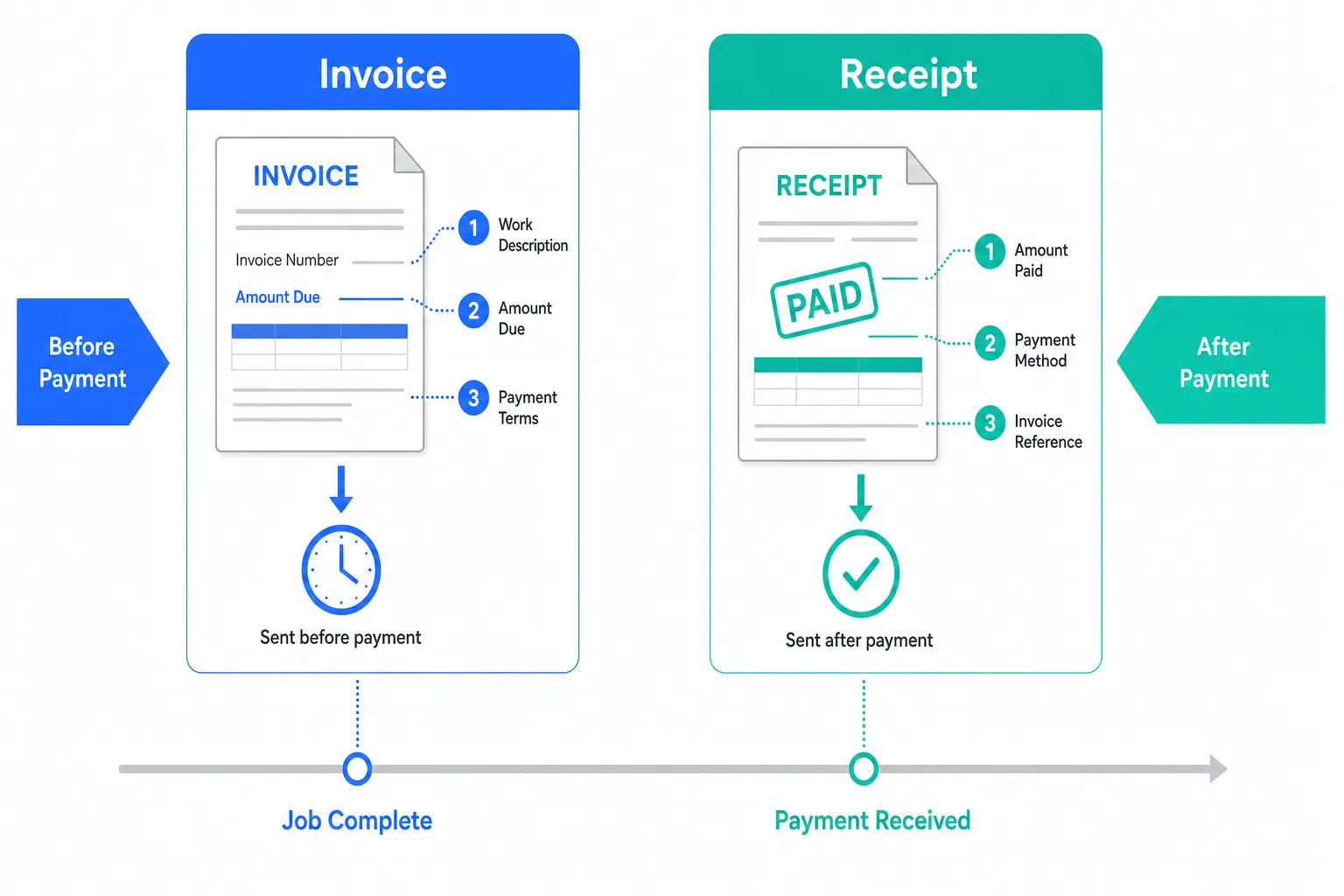
TLDR: an invoice is a request for payment you send before money changes hands. A receipt is proof of payment you give after. Mixing them up creates real problems, from disputes with homeowners to messy bookkeeping at tax time. Here is what every contractor needs to know about the invoice vs receipt question.
The Core Difference Between an Invoice and a Receipt
An invoice says: here is what you owe me, and here is what I did to earn it. A receipt says: I got your money. These are two separate moments in the payment cycle, and they serve two completely different purposes.
An invoice is a legal request for payment, not proof that payment happened. It creates the obligation. The receipt closes it. Handing someone a receipt before you have their money is like signing off on a job before you have inspected it.
Think of it this way. You finish a bathroom remodel, send the invoice, the homeowner pays by check three days later. That is when you issue the receipt. Not before. Swapping the order, or using one document to do both jobs, is where most small contractors get into trouble.
What an Invoice Actually Contains
A solid invoice is more than a number on a page. It is a record that can hold up if a customer disputes the charge or if you end up in small claims court.
At minimum, your invoice should include your business name and contact information, the customer's name and address, a clear description of the work performed, the date the work was done, the amount owed broken out by labor and materials, your payment terms, and a unique invoice number.
Payment terms matter more than most contractors realize. If you write nothing, a customer can argue they had thirty days, sixty days, or indefinitely. Spell it out. And if you use progress billing on larger jobs, each invoice should reference the project and clearly show which phase or milestone it covers.
If you are still writing invoices by hand or patching together a Word file, creating one quickly with a voice invoice generator is worth a look. It takes less time than most people expect.
What a Receipt Actually Contains
A receipt is simpler but it still needs to be accurate. It confirms the amount paid, the date of payment, and the method, whether that was cash, check, card, or a transfer.
The receipt should reference the original invoice number so both documents are tied together in your records. If a homeowner calls six months later claiming they overpaid, you want to pull up both documents in thirty seconds, not dig through a pile of texts and screenshots.
For cash jobs especially, handing over a written receipt protects you as much as it protects the customer. If there is ever a question about whether you were paid, a signed receipt is your documentation. Do not skip it because it feels like extra paperwork.
Why Contractors Confuse the Two (and the Real Cost of It)
The confusion usually starts with apps or systems that call everything an invoice, even after payment is recorded. Some accounting software automatically marks an invoice as paid and never generates a separate receipt. That can work internally, but it creates problems when a customer asks for proof of payment.
Here is a scenario that happens more often than it should. A property manager pays you, then a few weeks later their accounts payable team cannot find the receipt. They call you. You send the invoice. They say this does not show payment. Now you are going back and forth when you should be on a job site.
Keeping your invoice records and your payment records clean and separate saves you from these conversations entirely. The fifteen minutes you spend setting up a consistent system, even a simple folder on your phone, pays back in fewer disputes and faster bookkeeping every quarter.
On the tax side, the invoice vs receipt distinction also matters. Your invoices tell the story of your revenue. Your receipts, along with your expense receipts, are what your accountant uses to verify everything. They are not the same document, and treating them that way creates gaps that are annoying to reconstruct later.
When Your Customer Needs One, the Other, or Both
Most residential homeowners care about the receipt. They want proof they paid you, something they can file with their home records or show to their insurance company. Send them both, but the receipt is what they will actually look for.
Commercial customers and property managers often need the invoice first because their accounts payable process requires an invoice on file before they can cut a check. Some require a purchase order reference too. Ask at the start of the job, not after the work is done.
General contractors working with subs have their own rhythm. If you are the sub, your GC typically needs a proper invoice to process your payment through their system. If you are the GC managing subs, you need their invoices to support what you bill the owner.
For any job over a few hundred dollars, send both documents, the invoice before payment and the receipt after, and keep copies of each. This is the cleanest habit you can build.
My Take
My advice: treat the invoice and the receipt as two distinct checkpoints in every job, not interchangeable paperwork. The invoice goes out when the work is done and payment is due. The receipt goes out when the money is in your account.
Getting this right is less about being formal and more about protecting yourself. Disputes over whether a job was paid, and how much, are one of the most preventable headaches in contracting. A clear invoice followed by a clear receipt makes both sides of the transaction easy to verify.
You do not need complicated software to do this well. What you need is consistency. Same format every time, invoice number on both documents, and a simple habit of sending the receipt within a day or two of receiving payment.
If you want a faster way to get invoices out of the truck and into the customer's inbox, building one from your phone using a voice invoice generator is one of the most practical changes a small contractor can make.
Common Questions
Can I use one document for both the invoice and the receipt? Technically you can mark an invoice as paid and use it as a receipt, but only after payment is confirmed. Sending it before you have the money creates confusion about whether payment was actually expected or already received. Keeping them separate is cleaner.
Does a receipt need to be signed? There is no universal federal rule requiring signatures on receipts, and requirements vary by state and by the type of transaction. For cash payments, getting a signature or a written acknowledgment from the customer gives you solid documentation. For card payments, the card processor record usually serves that purpose.
What if a customer asks for a receipt but I only have the invoice? Issue a separate receipt. Write the invoice number on it, the date you received payment, the amount, and the method. It does not have to be elaborate. What matters is that it exists as a standalone record of the payment event.