TLDR: An itemized invoice breaks your charge into individual line items, labor, materials, fees, so the customer sees exactly what they paid for. It reduces disputes, supports your lien rights in most states, and makes you look like a professional who runs a real business. If you skip the detail, you hand the argument to the customer before it even starts.
What an Itemized Invoice Actually Is
A lot of contractors send a number. One line. 'Bathroom remodel, $4,200.' The homeowner sees it, squints, and the questions start. An itemized invoice does the opposite. It lists every component of the job separately.
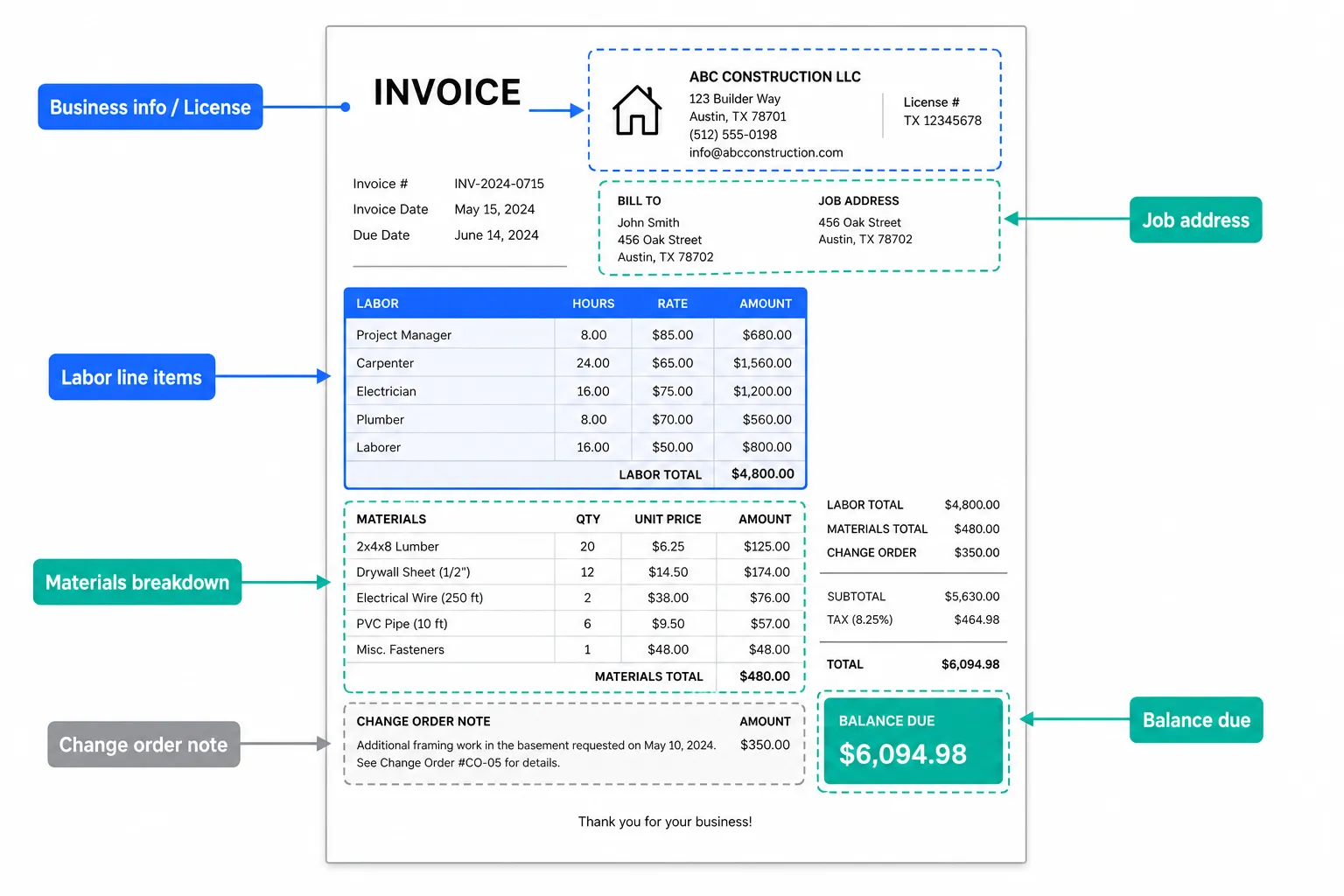
That means labor hours broken out, materials listed by type or product, disposal fees called out, permit costs shown, and any subcontractor charges identified. The goal is that a customer can follow the invoice like a receipt and match it to what happened on the job site. Nothing hidden, nothing lumped together in a way that invites suspicion.
Some contractors worry that showing the detail exposes their markup. That concern is understandable. But in practice, a well-structured itemized invoice frames your pricing as deliberate and fair, not arbitrary. Customers who understand what they bought rarely fight the number.
The Real Reason Disputes Start
Most payment disputes are not really about money. They are about surprise. The customer thought they were getting one thing, and the invoice says something different. Or they forgot something was discussed. Or they genuinely cannot tell what they are paying for.
A vague invoice feeds all three of those problems. An itemized invoice kills them at the source.
Here is what typically goes wrong on jobs without detailed invoices:
-
Labor gets questioned because there is no record of hours worked or crew size.
-
Material costs look inflated when customers check prices online and have no context for your actual cost or markup.
-
Add-ons and change orders disappear into the total and the customer swears they were never discussed.
-
Disposal or haul-away fees feel like surprises because they were not broken out up front.
When you put every line in writing, the customer has already agreed to the structure before the work even starts, especially if your itemized estimate mirrored your invoice. That consistency is what closes the argument before it opens.
Itemized Invoices and Your Legal Position
This is where it gets serious. If you ever need to file a mechanics lien, take a customer to small claims court, or defend yourself in a dispute, your invoice is your evidence. A single-line invoice with a total gives you almost nothing to stand on.
Lien laws vary by state. Deadlines are short. Requirements differ. But most states want documentation that supports the claim, and a detailed invoice showing what labor was performed and what materials were supplied is far stronger than a lump sum. Some states have specific requirements around how charges must be described. Knowing what your state requires is worth checking with a construction attorney.
A detailed invoice is not just good customer service, it is a business record that can protect your money when a job goes sideways. Do not treat it as optional paperwork.
What to Include on Every Itemized Invoice
The basics should always be there. Your business name, license number if your state requires it on invoices, your contact information, the customer's name and property address, and the invoice date. Those never move.
Then the line items. Build the habit of writing them this way:
-
Description of each task or trade (demo, framing, electrical rough-in, paint, etc.)
-
Labor: hours or days, role or crew, rate per unit
-
Materials: product name or type, quantity, unit cost
-
Subcontractor work listed separately, not buried in labor
-
Fees that are real costs, permit, inspection, dump run
-
Any retainage, deposit credit, or partial payment already received
-
A clear balance due and payment terms
If there were change orders, list them as separate line items with a reference to when they were approved. Do not fold them into the original scope without noting them. That one habit prevents more arguments than almost anything else on a job.
If you use voice-to-text or dictation on the job site, a tool like the free voice invoice generator can turn your spoken line items into a structured invoice without you typing anything after a long day.
The Estimate-to-Invoice Consistency Rule
Here is a mistake that costs contractors money constantly. They send a detailed estimate, win the job, then send a vague invoice. The customer compares the two documents and the numbers do not match up neatly. Now there is a conversation.
The invoice should mirror the estimate line by line. Same categories, same level of detail. If the scope changed, note it. If a material was substituted, note it. Consistency between your estimate and your invoice signals that you ran the job the way you said you would, and that trust is worth more than the clerical time it takes.
Customers who see an invoice that tracks back to the estimate they signed almost never dispute it. They recognize the job they bought.
My Take
My advice: always itemize, even on small jobs. Especially on small jobs, honestly. The jobs where contractors skip the detail are usually the ones where the customer later claims they did not know what they were paying for.
A $600 invoice with five line items protects you just as much as a $6,000 one. And the time it takes to add the detail is almost nothing if you build it into your process from the start.
Vague invoices create leverage for customers who want to delay or negotiate after the fact. Itemized invoices do not. That is the whole argument.
The other thing worth knowing: an itemized invoice also makes your follow-up easier. When a customer goes quiet on an unpaid invoice, having the line items in front of them during a follow-up call gives the conversation structure. You can talk about specific line items rather than defending a total. If you want to understand how following up on unpaid invoices fits into a broader system, that is worth exploring on its own.
Common Questions
Does an itemized invoice mean I have to show my markup? No. You list the charge for materials, not your cost. The customer sees what they are paying, not your margin. Plenty of contractors include a materials line at the price they charge, not the price they paid.
What if the customer asks me to break it down further than I want to? You can describe items clearly without giving away your business model. 'Roofing labor, 2 days, crew of three' is detailed. It does not expose your hourly rate unless you choose to show it. Be consistent and descriptive without overexplaining.
Is a handwritten itemized invoice valid? In most cases, yes. A clear, signed document showing what was done and what was charged can hold up in a dispute or a lien claim. That said, a typed invoice with your business name and license number looks more professional and is easier to read under pressure.