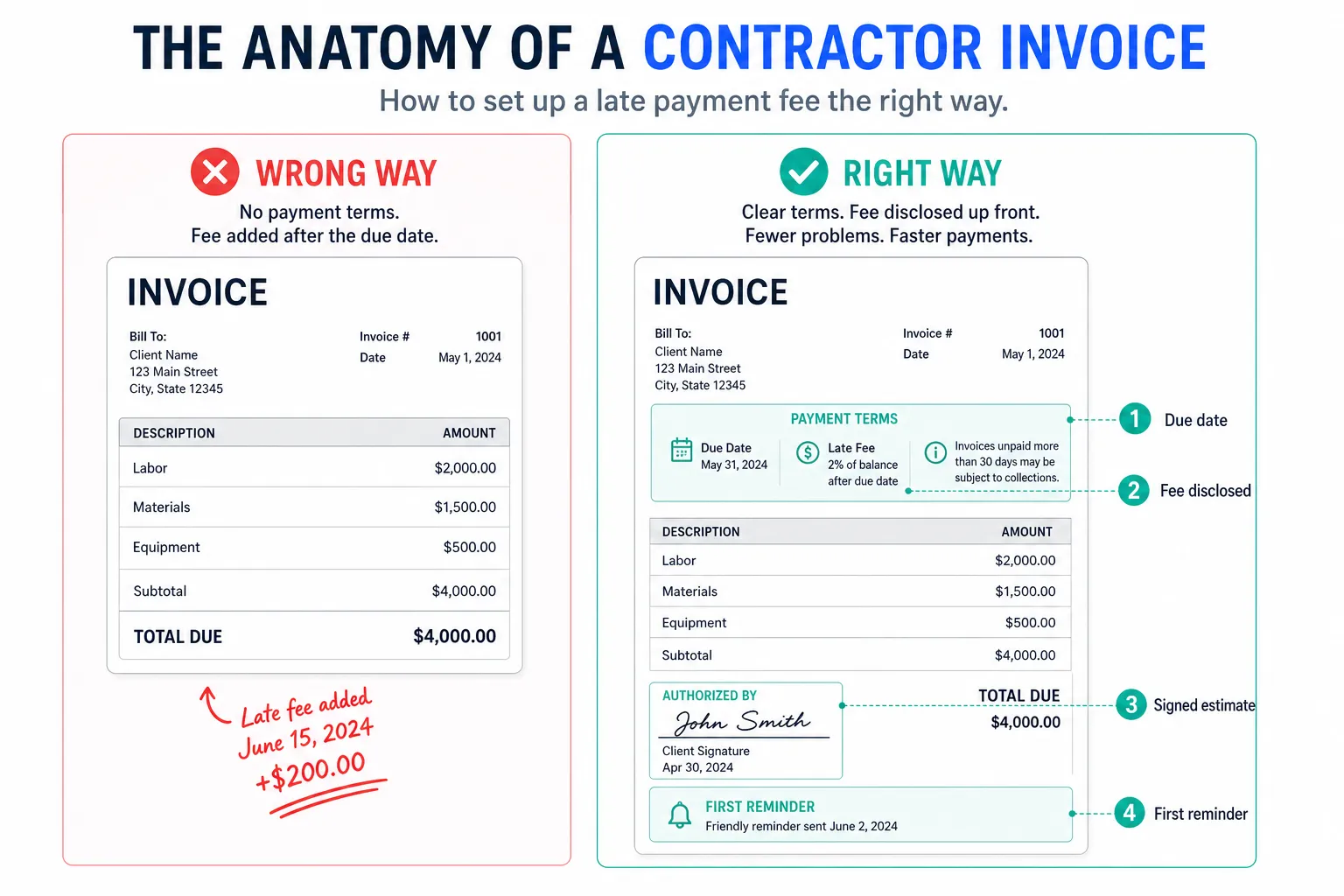
TLDR: You can charge a late payment fee, but only if your contract or invoice spells it out before the work starts. Spring it on someone after the fact and you will likely lose the argument, and the customer. Done right, it protects your cash flow and almost never costs you a good relationship.
What a Late Payment Fee Actually Is
A late payment fee, sometimes called a finance charge or interest charge, is a pre-agreed penalty that kicks in when a customer pays after the due date. It is not a punishment you invent on the spot. It is a contractual term you set upfront.
Most contractors charge it as a percentage of the outstanding balance per month. Some charge a flat fee. Both approaches work, but the method you choose has to be written down before anyone signs anything.
The fee is only enforceable if the customer agreed to it before you did the work. That agreement can live in your contract, your estimate, or the payment terms on your invoice, as long as the customer saw it and accepted it.
The Legal Side: What You Need to Know Before You Charge
This is where a lot of contractors get into trouble. Late payment fees are legal in all US states, but the rules around them vary. Some states cap the maximum interest rate you can charge. Others have specific requirements about how the terms must be disclosed.
Never assume a rate is fine just because a buddy uses it. What flies in Texas may not fly in California. If you are not sure what your state allows, ask a local attorney or your contractor's association. That is a one-time question that protects you for years.
A few things are consistent pretty much everywhere:
-
The fee must be disclosed before the job, not after.
-
The customer must have a reasonable opportunity to read and accept the terms.
-
You generally cannot charge a rate that violates your state's usury laws.
Do not pick a rate out of thin air and add it to invoices retroactively. That is the fastest way to lose in small claims court.
How to Set the Terms Without Awkward Conversations
The trick is making this a paperwork conversation, not a personal one. You are not threatening anyone. You are explaining how your business works, the same way a phone company explains its billing.
Put your payment terms on every estimate and every invoice. Something like 'Payment due within 30 days. A late payment fee of X% per month will apply to unpaid balances after that date.' Plain language, easy to find, hard to dispute.
When you send the estimate, say it out loud too. 'Hey, just so you know, I do charge a late fee on overdue invoices, it is in there on page one.' That quick heads-up removes the surprise and actually makes people take the due date more seriously.
If you want a clean, professional invoice that has a dedicated field for payment terms, put your payment terms in the invoice from the start. Formatting matters because buried terms look like traps. Visible terms look like policy.
Charging the Fee Without Blowing Up the Relationship
Most customers who pay late are not trying to stiff you. They forgot, they got busy, or they are waiting on their own cash. That context should shape how you handle the first late invoice.
A good sequence looks like this:
-
Day one after the due date: send a short, friendly reminder. No fee mentioned yet.
-
Seven to ten days late: follow up again, mention the fee is going to kick in.
-
Fifteen or more days late: send the invoice with the fee added, and explain it briefly.
The customer who gets a warning before the fee hits almost never gets angry. The customer who opens an invoice with a mystery charge added is the one who calls you screaming.
Keep the tone flat and professional. 'Per our agreement, a late payment fee has been added to this invoice. Please let me know if you have any questions.' That is it. No lecture, no guilt trip.
When to Waive It, and When Not To
You are allowed to waive a late payment fee. Good customers have bad months. A long-term relationship is worth more than one finance charge.
But waive it as a choice, not as a reflex. If you automatically remove it every time someone complains, the fee loses all meaning. Word gets around too, and you will have customers who pay late on purpose knowing you fold.
A useful rule of thumb: waive it once for a good customer, note it, and do not waive it again for that same customer in the same year. That is a policy, not a personal decision, and it is easier to explain.
Never waive the fee in a way that looks like you admitted the fee was wrong to charge. Just say 'I am removing it this time as a courtesy.' Short and firm.
My Take
My advice: set the fee, put it in writing, say it once at the start, and then enforce it calmly. That is the whole system.
Contractors who skip the fee because they are afraid of the conversation end up with the same slow payers, just with no recourse. The conversation is uncomfortable for about thirty seconds when you set the terms. The alternative is chasing an invoice for two months.
The follow-up problem is real too. Most unpaid invoices are not disputed, they are just forgotten. A consistent follow-up routine does more for your cash flow than the fee itself. The fee is the backstop. Follow-up is the main tool. If you want to see how automatic estimate and invoice follow-up works in practice, that is worth a look.
Also, make sure your invoices are clean and professional before any of this. A sloppy invoice is the first thing a slow payer uses to justify not paying. Generate a clear, complete invoice and there is nothing to hide behind.
Common Questions
Can I add a late payment fee to an invoice I already sent? Not cleanly. If the fee was not in your original terms, adding it later is hard to enforce and tends to escalate the dispute. Get it in writing before the next job.
What if the customer just refuses to pay the fee? You have a few options: negotiate it down, waive it as a one-time courtesy, or pursue it in small claims court if the amount justifies it. Most contractors do not go to court over a fee. They use it as leverage to get the base invoice paid faster.
Does the late payment fee count as taxable income? Generally yes, but tax treatment can vary depending on how your business is structured and what state you are in. Check with your accountant rather than assuming.