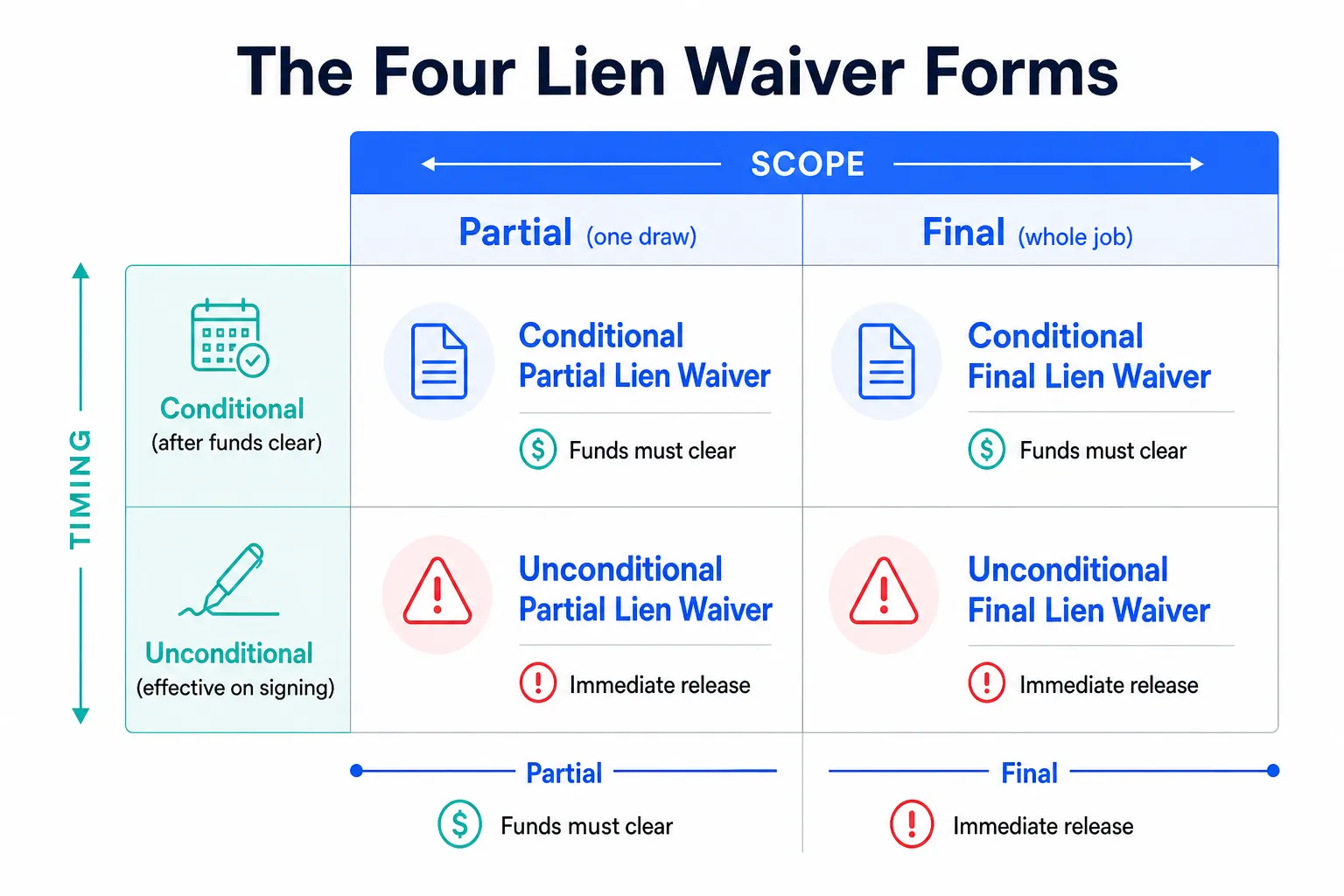
TLDR: There are four standard lien waiver forms, built from two pairs: conditional vs. unconditional, and partial vs. final. Signing the wrong one at the wrong time can wipe out your right to file a mechanics lien before you ever get paid. Here is what each type means, in plain language, so you stop guessing on the job site.
Why a lien waiver form matters more than most contractors think
A lien waiver is a legal document. When you sign it, you give up, either partly or fully, your right to place a mechanics lien on the property you worked on. That lien is your main leverage if a GC or property owner decides not to pay.
Most contractors read lien waivers the same way they read a terms-of-service agreement: they scroll to the bottom and sign. That habit has cost real people real money. The form looks routine. It gets handed over with a check or a payment request. But the language inside determines whether you still have a claim if that check bounces or the payment never comes.
Before anything else, know this: lien waiver rules vary by state. Some states have mandatory statutory forms you must use. Others leave the language to the parties. California, Texas, and a handful of others are strict about form and timing. Check your state's requirements, or ask a construction attorney, before you standardize on any template.
The two axes: conditional vs. unconditional
Think of the four types as a two-by-two grid. One axis is conditional vs. unconditional. The other is partial vs. final. Start with the first axis because it is the most important distinction you will make.
A conditional waiver takes effect only when a specific condition is met, almost always the actual receipt of payment. If the check clears, the waiver kicks in. If the check bounces, the waiver is void. You still have your lien rights intact.
An unconditional waiver takes effect the moment you sign it, regardless of whether funds have actually landed in your account. Sign an unconditional waiver before the money hits, and you have given away your lien rights for free. This is the single most common, and most painful, mistake subs and suppliers make.
The practical rule: conditional waivers are exchanged before or at the time of payment. Unconditional waivers are handed over after you have confirmed the money is real and in your account.
The second axis: partial vs. final
A partial waiver, sometimes called a progress waiver, covers a specific portion of the work, typically one draw or billing period. You are waiving rights for that slice of the job, not the whole project. These get exchanged repeatedly throughout a long job, one per payment.
A final waiver covers the entire project. It says: I have been paid in full for everything I did on this job, and I give up all lien rights for all of it. You sign this once, at the true end of the project, after every dollar has cleared.
Never sign a final waiver when you are still owed a retainage, a change order, or any disputed amount. Some owners or GCs will try to get a final waiver signed early, sometimes by slipping it in with routine paperwork. Read the header of every waiver before you put your name on it.
The four lien waiver form types, defined cleanly
Put the two axes together and you get four forms. Here is each one in plain English:
Conditional waiver on progress payment. You are releasing lien rights for a portion of the work, but only once a specific payment clears. Safe to hand over with a payment application or before a draw.
Unconditional waiver on progress payment. You are releasing lien rights for a portion of the work, effective immediately upon signing. Only sign this after you have confirmed that the corresponding payment is actually in your account.
Conditional waiver on final payment. You are releasing all lien rights for the entire project, but only once final payment clears. Appropriate to exchange at project closeout, before the last check clears.
Unconditional waiver on final payment. You are releasing all lien rights for the entire project, effective immediately. This is the last document you sign on a job, and only after every dollar, including retainage and approved change orders, has posted to your account.
Keep those four descriptions somewhere in your truck or your office. When a waiver lands in front of you, find those two words: conditional or unconditional, partial or final. Everything else follows from there.
What actually goes wrong on real jobs
The most common mistake is signing an unconditional waiver in exchange for a promise of payment instead of actual payment. A GC says the check is 'on the way.' You sign the unconditional waiver to keep things moving. The check arrives two weeks late, or short, or not at all. Your lien rights are already gone.
The second mistake is not tracking which waivers you have signed across a long job. By month four of a six-month project, it gets hard to remember which draws have conditional waivers outstanding and which have been converted to unconditional. That tracking gap creates real exposure.
A third issue: some contractors use a lien waiver form pulled from the internet that does not match their state's required language. In states with mandatory statutory forms, a non-compliant waiver may not be enforceable, which sounds like a good problem to have, but it creates confusion and disputes that slow payment down even further.
Speaking of slow payment, if you are losing track of which estimates have even been accepted before you get to the waiver stage, a tool that handles automatic estimate follow-up can cut that gap significantly. Waivers only matter on jobs you actually land.
My take
My advice: treat every lien waiver form as a one-way door. Once you walk through it, especially on an unconditional, you cannot walk back. The paperwork looks boring and bureaucratic right up until it is the only thing standing between you and a serious loss.
The habit worth building is simple: conditional waivers go out before or with payment requests, unconditional waivers go out only after you verify cleared funds. That one rule handles most of the risk.
For final waivers, slow down even more. List every open item before you sign: retainage, approved change orders, disputed extras. If anything is unresolved, get it resolved or excluded in writing before you put your signature on a final unconditional. Some attorneys recommend a written settlement agreement alongside the final waiver if there are any open disputes.
And if you are also juggling invoices on top of all this paperwork, a free voice invoice generator can at least take one task off your plate so you can focus on the documents that carry legal weight.
Lien waivers are not the most exciting part of running a contracting business. But they are the paperwork that actually protects you when a job goes sideways.
Common questions
Can I cross out language on a lien waiver before signing it? Yes, in many cases you can negotiate the language, especially on private jobs. Mark any changes clearly, initial them, and get the other party to initial them too. On public jobs or in states with statutory forms, the rules are different. Check with an attorney if you are unsure.
What happens if I sign a lien waiver and never get paid? If you signed a conditional waiver, the condition was never met, so the waiver likely did not take effect and your lien rights may be intact. If you signed an unconditional waiver, you have a much harder road. You may still have a breach of contract claim, but your mechanics lien option is likely gone. This is exactly why the conditional vs. unconditional distinction matters so much.
Do subs and suppliers need to sign the same type of waiver as the GC? Not necessarily. Each party on a job, the GC, each sub, each material supplier, holds their own lien rights and signs their own waiver for their own scope. A GC signing a final unconditional does not waive a sub's rights. Owners often collect waivers from every tier of the project at closeout, which is why subs should pay close attention to what they are signing, not just assume the GC is handling it.