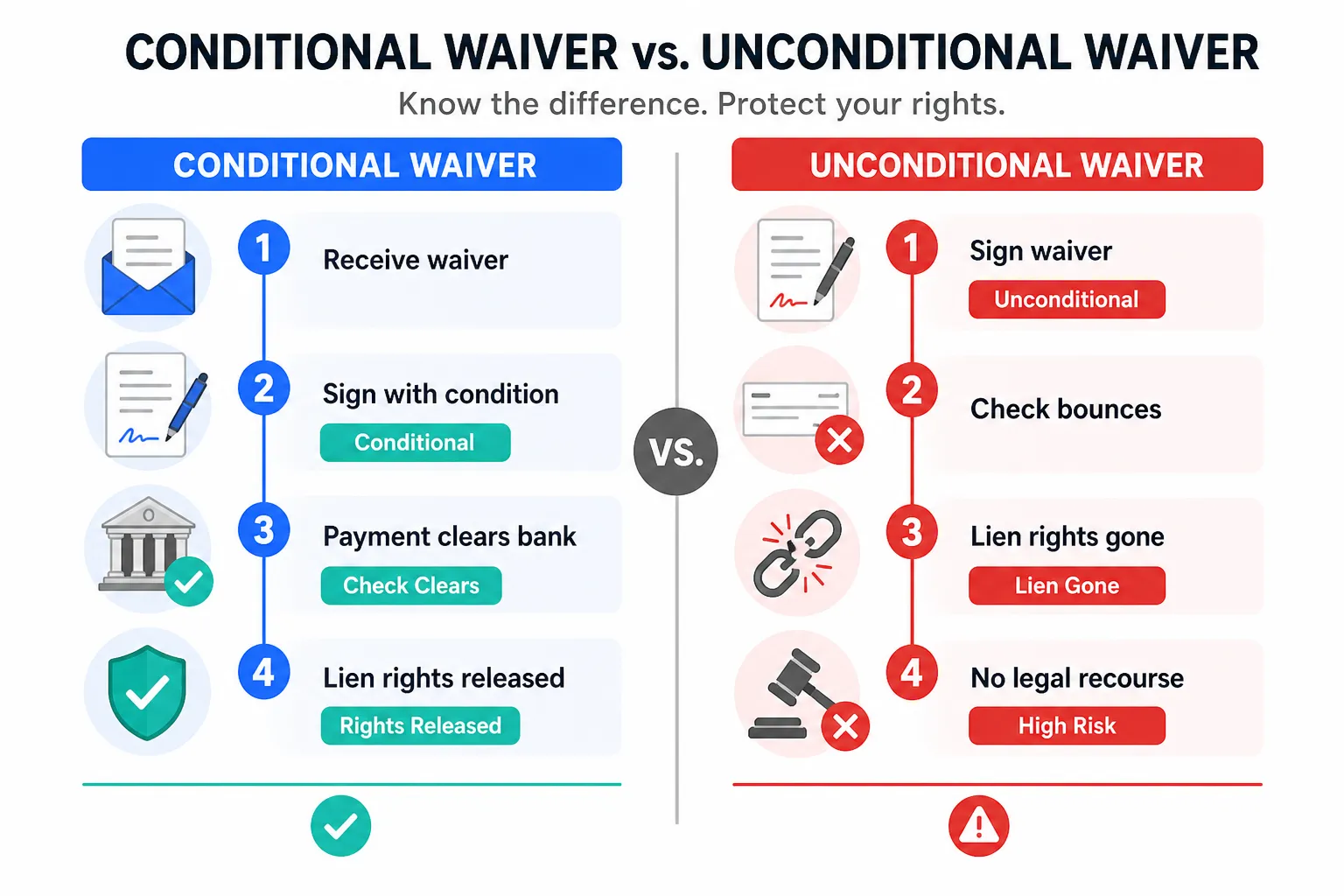
TLDR: A lien waiver is a document where you, the contractor, give up your right to file a mechanics lien against a property in exchange for payment. Sign the wrong type, or sign too early, and you may lose your only legal leverage to get paid. Here is what you need to know before you put your name on one.
What a Lien Waiver Actually Does
A mechanics lien is your legal claim against a property when you have not been paid for work or materials. It is one of the most powerful collection tools a contractor has. A lien waiver is the document that releases that claim.
When you sign a lien waiver, you are not just signing a receipt. You are giving up a legal right. The property owner or general contractor can use that document to show a title company, a lender, or a court that you no longer have a claim against the property. That is final. You cannot un-ring that bell.
The trade is simple in theory: you get paid, they get a clean title. But the problems start when the waiver is signed before the check clears, or when the waiver language covers more than the payment you actually received.
The Four Types of Lien Waivers
Most states recognize four types. Some states have mandatory statutory forms. Others let the parties use any language they agree on. That variation alone is why you should never assume a form from one job works on the next.
Here are the four types and what each one means for you:
Conditional Waiver on Progress Payment: waives your lien rights for a specific payment, but only once that payment actually clears. This is generally safe to sign before the check clears because the condition has to be met first.
Unconditional Waiver on Progress Payment: waives your lien rights for work done to a certain date, no conditions. If you sign this before the check clears and the check bounces, you are in trouble.
Conditional Waiver on Final Payment: waives all remaining lien rights once final payment clears. Reasonable if you have truly been paid in full.
Unconditional Waiver on Final Payment: waives everything, permanently, with no conditions. Never sign this until the money is in your account and has cleared. No exceptions.
The words 'conditional' and 'unconditional' are the most important words in any lien waiver. Read them before anything else.
The Classic Mistakes Contractors Make
The most common mistake is signing an unconditional waiver to get a check, then watching the check bounce. At that point, your lien rights are gone. You are left pursuing the owner in small claims or through a collections attorney, which costs time and money you probably do not have.
A close second: signing a waiver that covers more work than the payment it is tied to. A general contractor might send you a waiver worded to release all claims through the end of the project, when you are only receiving a draw for one phase. Read the dates and the dollar amounts carefully.
The waiver language and the payment amount have to match exactly. If you were paid for rough-in plumbing, the waiver should cover rough-in plumbing, not the entire scope.
Another thing people forget: your subs and suppliers have lien rights too. If they have not been paid and you sign a waiver on their behalf, you may have created a problem for yourself. Some states require you to verify that subs were paid before signing. Know your state's rules, or ask an attorney.
How State Law Changes the Rules
Lien law is almost entirely state law. There is no single federal standard. Some states, California being a well-known example, have mandatory statutory forms for lien waivers. If you do not use the correct form, the waiver may not be enforceable, or it may not be recognized by title companies.
Other states have no mandatory form at all, which means the language in the document controls everything. That is actually riskier for a contractor who is handed a form by a general contractor or owner, because that form was almost certainly written to favor the other side.
If you are working in a state you are not familiar with, do not assume the waiver forms you have always used are legally sufficient there. Deadlines to file a mechanics lien are also short in most states, and missing them wipes out your rights even without a waiver.
When in doubt, a construction attorney who knows your state is worth the hourly rate. One bad waiver can cost you far more than a consultation.
Protecting Yourself Before the Waiver Conversation Even Starts
Lien waivers come at the payment stage, but your protection starts much earlier. A clear, detailed estimate and a signed contract define the scope. That scope is what a judge or arbitrator will look at if things go wrong.
If you are still tracking estimates on a notepad or a spreadsheet, staying on top of unsigned estimates becomes harder than it needs to be. The more professional your paperwork, the more seriously owners and general contractors take your payment requests.
Follow up on unsigned estimates before they go cold. An owner who never signed off on the scope is an owner who will dispute the invoice later, and that dispute will complicate every waiver conversation that follows.
Get preliminary lien notices out early, in the states that require or allow them. That notice signals to the owner and the GC that you know your rights. It also starts the clock for certain protections in some states. Missing that window can cost you your lien rights before any waiver is even involved.
My Take
My advice: treat a lien waiver the way you treat a contract. Read every word before you sign. Match the waiver type to the payment type. Never sign unconditional anything until the money has cleared your account.
The waiver is the other party's tool. Your signature is what makes it work against you. There is no shame in telling a GC or property manager that you need 24 hours to review a document before signing. Any professional who refuses that request is a red flag.
If you are regularly chasing payments and dealing with waiver pressure, the real problem is often upstream. Unsigned estimates, unclear scopes, no contract, no preliminary notice. Fix those, and the lien waiver conversation gets a lot easier. Keeping your estimate pipeline organized is one of the simplest ways to start.
Common Questions
Can I negotiate the language in a lien waiver? Yes. A waiver is a contract, and contracts are negotiable. You can cross out language, add conditions, or propose a different form. The other party does not have to agree, but you have the right to try.
Does signing a lien waiver mean I cannot sue for payment? No. A lien waiver releases your lien rights against the property. It does not necessarily prevent you from suing the person or company who owes you money on a contract claim. Those are two different legal remedies. An attorney in your state can clarify how much overlap there is.
What if I signed a waiver and did not get paid? Talk to a construction attorney immediately. The options depend on whether the waiver was conditional or unconditional, the specific language used, and the laws of your state. In some cases there is a remedy. In others there is not. The sooner you get advice, the more options you have.