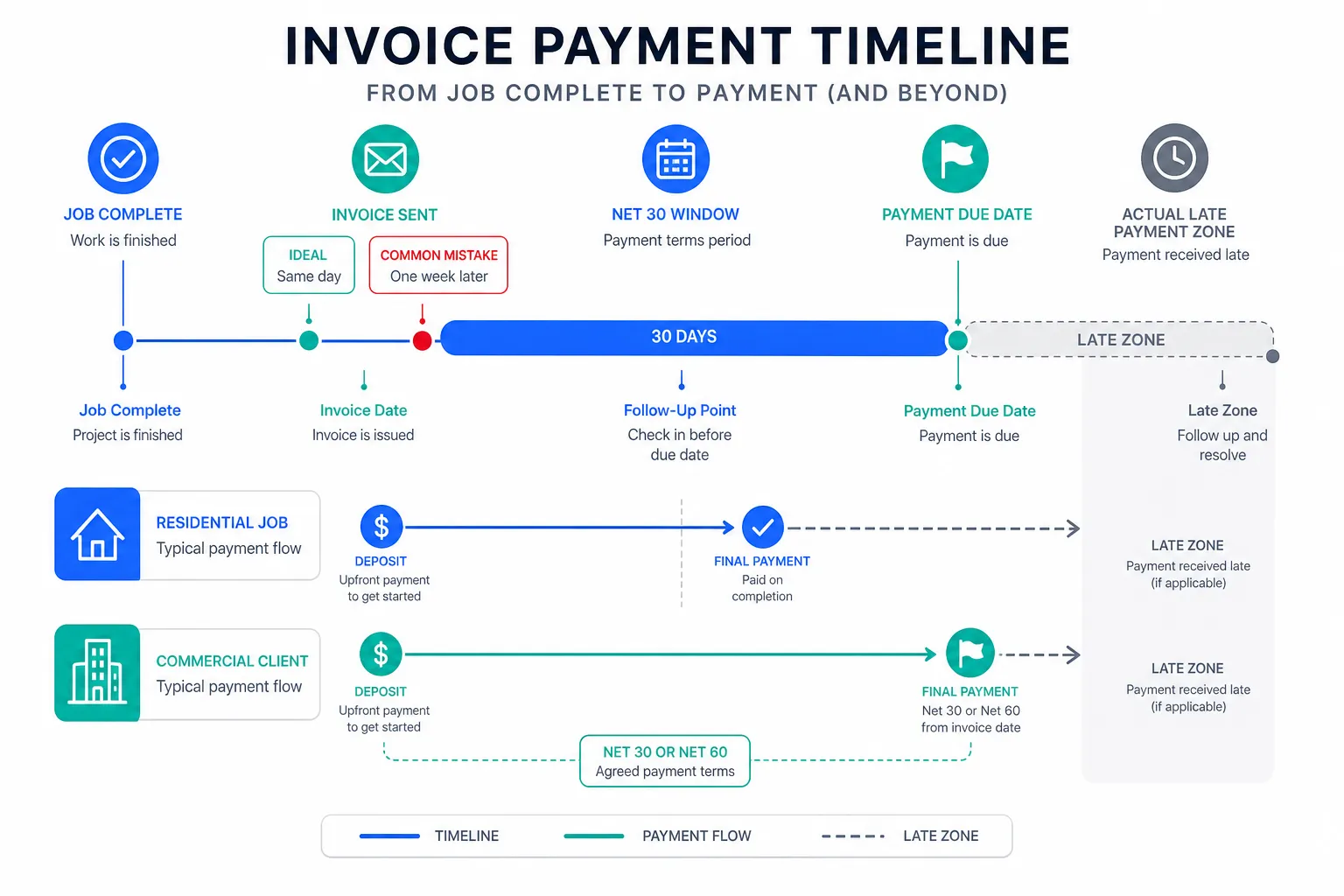
TLDR: Net 30 means your customer has 30 calendar days from the invoice date to pay you. It is a standard term, but for contractors and tradespeople running tight margins, it can quietly strangle your cash flow if you let it run on autopilot.
You finish a job on a Tuesday. You send the invoice. Then you wait. The homeowner or property manager has a whole month to write a check, and plenty of them will use every single day of it. Meanwhile, your supplier wants payment, your truck payment is due, and your guys need to get paid Friday. That gap is where net 30 payment terms cause real problems for small contracting businesses.
What Net 30 Actually Means
Net 30 is a payment term that tells your customer the full invoice balance is due within 30 days of the invoice date. Not 30 days after the work is done. Not 30 days after they open the email. Thirty days from the date printed on the invoice.
That distinction matters. If you date an invoice wrong, or send it a week late, you just pushed your payment out further with no reason to. The clock starts on the invoice date, so getting that invoice out the door fast is the first move.
You will also see variations like net 15, net 45, or net 60. Larger commercial clients and property management companies sometimes push for longer terms. Know what you are agreeing to before you start work, not after.
Some contractors write terms like '2/10 net 30.' That means the customer gets a small discount if they pay within 10 days, otherwise the full amount is due in 30. It is a way to reward fast payment. Whether it makes sense for your business depends on your margins and how badly you need cash early.
How Net 30 Payment Terms Hit Your Cash Flow
Here is the real problem. Most contractors are not operating with a fat cash cushion. You buy materials, pay labor, run equipment, and then wait on the customer to make you whole. Net 30 stretches that gap to at least a month.
And 30 days is the best case. In practice, plenty of customers pay on day 35, day 45, or later. They forget. They lose the invoice. They have their own cash flow problems. The term says 30 days, but the money often shows up later than that unless someone is actively following up.
This is where the math gets uncomfortable. You might have three or four jobs invoiced with net 30 terms at any given time. That is a significant chunk of money sitting out there doing nothing for your business. You cannot use it to take on more work, buy more materials, or cover your overhead.
Residential jobs tend to move faster than commercial. Homeowners usually pay within the terms, sometimes faster. Commercial clients, general contractors, and property managers often have their own payment cycles that have nothing to do with what your invoice says. Getting paid by a GC often means waiting for them to get paid first, regardless of your terms.
When Net 30 Makes Sense and When It Does Not
Net 30 is not always the wrong choice. For established commercial clients who pay reliably and give you steady volume, offering standard terms builds trust and keeps the relationship easy. You know they will pay, and the float is predictable enough to plan around.
For one-off residential jobs, net 30 is often too generous. A homeowner who just had their kitchen remodeled has no incentive to pay quickly unless you create one. Asking for a deposit upfront and collecting the balance on completion is a far better structure for most residential work.
Think about your actual client mix before you decide what terms to use. Ask yourself a few things.
- Is this a repeat customer with a clean payment history?
- Is this a new client I have never worked with before?
- Am I working through a GC who has their own payment timeline?
- Do I have enough cash reserves to float 30 or 60 days comfortably?
- Would this client push back if I asked for faster terms or a deposit?
The answers will tell you more than any generic advice can.
The Invoicing Mistakes That Make Net 30 Worse
Late invoicing is the most common self-inflicted wound in contracting. You finish a job on a Friday, you are exhausted, and you figure you will send the invoice Monday. Then something comes up Monday. Suddenly it is Wednesday, and you have already burned a week of your 30-day window before the clock even started.
Get the invoice out the same day the job is done, or as close to it as possible. If you use a tool to create your invoice quickly on the job site, you can send it from the truck before you pull out of the driveway. That discipline alone can recover several days of float across every job.
Other common invoicing mistakes that compound the net 30 problem.
- Sending the invoice to the wrong person or email address
- Missing a purchase order number that a commercial client requires
- Forgetting to include your payment instructions or methods accepted
- Not specifying what happens if payment is late
A clean, complete invoice with clear terms gets paid faster than a messy one, almost every time. Customers who have a reason to ask a question will use that question to delay payment. Give them nothing to ask about.
Late Payments and What You Can Actually Do
First, a note on late payment fees and interest charges. The rules on what you can legally charge, and how you must disclose it, vary by state. Some states cap interest rates on overdue invoices. Some require that the fee be stated on the invoice before the work begins. Do not assume you can just add a charge after the fact. Check the rules in your state or talk to someone who knows them.
What you can always do is follow up. This sounds obvious, but most contractors do not do it consistently. They send one invoice and then wait, feeling awkward about chasing money. The awkwardness costs them real dollars.
A simple follow-up sequence works. Send the invoice on completion. Follow up a few days before the due date with a friendly reminder. Follow up again the day it is due if it has not been paid. After that, escalate the tone. The contractors who get paid fastest are the ones who treat follow-up as part of the job, not an afterthought.
If you find yourself managing a lot of open invoices at once, automated follow-up, the kind that goes out on a schedule without you having to remember, can recover a surprising amount of money that would otherwise just sit there aging.
My Take
My advice: stop thinking of net 30 as a default you just write on every invoice. It is a business decision, and it should be made deliberately for each type of client you work with.
For residential customers, push for a deposit and final payment on completion whenever you can. Reserve net 30 for commercial clients who have earned the trust and give you enough volume to justify the wait. And no matter what terms you use, get the invoice out the same day the job closes.
The biggest cash flow leak in most small contracting businesses is not the terms themselves, it is the combination of slow invoicing and no follow-up system. Fixing those two things will do more for your bottom line than renegotiating terms with every customer.
If a commercial client insists on net 60 or longer, factor that into your price. The cost of carrying that receivable is real, and someone should be paying for it. That someone should not be you.
Common Questions
Does net 30 mean 30 business days or 30 calendar days? Calendar days, unless your invoice explicitly says business days. Most standard usage in the US means calendar days. If you want to specify business days, write it out clearly on the invoice.
Can I switch from net 30 to shorter terms for existing clients? Yes, but give them notice before the next job starts, not after you have already done the work. Changing terms mid-relationship without a conversation creates friction. A simple heads-up is enough for most clients.
What if a client just ignores the invoice past the due date? Follow up by phone, not just email. A real conversation moves things faster than another email in an inbox. If the balance is significant and the client is unresponsive, you may have options like a mechanics lien depending on your state and the type of work. Lien rules vary considerably by state, so check the specifics where you operate.