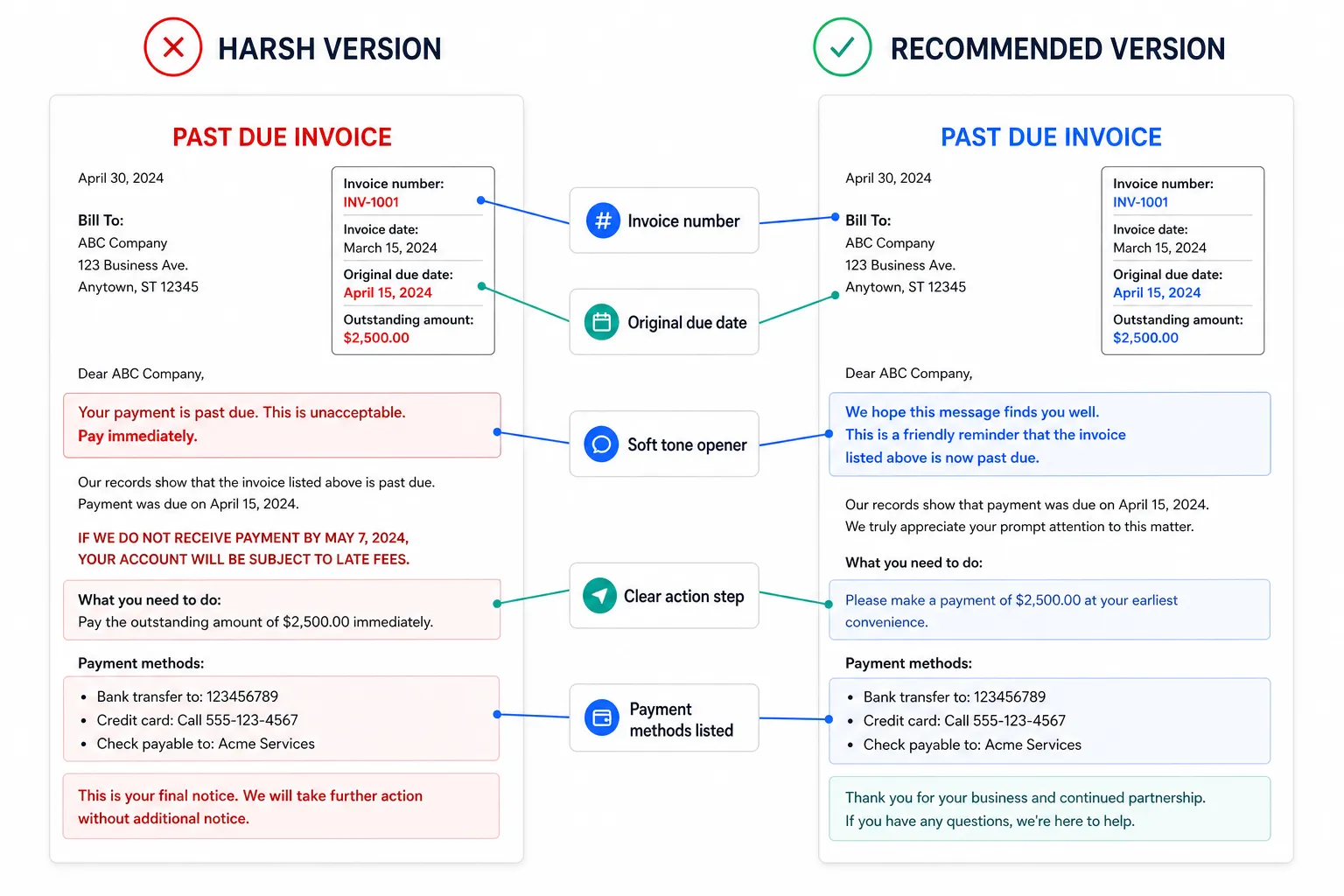
TLDR: A past due invoice letter should remind, not accuse. Keep it short, name the amount and the original due date, give one clear action step, and leave the door open. That is the whole formula. Most contractors either wait too long to send one or write something so stiff it embarrasses the customer into ignoring it. Neither works. Here is what actually does.
Why Most Past Due Invoice Letters Fail
The most common mistake is tone. The letter sounds like a collections agency wrote it, even when the customer is a good one who just got busy or lost the invoice in their inbox. That tone puts them on the defensive right away.
The letter should feel like a professional nudge from someone who expects to be paid, not a threat from someone who thinks they are being cheated. There is a big difference, and your customer will feel it immediately.
The second mistake is waiting. A week past due feels awkward to bring up. Two months past due feels like an argument. The faster you send the letter, the easier the conversation stays.
The Template Itself (Annotated)
Below is a working past due invoice letter. It is plain, direct, and warm enough to keep a repeat customer. Adjust the bracketed parts to fit your situation.
Subject: Invoice [#NUMBER] Still Outstanding, Due [ORIGINAL DUE DATE]
Hi [First Name],
I wanted to follow up on invoice [#NUMBER] for [brief description of the work, e.g., 'the kitchen remodel at Oak Street'] in the amount of [AMOUNT]. According to my records, it was due on [ORIGINAL DUE DATE].
I have not seen the payment come through yet. Could be a timing thing or it crossed in the mail. Either way, I wanted to make sure you had everything you need on your end.
You can pay by [list your accepted methods: check, ACH, credit card, etc.]. I have attached the invoice again for your convenience.
If there is a question about the work or the invoice itself, I am happy to talk it through.
Thanks, [Your Name] [Business Name] [Phone Number]
Notice what the letter does not do. It does not threaten, does not assume bad faith, and does not list every past communication. One clear ask, one action step, one soft door left open.
Adjusting the Letter for Each Stage
A letter sent a week after the due date should be lighter than one sent a month later. Think of it in rounds.
Round one (a few days to one week late): Assume it was an oversight. Keep it conversational, almost casual. The template above fits this stage perfectly.
Round two (two to four weeks late): Restate the amount, reference your earlier message, and be a little more direct about needing a response. You can add a line like 'Please let me know by Friday so we can close this out.'
Round three (over a month late): Now you mention next steps without being dramatic. Something like 'I would like to resolve this before it has to go further' signals seriousness without burning anything down. At this stage, a phone call alongside the letter often works better than the letter alone.
Do not skip straight to round three because you are frustrated. Escalate one step at a time. Most late payments resolve by round two.
Sending Channel Matters More Than Most People Think
Email is the default and usually the right move. It is documented, timestamped, and easy for the customer to forward to a spouse or bookkeeper who actually pays the bills.
Text is sometimes better for residential customers, especially homeowners you have a casual relationship with. A short text saying 'Hey, just saw invoice 47 is still open, can you check on that?' often gets a faster reply than a formal email.
For commercial customers, property managers, or general contractors, email with the invoice attached is almost always the right format. They have accounts payable departments and paper trails matter.
If you are also tracking which estimates never converted into jobs in the first place, the follow-up tools on Lienzor's home page handle that side separately from invoicing. Knowing which open estimates need a nudge is a different problem from collecting on completed work.
What to Do When the Letter Gets No Response
Silence after two rounds of follow-up is a signal, not a mystery. Pick up the phone. A real conversation clears up more than three emails ever will.
If the customer still does not respond or pay, you have a few options depending on the size of the balance. Small claims court is available in every state and is designed for exactly this situation. The dollar thresholds vary by state, so check your state's rules before assuming a balance qualifies. Some contractors also use a demand letter from an attorney, which costs money but signals that you are serious.
Mechanics lien rights are another option in many states, especially for work on real property. The process, deadlines, and eligibility rules differ significantly from state to state. If you have not filed a preliminary notice or followed the required steps in your state, you may have already lost that right. Worth looking into before the job starts, not after.
On smaller balances, you have to weigh the time and stress against the amount owed. Sometimes cutting the loss is the right business decision. That is hard to accept, but chasing a small balance for months costs you more in time than it returns.
My Take
My advice: send the first follow-up sooner than feels comfortable and keep it friendlier than feels right. The goal at that point is not to express frustration. The goal is to get paid.
Most people who ignore invoices are not trying to steal from you. They are busy, disorganized, or embarrassed they forgot. A letter that gives them an easy way to handle it quietly is more effective than one that puts them on the spot.
Also, prevent the problem on the front end. A clean, professional invoice that arrives the day the job closes gets paid faster than one that trickles in a week later. If you want a faster way to create the invoice on the spot, the free invoice generator can help you put one together before you even leave the driveway.
The past due invoice letter is just a tool. What it does is buy you a conversation, and that conversation is where the relationship either holds or breaks.
Common Questions
How long should I wait before sending a past due invoice letter? Send the first one within a week of the missed due date. The sooner you send it, the easier the tone can stay. Waiting longer does not make the conversation easier.
Should I charge a late fee? That depends on whether your original contract or invoice specified one. If it did not, adding one now creates a new dispute on top of the existing one. Going forward, spell out your late fee policy in writing before the job starts, not after.
What if the customer disputes the invoice instead of paying? Treat that as a separate conversation from the payment follow-up. Ask what specifically they are disputing, get it in writing if you can, and address it directly. A legitimate dispute handled professionally usually ends in a payment, maybe a smaller one, but a payment.