TLDR: A proforma invoice is a preliminary document that looks like an invoice but carries no legal payment obligation. It is a quote in invoice format. Send one when a customer needs a formal price preview before committing. Do not send one when you actually want to get paid, because it will not hold up the way a real invoice does.
Contractors run into this term and get confused fast. A homeowner asks for a "proforma" before signing off on a kitchen remodel. A property manager wants one for their accounting department. You are standing in a parking lot between jobs, and you have no idea if this is just another word for estimate or something different entirely. It is worth knowing the difference, because sending the wrong document at the wrong time can delay your payment or muddy your paper trail.
What a Proforma Invoice Actually Is
The word proforma comes from Latin, meaning "as a matter of form." A proforma invoice is a document formatted like an invoice, with line items, quantities, and a total, but it is not a demand for payment. It is a formal preview of what the final invoice will look like.
The key distinction is this: a proforma invoice is not recorded as accounts receivable, and the customer has no legal obligation to pay it. It is essentially a confirmed quote dressed up in invoice clothing. Some buyers need that format for internal approvals, import paperwork, or budgeting purposes. That is the whole reason the document exists.
Think of it as a handshake on paper. You are telling the customer, here is exactly what this job will cost, before any work starts and before any money is due.
When Sending a Proforma Invoice Makes Sense
There are specific situations where a proforma is the right call. Knowing them saves you from sending the wrong thing.
- A commercial client or property management company needs a formal document to get internal budget approval before signing a contract.
- You are quoting work that will cross state lines and the buyer needs documentation for logistics or compliance purposes.
- A customer is applying for financing and the lender wants to see a formal price breakdown before approving the loan.
- You are doing work for a nonprofit or government entity that requires purchase order approval before any contract can be signed.
In all of these cases, the customer is not stalling. They have a real process to follow. A proforma gives them what they need without you committing to a final number before you have fully scoped the job. If the scope changes after the proforma, you update it. No harm done.
When a Proforma Invoice Is the Wrong Document
Here is where contractors get burned. You send a proforma thinking it is professional and thorough. The customer receives it, files it, and assumes the job is not officially started. Or worse, they pay it, and now your accounting is a mess because the document was never meant to trigger payment.
Do not send a proforma invoice when you need a legally binding record of what is owed. For that, you need a real invoice. A proforma has no standing if a payment dispute ends up in small claims court. It is not a lien-qualifying document in any state. It does not start the clock on late fees or payment terms.
Also skip the proforma when you are dealing with a regular residential customer who just wants to know the price. That customer does not need a proforma. They need a clear written estimate that protects you both. Sending a proforma to a homeowner usually just creates confusion.
Proforma Invoice vs. Estimate vs. Final Invoice
These three documents do different jobs. Mixing them up is one of the most common admin mistakes small contractors make.
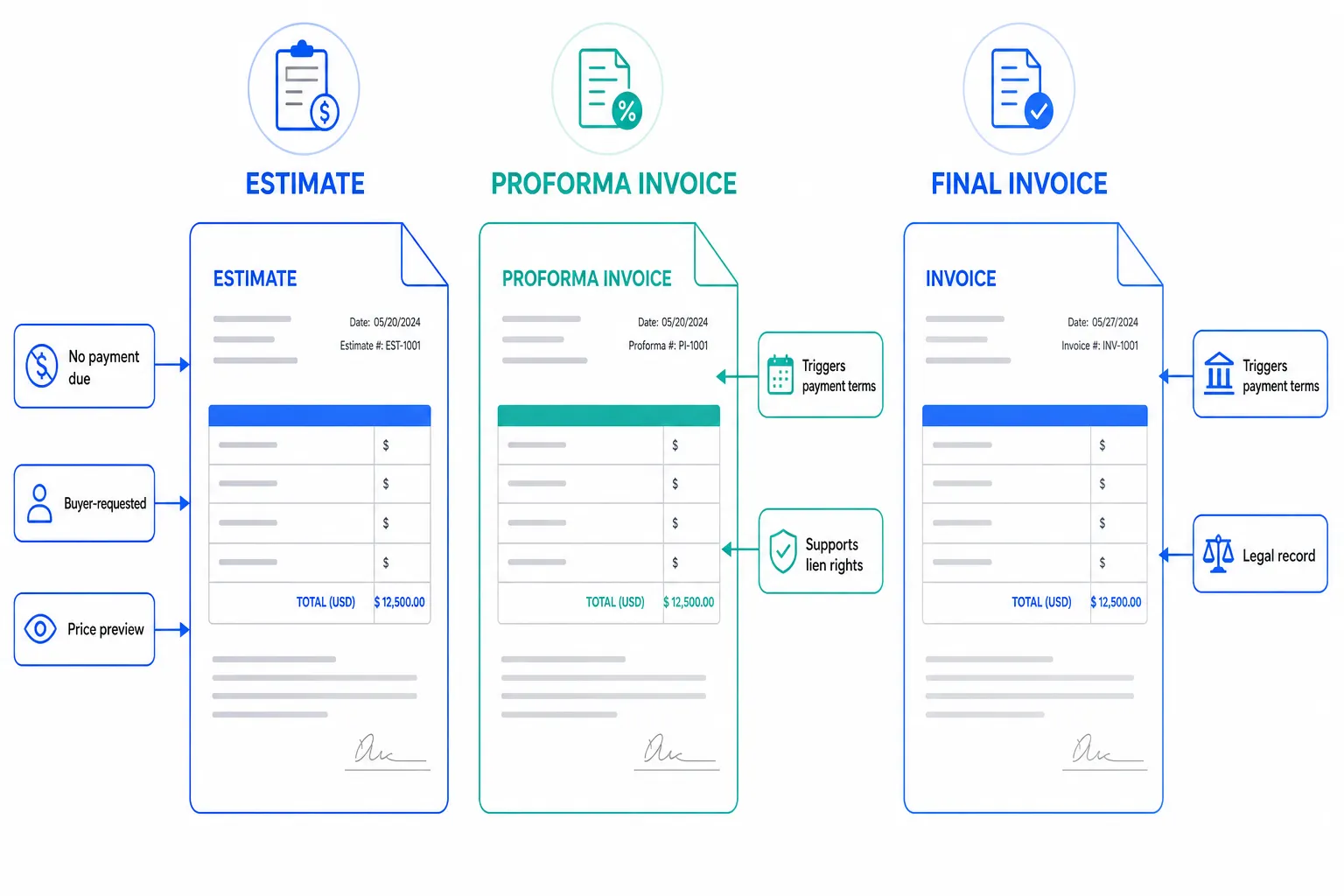
An estimate is your best projection of cost before the job. It may or may not be binding depending on how it is written and what your state's contractor licensing rules say. A proforma invoice is a more formal version of that projection, formatted to look like an invoice, usually requested by a buyer who needs it for their own process. A final invoice is the real thing. It records what was actually done, what is owed, and when payment is due.
- Estimate: early stage, may be informal, used to win the job.
- Proforma invoice: formal price preview, no payment obligation, often buyer-requested.
- Final invoice: legal record of the debt, triggers payment terms, supports lien rights where applicable.
Send them in the right order and your paper trail stays clean. Skip one or swap two and you will spend time explaining yourself to a customer or a bookkeeper.
My Take
My advice: treat the proforma invoice as a tool you pull out when a customer specifically asks for it, not as a default step in your workflow.
Most contractors do not need to send proformas regularly. A solid estimate followed by a clear contract followed by a proper final invoice covers ninety-nine percent of residential and small commercial jobs. The proforma lives in a narrower lane: commercial clients, institutional buyers, or cross-border work.
If you are generating final invoices quickly on the go, a voice-powered invoice generator can help you move from job to payment without the paperwork pile-up. The goal is always to get the right document in front of the right person at the right time, and then follow up until you get paid.
Common Questions
Can a customer pay a proforma invoice? Technically yes, but it is not designed for that. If a customer pays a proforma, record the payment carefully and issue a proper final invoice to replace it. Some industries treat a proforma payment as a deposit, but your contract should spell that out explicitly, not just the proforma document itself.
Does a proforma invoice protect me legally? No, not in any meaningful way. It is not a contract. It does not establish lien rights. It does not start a payment clock. If you need legal protection, you need a signed contract and a final invoice. Rules on contractor lien rights vary by state, so check your state's specific requirements.
What if a customer calls my estimate a proforma invoice? That happens. Some customers use the terms interchangeably. Ask what they actually need the document for. If they need it for internal approval or budgeting, a well-formatted estimate or a proforma works fine. If they are trying to avoid a binding agreement, that is a different conversation worth having before you start work.