TLDR: A referral fee agreement between contractors can be perfectly legal, or it can expose you to a license violation, depending on your state and your license type. No single federal rule governs this. Before you promise anyone a cut, you need to know your state's contractor licensing laws and, if you're in a licensed trade, your board's specific rules on fee-splitting.
Someone refers you a $40,000 kitchen remodel. You want to send them $500 as a thank-you. Simple enough, right? Not always. The moment that thank-you becomes a standing arrangement, you may be in territory your state regulates closely. And the person you're paying may have obligations you never thought about either.
Why a Referral Fee Agreement Is Not Just a Handshake Deal
Most contractors start with informal arrangements. A plumber tells a GC, "Send me jobs and I'll take care of you." That works until it doesn't. The problem is that an ongoing, repeated exchange of money for leads starts looking a lot like a business arrangement to a licensing board.
Once you put money on the table regularly, you have a contract, even without a signed document. If a dispute comes up, or if a board investigates, the absence of a written referral fee agreement often makes things worse, not better. You lose the ability to point to agreed terms, and you look disorganized on top of it.
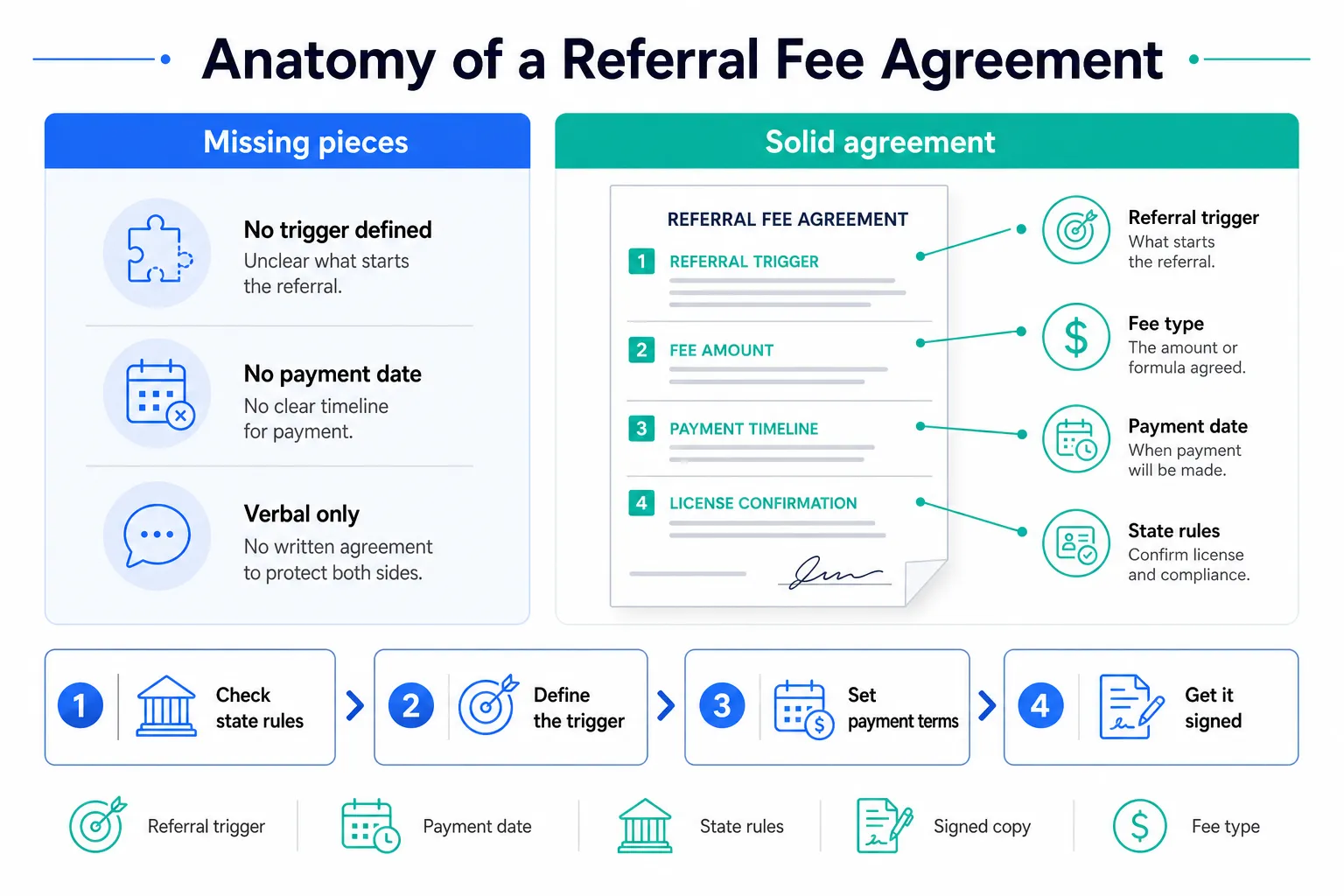
A written agreement at least forces both parties to think through the basics: what triggers the fee, when it gets paid, how disputes are handled, and what happens if the referred job falls apart after the deposit clears.
The State-by-State Problem Nobody Warns You About
Here is what trips contractors up. They assume that because referral fees are common in real estate, they must be fine in construction. That assumption is wrong in many states.
Some states restrict fee-splitting between licensed contractors and unlicensed parties. Others regulate it only in specific trades, like electrical or HVAC. A handful of states have almost no restriction at all. The variation is wide enough that advice that works in Texas may get a contractor in California disciplined.
The trades that tend to face the most scrutiny include:
- General contracting, in states with strict licensing reciprocity rules
- Roofing, which several states have tightened up after storm-chaser complaints
- HVAC and plumbing, where trade-specific boards often have their own fee-splitting language
- Home improvement contractors in states that protect homeowners through dedicated home improvement acts
Before you draft any referral fee agreement, look up your state contractor licensing board's rules, not just the general business law. The board's language is what gets you disciplined.
What a Solid Referral Fee Agreement Should Actually Cover
Assuming your state allows the arrangement, a written agreement protects both sides. Here is what belongs in it.
First, define what counts as a referral. Is it anyone who calls and mentions the referring party's name? Or only signed contracts? This one gap causes most of the arguments later.
Second, spell out the trigger for payment. Many contractors pay on contract signing, which is clean and easy to document. Others pay on final payment from the customer, which is safer for cash flow but harder to track.
Third, state the fee structure clearly. A flat amount per job, or a percentage of the contract value, both work. Percentages create more risk if a job balloons in scope, so factor that in.
A few other things worth including:
- A clause covering what happens if the customer cancels before work starts
- A confidentiality line if you don't want competitors knowing your referral sources
- A statement that both parties hold the appropriate licenses for their role
- A clear payment timeline so neither side is chasing the other
None of this needs to be a 10-page legal document, but it does need to exist in writing and be signed by both parties.
Referral Fees Versus Finder's Fees: A Distinction That Matters
You'll hear both terms used. They're not always the same thing, and the difference can matter legally.
A finder's fee typically refers to a one-time payment for making an introduction. A referral fee often implies an ongoing arrangement where someone regularly sends leads your way. Some state laws treat these differently. A single thank-you payment is far less likely to draw scrutiny than a structured, recurring arrangement that starts to look like a subcontracting relationship or a lead generation business.
If you're building an ongoing referral network, that's closer to a formal referral program than a casual handshake. The structure you put around it matters, both legally and for managing expectations between parties.
When the arrangement becomes frequent and the amounts become significant, it's worth a conversation with a lawyer who knows contractor licensing in your state. That's not overcaution. That's just how you avoid a complaint to your licensing board.
What Happens When You Get It Wrong
The worst-case scenario isn't a lawsuit from the person you paid, it's a complaint to your licensing board. A disgruntled subcontractor, a competitor, or even a homeowner who feels something was improper can file a complaint. Boards investigate. Investigations take time, create stress, and can result in conditions on your license.
Unlicensed referral arrangements, meaning money paid to someone who isn't licensed and who is doing more than just making an introduction, can cross into what some states treat as contracting without a license. That's a more serious category of violation in most places.
The contractor who receives the referral fee can also face exposure. If they're unlicensed or working in a trade that requires a specific license, the fact that they're being paid for referrals may be relevant to how a board views their overall operation.
None of this is meant to make you paranoid. Referral arrangements work well for thousands of contractors. But they work because those contractors checked the rules first.
My Take
My advice: treat a referral fee agreement the way you treat a subcontractor agreement. Write it down, keep it short, make sure both parties sign it, and check your state's rules before you promise anything out loud.
The informal system works fine until someone feels shorted. Then you're arguing over what was said in a parking lot six months ago. A one-page agreement kills that argument before it starts.
If you want to build something more structured, where people who know your work can send you business reliably, look at how a real referral program is structured. It takes the ambiguity out of the relationship and gives both sides clear expectations from day one.
The contractors who get burned by referral arrangements almost always skipped the step of checking their state's rules. Don't skip that step. It takes an hour. It can save your license.
Common Questions
Can I pay a homeowner a referral fee if they send me a neighbor? In most states, yes, a simple thank-you payment to a homeowner is not regulated the same way a contractor-to-contractor arrangement is. But if the homeowner is doing this regularly and you're paying them consistently, some states may view them as an unlicensed solicitor. Keep it truly informal and occasional if you go this route.
Does the referral fee have to be a percentage, or can it be a flat amount? Either works. A flat amount is simpler to administer and easier to put in writing. A percentage ties the fee to job size, which can feel fairer on big jobs but creates complications if the scope changes after signing. Pick whichever you can track cleanly.
Do I need a lawyer to write a referral fee agreement? Not necessarily for a simple arrangement between two contractors. A plain-language written agreement that both parties sign covers most situations. Where you do want a lawyer is when the amounts are significant, the relationship is ongoing, or you're unsure whether your state's licensing rules allow the arrangement at all. That's worth an hour of legal time before you commit.