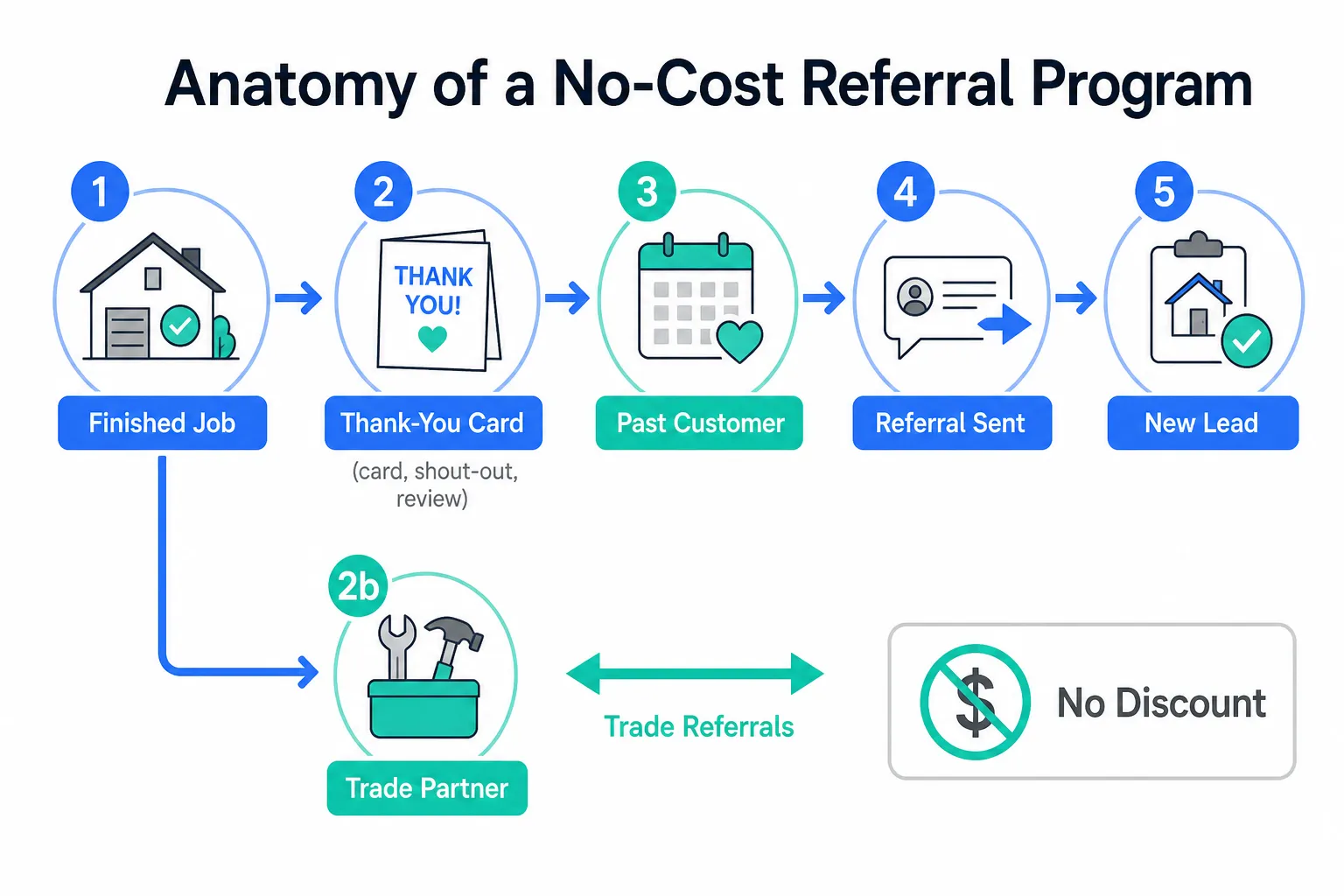
TLDR: You can run a referral program without giving away cash or cutting your prices. The best referral program ideas for contractors trade on things you already have, your time, your name, your network, and your goodwill. Here is how to build one that actually works.
Every contractor has heard the advice: 'Just ask for referrals.' Great. But ask how? With what incentive? And what do you do when someone sends you a job and you want to say thank you without it eating into your margin? That is the real question, and it deserves a real answer.
Why Most Referral Program Ideas Fall Apart
The classic mistake is promising cash. You tell a past customer you will give them $100 for every referral. They nod. Then they forget. Or they send you one lead that goes nowhere, feel awkward about asking for the money, and the whole thing quietly dies.
Cash feels transactional to the person sending you the referral. It also feels transactional to the new prospect. Nobody wants to feel like a commission check walking through your door.
The referral programs that actually stick are built on recognition and reciprocity, not payouts. Recognition means the referring customer feels seen and valued. Reciprocity means you give something back that money cannot easily replace.
Referral Program Ideas That Cost You Nothing Upfront
Start with the easiest wins. These cost you no margin at all.
Give public recognition. If a customer sends you a job, mention them by name when you post the finished work on your social pages. Something like: 'Thanks to the Hendersons for trusting us and for sending us the Martinez family.' Most people love a genuine shout-out. It costs you nothing and it signals to everyone watching that you treat your customers well.
Write them a Google review in return. If you used a supplier they recommended, or if they run their own small business, leave them a thoughtful review. You know better than anyone how much a good Google review means. Giving one is a genuinely valuable gift.
Send a handwritten card. It takes three minutes. Almost nobody does it anymore. A short note saying you appreciated the introduction lands differently than a text. Keep a stack of cards in your truck.
Low-Cost Ideas That Still Protect Your Margin
Some referral program ideas do involve a cost, but they do not have to shrink your take-home.
Think in terms of perceived value, not actual cost. A $30 gift card to a local restaurant feels personal. It is not a discount on your invoice. You are not touching your labor rate or your materials margin. The gift sits outside the job entirely.
Give something tied to the job, not the invoice. A small plant for the backyard after a landscaping job. A nice hand towel set after a bathroom remodel. Something that connects to the work you did. It doubles as a reminder of the project every time they see it.
Other low-cost options worth trying:
-
Priority scheduling: tell your best referrers that when they call, you fit them in first. That is genuinely valuable in markets where good trades are booked out. And it costs you nothing unless you are at full capacity.
-
A referral lunch: if a property manager sends you four or five jobs a year, take them to lunch once. One lunch is cheaper than any discount you would have had to give to win those jobs cold.
-
Early access to your calendar: give your top referrers a number they can text directly. They skip the intake form. That kind of access feels exclusive and it is.
How to Actually Ask Without It Being Awkward
The timing matters more than the script. The best moment to ask for a referral is right after the customer has said something positive. They tell you the floor looks great. They say their neighbor asked who did the roof. That is your opening.
You do not need a long speech. 'If you know anyone else who needs this kind of work, I would really appreciate the introduction. I take good care of the people you send my way.' That is enough.
Following up on past customers is where most contractors leave money on the table. Someone you worked for two or three years ago has probably moved, renovated again, or knows someone who needs exactly what you do. They already trust you. They just forgot to call. A simple check-in message, not a sales pitch, just a hello and a reminder you are still around, brings a surprising number of jobs back.
If you want a structured way to stay in front of past customers without doing it manually, the follow-up tools in Lienzor's referral program handle that piece for you.
Who Should Be in Your Referral Network (It Is Not Just Customers)
Past customers are the obvious source. But the contractors who build the strongest pipelines think broader.
Adjacent trades are huge. If you do HVAC, you want to know every plumber, electrician and insulation contractor in your area. You send each other work. Nobody pays a referral fee. The reciprocity is built into the relationship over time. Same idea for real estate agents, property managers, insurance adjusters, and interior designers. These people talk to homeowners constantly.
Your material suppliers sometimes know who is building what before you do. A lumber yard rep, a tile distributor, a plumbing supply counter person. Be the contractor they think of first when a customer asks for a recommendation.
Build relationships with two or three people in each adjacent category and treat those relationships like any other business asset. Check in, send them something when you finish a job they referred, and return the favor when you can.
My Take
My advice: stop thinking about referral programs as a financial instrument and start thinking about them as a reputation system.
The contractors I see doing this well are not running spreadsheets tracking referral fees. They are just genuinely good at staying in touch, saying thank you in a way that feels real, and being easy to refer because their work is clean and they communicate well.
A referral program that costs you margin is a sign the rest of your process has a gap. If your estimates are not converting, if past customers are not hearing from you, if your online reviews are thin, fix those things first. A referral incentive layered on top of a broken process just costs you money for nothing.
If your follow-up process is the gap, looking into how automatic follow-up works for estimates and past customers is worth a few minutes of your time.
Common Questions
Do I have to register a referral program with my state? It depends on the structure and your state. A simple thank-you gift to a past customer is generally not regulated. But if you are offering recurring commissions or working with licensed real estate professionals, rules can get more specific. When in doubt, ask your accountant or a local attorney. Rules vary by state and by profession.
What if someone sends me a bad lead? Thank them anyway. A referral that does not close is still a signal that someone thought of you. You do not owe a reward for a lead that does not pan out, just for the ones that turn into paying jobs. Make that clear from the start so there is no awkwardness.
How do I track who referred who without a complicated system? Ask every new customer directly: 'How did you hear about us?' Write it down. A simple spreadsheet or a note in your job file is enough when you are starting out. Once you are getting enough referrals that tracking becomes a job in itself, that is a good problem to have and a good time to automate it.