TLDR: A final invoice is the last billing document you send when a job is complete. Get the line items right, send it the same day you finish, and follow up fast. Most unpaid contractor invoices are not disputes. They are just forgotten.
What a Final Invoice Actually Is
A final invoice closes the financial loop on a job. It is different from a deposit request, a progress billing, or a change order. It says: the work is done, here is the total, here is what you still owe me.
Some contractors confuse a final invoice with a statement or a receipt. A statement lists a history of charges. A receipt confirms payment already received. A final invoice is a demand for money not yet paid. The distinction matters when a customer tries to claim they already settled up.
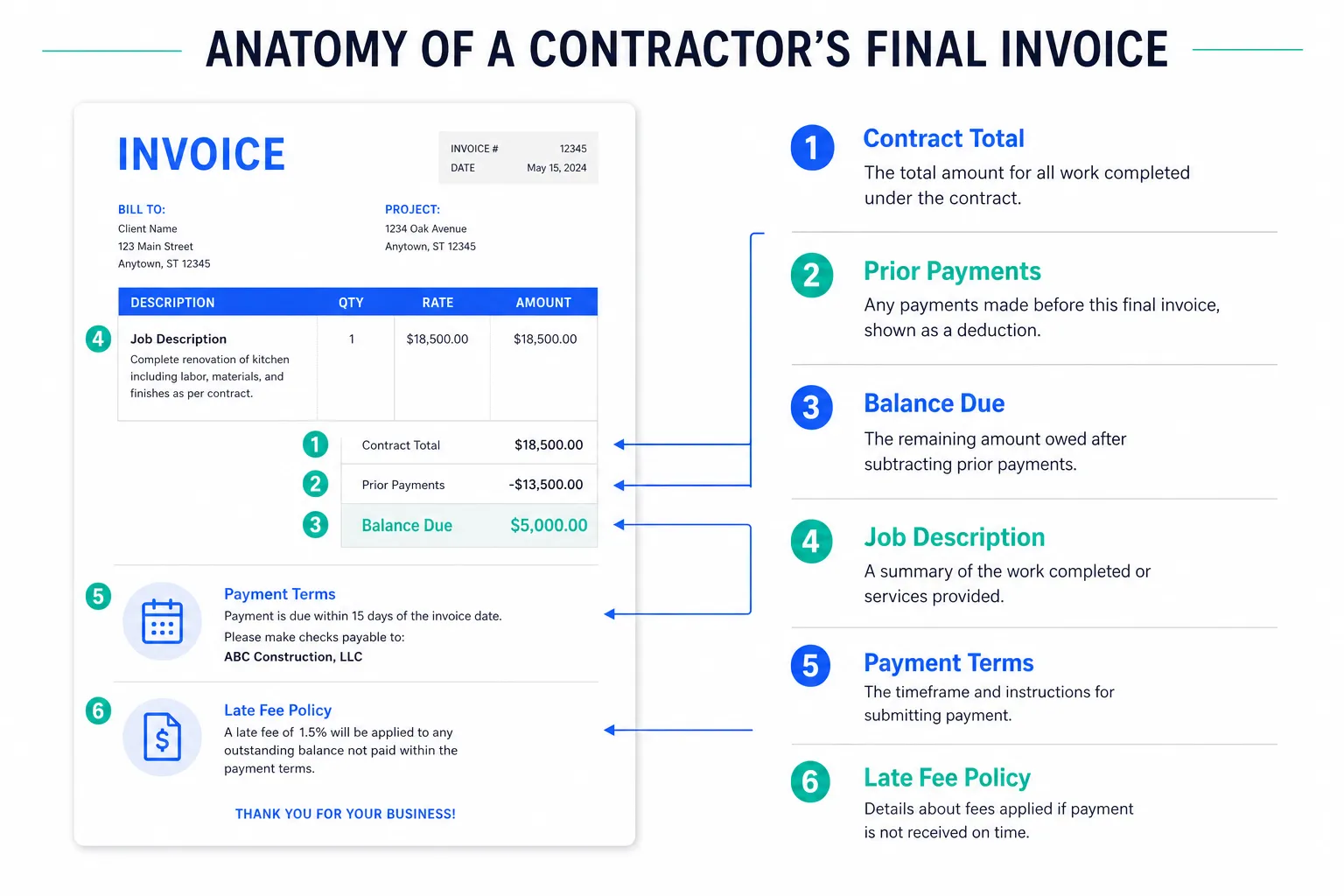
If you collected a deposit or billed progress payments, your final invoice should clearly show the original contract total, every amount already paid, and the remaining balance. Nothing creates more friction than a customer who opens an invoice and has no idea how you arrived at that number.
What to Include on Every Final Invoice
A lot of contractors write invoices the way they write text messages. Short, fast, missing half the information. That works fine until someone disputes the charge or you need to file a lien.
Here is what belongs on every final invoice:
- Your business name, address, and license number if your state requires it on billing documents (requirements vary by state and trade).
- The customer's full name and the service address, not just their phone number.
- A clear job description. 'Labor and materials, kitchen remodel' is not enough. List what you did.
- Itemized costs for labor, materials, and any subcontractor work.
- The contract total, prior payments received, and the balance due.
- Your payment terms. Net 15, net 30, whatever you agreed on, write it on the invoice.
- Accepted payment methods. Do not make them guess.
- Your late fee policy, if you have one.
That last point is worth slowing down on. If your late fee policy is not written on the invoice, enforcing it later is a very hard conversation. Put it there from the start.
The Timing Mistake Most Contractors Make
You finish the job on a Friday afternoon. You are tired. You have another site starting Monday. The invoice can wait until next week.
That is how a two-week job turns into a two-month collection problem.
Send the final invoice the same day the job wraps. Or the morning after at the absolute latest. The customer is still in the mindset of the project. The work is fresh. They saw you and your crew there that morning. The longer you wait, the more the memory fades and the easier it is for payment to slip down their priority list.
If you are on the job site and do not have a computer nearby, you still have no excuse. A voice invoice tool lets you dictate the line items out loud and turn them into a formatted invoice on the spot. That is exactly the kind of thing the free voice invoice generator at Lienzor was built for.
How Final Invoices Interact With Lien Rights
This is the section most contractors skip. Do not skip it.
In most states, your right to file a mechanics lien is tied to deadlines that start running when the job is substantially complete, when you last provided labor or materials, or when your final invoice is sent. The exact trigger and the length of the window vary by state. Some windows are short. Miss them and you lose the right to lien entirely.
A well-documented final invoice is not just about getting paid this week. It is also your paper trail if you ever need to enforce your lien rights. The invoice date, the job address, the scope of work, and the amount owed are exactly what a lien filing requires.
Keep a copy of every final invoice with proof of delivery, whether that is a read receipt on an email or a text confirming the customer received it. If you send it and they claim they never got it, you want something to point to.
Lien laws vary significantly from state to state. If you are unsure about the rules in your state, talk to a construction attorney or your trade association before a dispute comes up, not after.
What to Do When the Final Invoice Goes Unanswered
You sent it. A week goes by. Nothing.
Most contractors either do nothing or go straight to an angry phone call. Neither works well. A short, professional follow-up message sent within a few days of the due date is usually enough to get a response. Not a reminder that sounds like a threat. Just a nudge.
If you still hear nothing, keep the paper trail moving. Send a second follow-up referencing the original invoice date and the amount due. Note everything: when you sent the invoice, when you followed up, what the customer said.
The contractors who collect most reliably are not the most aggressive. They are the most consistent. A follow-up that goes out automatically two days after a missed due date is more effective than a phone call you make three weeks later when you finally notice the invoice aged out.
You can handle invoice follow-up without chasing customers manually once you have a system in place. The goal is to never let an invoice sit in silence for more than a few days.
My Take
My advice: treat the final invoice as part of the job, not the paperwork after the job.
The contractors who struggle to collect are almost always the ones who do the work, disappear for a week, then send a vague invoice with no itemization, no payment terms, and no follow-up plan. Then they are surprised when the customer drags their feet.
Send a clean, detailed invoice the day the work is done, follow up on a schedule, and know your lien deadlines before you ever need them. That combination closes more jobs clean than any other habit I have seen.
Common Questions
Can I charge a late fee if I did not mention it in the original contract? It depends on the state and sometimes the amount. In general, late fees are much easier to enforce when they are spelled out in writing before the job starts, in the contract and on the invoice itself. Adding one after the fact is a harder argument to make.
How long should I wait before sending a final invoice to collections? There is no universal rule. Many contractors wait 60 to 90 days past the due date. Before you send anything to collections, exhaust your lien rights if you still have them. A lien is often a faster and cheaper path than a collection agency.
Does a final invoice need to be different from a regular invoice? Not in terms of format. But it should clearly indicate that it is the final billing for the project, show prior payments already applied, and display the remaining balance. That clarity prevents the most common payment disputes.