TLDR: Most unpaid invoices get resolved before any legal step, if you follow a clear sequence. Send the right message at the right time, document everything, and know when to stop being polite. Skip a step and you either lose money or burn a customer you could have kept.
You finished the job. You sent the invoice. Nothing came back except silence. That feeling is one of the worst parts of running a contracting business, and it happens to almost everyone at some point. The good news is that most of these situations are recoverable if you move through them in the right order.
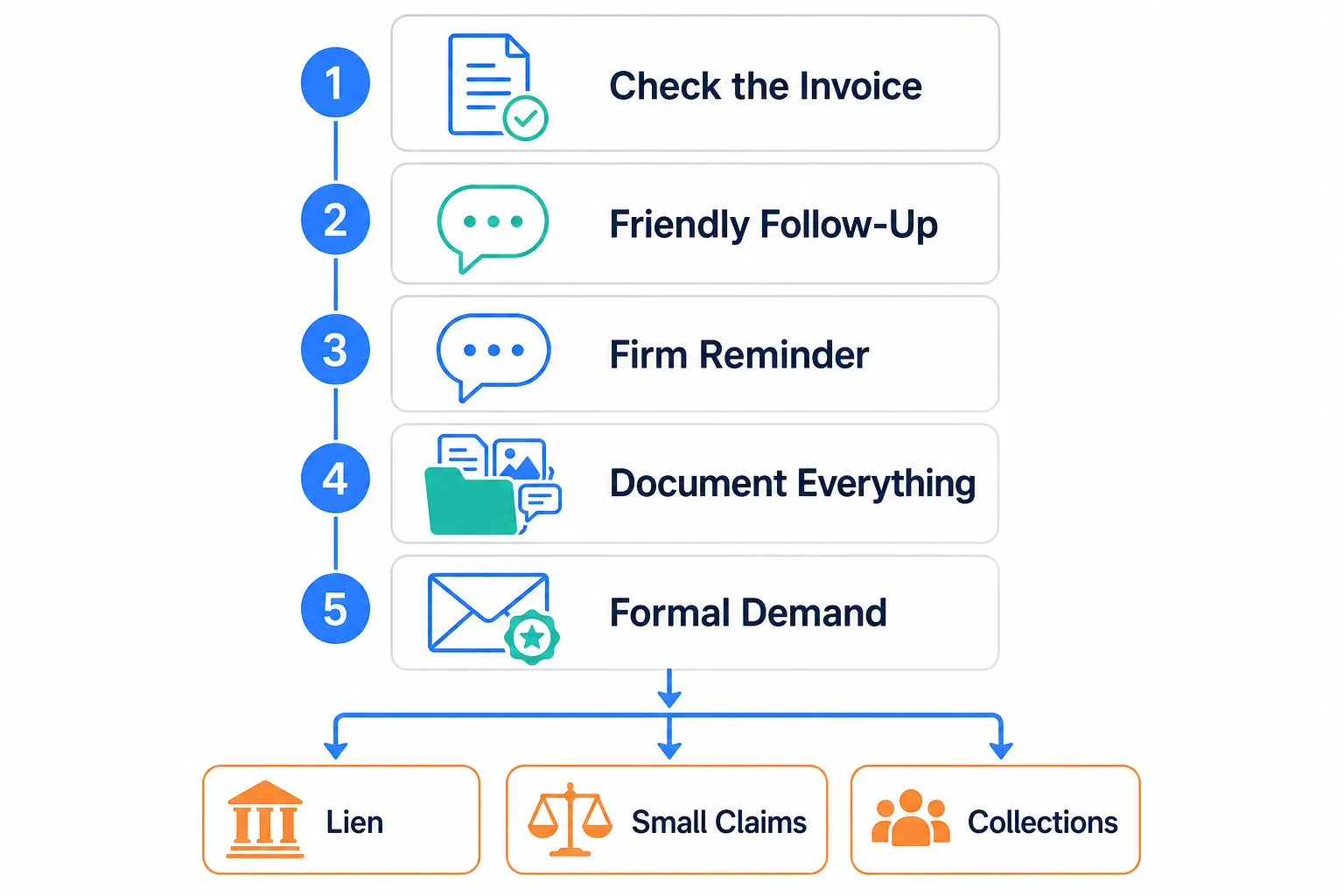
Start With the Invoice Itself
Before anything else, look at what you actually sent. A lot of unpaid invoice problems start with a document that was vague, went to the wrong email, or listed the wrong amount. It sounds basic, but when you're running a crew and jumping between job sites, it's easy to fire off an invoice at 9pm from your truck and not double-check it.
If your invoice doesn't clearly state the work performed, the total due, the due date, and your payment instructions, you've given the customer an easy excuse to stall. Go back and confirm the invoice was received. A quick text works. 'Hey, just checking you got my invoice, let me know if anything looks off.' That one message has resolved more slow-pays than any formal letter.
If you're still building out your paperwork process, a clean starting point matters. A structured document from a tool like the free voice invoice generator removes a lot of the common gaps that give customers room to dispute.
The First Follow-Up: Friendly, Fast, and Written
Once the due date passes, don't wait. The longer you wait, the more the customer assumes you're not tracking it. A short, professional message within a day or two of the missed due date is the right move.
Keep the tone neutral. Something like: 'Hi, I noticed your invoice from [job description] is now past due. Please let me know if you have any questions or if payment is on its way.' That's it. Written contact, even a text, starts building the paper trail you'll need if this escalates later.
Don't rely on a phone call alone at this stage. Calls don't leave a record. If they say 'I'll send it this week,' follow up that call with a short text or email confirming what was said. One sentence is enough. You're building a timeline.
The Second Follow-Up: Firmer, Still Professional
If a week goes by with no payment and no real response, it's time to be direct. This is where a lot of contractors go soft because they don't want to damage the relationship. But here's the thing: the customer already damaged it by not paying.
Your second message should acknowledge any previous contact and state clearly that the invoice is overdue. Name the amount. Name the original due date. Ask for a specific response by a specific day. Vague requests get vague results.
This is also the time to figure out if there's a real dispute or just avoidance. Sometimes a customer is holding payment because of a misunderstanding about the scope of work. Get that out in the open now, in writing. If there's a legitimate disagreement, address it head-on. If it's pure avoidance, that will become clear too, and that changes what you do next.
Document Everything Before You Go Further
If you're heading toward a formal demand, small claims court, or a mechanic's lien, your documentation is everything. Courts and collection processes care about what you can prove, not what you remember.
Pull together your signed estimate or contract, any change orders, photos of the completed work, and every written message between you and the customer. Note the dates. If there were verbal agreements that matter, write down what was said and when, even just for your own records.
Missing documentation is the number one reason contractors lose cases they should have won. A lot of pros skip the written estimate or skip getting a signature on a change order because the customer seems trustworthy. That's the classic mistake. The customers who seem the most trustworthy are sometimes the ones who are hardest to collect from later.
If your estimate process has gaps, that's worth fixing before the next job. Consistent follow-up from the estimate stage actually prevents a lot of unpaid invoice situations downstream. Tools that help you stay on top of estimates automatically reduce the number of jobs that start without clear expectations.
The Formal Demand Letter
If friendly follow-ups don't work, a formal written demand is the next step. This is a short letter, sent by email and ideally also by certified mail, that states the amount owed, the original due date, and a final deadline for payment before you take further action.
You don't need a lawyer to write a demand letter. You do need to be clear and factual. State what you did, what you invoiced, and what you're still owed. Do not make threats you won't follow through on. If you say you'll file a lien or take them to small claims court, be prepared to actually do it.
The demand letter works because it signals that you are serious and organized, which many customers did not expect. Some people test contractors to see if they'll just give up. A formal letter changes that calculation.
Knowing Your Options: Liens, Small Claims, and Collections
Once you've gone through the steps above with no result, you have a few paths. Each one has tradeoffs.
Mechanic's liens are available to contractors and subs in most states, but the rules vary significantly by state. Deadlines are usually short, the paperwork requirements differ, and filing in the wrong way can invalidate the lien. If you're considering this route, look up your specific state's rules or talk to a construction attorney. Do not assume what works in one state works in another.
Small claims court is a real option for lower-dollar amounts. Limits vary by state, so check what applies where you work. The process is generally designed to be accessible without a lawyer, and a judgment in your favor can sometimes be collected through wage garnishment or bank levies, though collecting on a judgment has its own challenges.
Third-party collections is a last resort. You'll recover less than the full amount and give up control of the process. Some contractors use it. Many don't bother unless the dollar amount justifies it.
Whatever path you choose, the clean documentation you built in earlier steps is what makes any of these options viable. Skip the paperwork, and all three paths get harder.
My Take
My advice: move fast and stay in writing from day one. The contractors who collect are the ones who treat follow-up like part of the job, not an afterthought. Waiting two or three weeks to send a first follow-up is the single most common mistake I see.
The emotional part is real. Nobody likes chasing money. But every day you wait, the customer gets more comfortable not paying, and your leverage gets smaller. The formal steps, liens, courts, collections, exist for a reason. Know them. But most of the time, a fast, consistent, documented sequence gets the money before you ever need them.
Getting paid starts before the invoice, at the estimate stage, where expectations get set and a paper trail begins. The whole process is a chain. A weak link early on makes everything downstream harder.
Common Questions
How long should I wait before following up on an unpaid invoice? Don't wait more than a day or two after the due date passes. Waiting a week or more sends the signal that you're not tracking it closely.
Do I need a lawyer to send a demand letter? No. A clear, factual letter you write yourself is usually enough at this stage. If the situation moves toward a lien or litigation, getting legal advice for your specific state makes sense.
What if the customer claims the work was bad? Get the dispute in writing immediately. Ask them to be specific about what they say is wrong. If the complaint is valid, address it. If it's not, having their claim in writing actually helps you, because it shows a court or mediator exactly what was said and when.