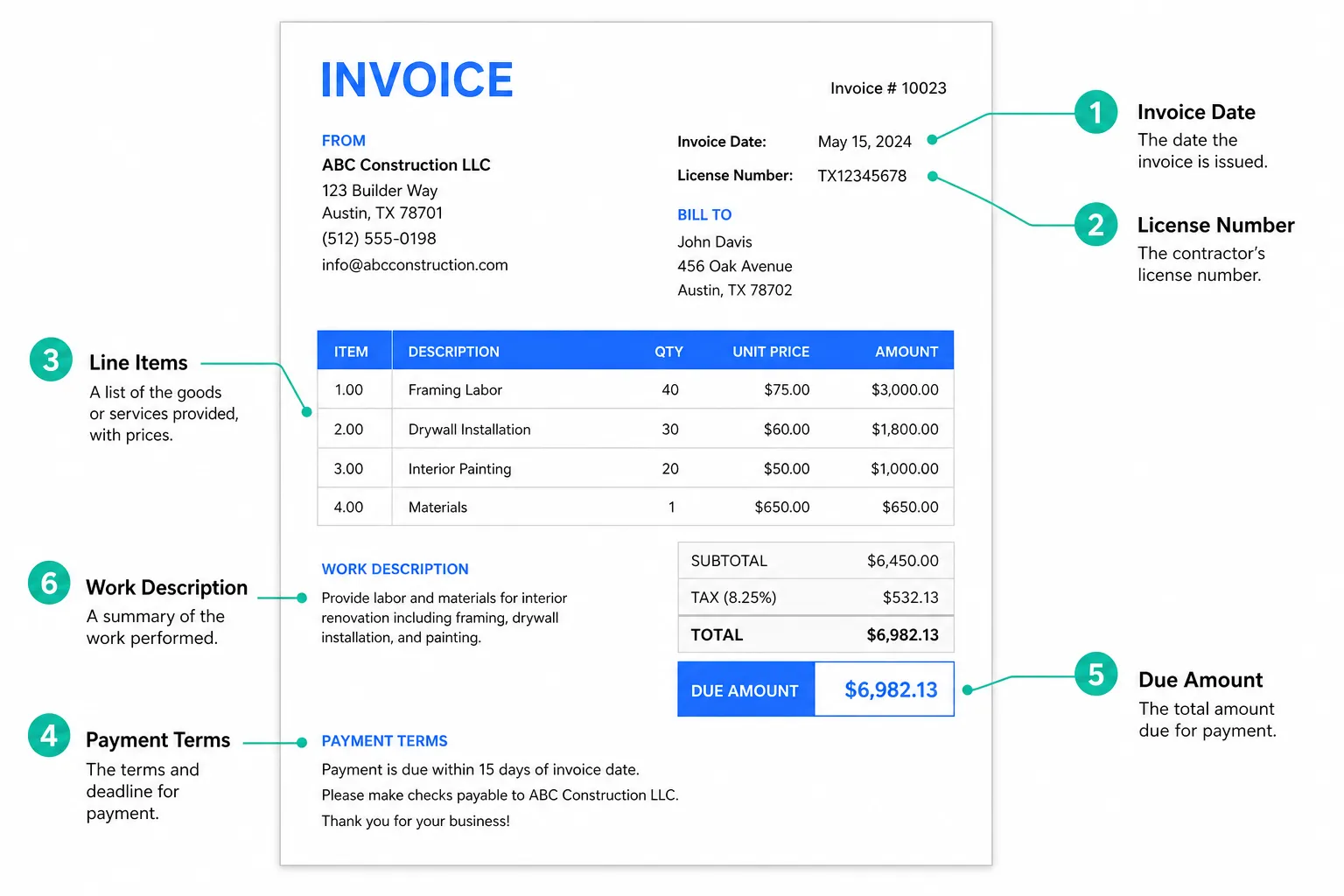
TLDR: An invoice is a written payment request you send after the work is done or at an agreed milestone. It records what was delivered, the amount owed, and the payment terms. For contractors, it is also your primary paper trail if a dispute ever lands in small claims court.
Most tradespeople learn invoicing by copying someone else's format, or by using whatever their accounting app spits out by default. That works until it does not. A missing line item, the wrong date, or a vague description can delay payment by weeks. This guide walks through what is an invoice, what every field means, and what actually matters when you are running jobs and chasing money.
What an Invoice Actually Is (and Is Not)
An invoice is a formal request for payment. You issue it. The customer owes it. That is the whole relationship in one sentence.
It is not a contract. The contract (or your signed estimate) is what both parties agreed to before the work started. The invoice refers back to that agreement and says, essentially, 'We did what we said. Please pay.'
The invoice is the document that starts the payment clock. Until you send it, most payment terms have not technically begun. That matters when you are thinking about late fees or your right to file a mechanics lien, which in most states has deadlines tied to when work was completed or when payment was requested.
It is also different from a receipt. A receipt confirms money was received. An invoice says money is owed. Two different moments in the same transaction.
Every Field on a Contractor Invoice, Explained
Here is what a proper contractor invoice contains, and why each piece exists.
- Invoice number: A unique identifier you assign. Keeps your records clean and makes it easy to reference in emails or court filings.
- Invoice date: The date you issued it. This is when most payment terms start running.
- Your business name and contact info: Name, address, phone, email. Some states require your contractor license number here too. Check your state's licensing board requirements.
- Customer name and billing address: The legal name of who owes you money. For a business, get the legal entity name, not just a first name.
- Description of work: What you did, where, and when. Vague descriptions like 'labor and materials' cause disputes. Be specific.
- Line items with unit costs: Break out labor, materials, and subcontractor work separately when you can. It builds trust and reduces questions.
- Subtotal, taxes, and total due: Sales tax on materials varies by state. Some states tax labor in certain trades. Do not guess. Talk to your accountant.
- Payment terms: Net 15, Net 30, due on receipt. Whatever you agreed to upfront.
- Payment methods accepted: Check, ACH, credit card, Zelle. Tell them how to pay you.
A missing customer address or a vague work description are the two things most likely to delay your check. Homeowners use both as excuses to stall.
Invoice vs. Estimate: The Difference Matters
An estimate is a price proposal before the work. An invoice is a payment demand after. Mixing them up creates real problems.
If you hand a customer something labeled 'estimate' after the job is done, they may treat it as negotiable. It is not. You have already done the work. Send a document that clearly says 'Invoice' at the top, with a due date, not a price quote.
The estimate is where you build the scope, present options, and get approval. If you want to tighten up that side of the process, building estimates by voice can save serious time between one job and the next.
Once the estimate is approved and the work is complete, the invoice should match it almost exactly, except for any documented change orders. If the numbers drift without a paper trail, you will lose that argument every time.
Why the Invoice Date and Payment Terms Are Critical
Most contractors write 'Net 30' without thinking about what that actually triggers.
Net 30 means the customer has 30 days from the invoice date to pay. If you forget to date the invoice, or you email it three weeks after the job, you have already eaten into that window. Worse, you have given the customer room to argue about when the clock started.
Late fees are legitimate, but they have to be disclosed before the work starts or at minimum before the invoice is sent. Tacking a 1.5% monthly late fee onto an invoice with no prior agreement is unlikely to hold up if challenged. State laws on late fees vary, so check what your state allows.
Send the invoice the same day the job wraps, or the same day a milestone is hit. Every day you wait is a day you are extending your customer free credit.
What Happens If You Do Not Invoice Properly
A lot of small contractors are informal about invoicing and it costs them. Here is what actually goes wrong.
- Disputes are harder to win: If your invoice has no description, no date, and no line items, a customer can claim they did not understand what they were paying for. In small claims court, paper wins.
- Liens become complicated: Mechanics lien rights depend partly on proper documentation. An invoice is not the lien itself, but it is part of the record you need. Lien rules vary significantly by state, and deadlines are short.
- Tax time gets messy: Your accountant needs to match invoices to payments. Missing or vague invoices create gaps and slow down your bookkeeping.
- Customers stall: Vague invoices are the easiest thing to sit on. A clear, itemized invoice with a due date is harder to ignore.
The contractor who invoices clearly and promptly gets paid faster than the one who is technically better at the trade. That is not fair, but it is consistently true.
My Take
My advice: treat your invoice like a legal document from the moment you create it, because that is exactly what it is.
I have seen skilled tradespeople lose money not because a customer was dishonest, but because the invoice was so thin that the customer had cover. No date, no breakdown, no license number. The contractor assumed the work spoke for itself. It does not, not on paper.
The habit I recommend is simple. Close out the job, take your final photos, and send the invoice before you drive off the site. If you are doing a lot of volume, a voice invoice generator can get you from blank screen to sent invoice in the time it takes to walk to your truck.
Do not wait until Friday. Do not batch invoices once a week. The longer you wait, the more leverage the customer has, and the more likely something falls through the cracks.
Common Questions
Do I need to charge sales tax on my invoice? It depends on your state, the type of work, and whether you are billing for materials separately from labor. Some states tax materials but not labor. Some tax both in certain trade categories. Your state's department of revenue website is the right place to check, or ask your accountant.
What if the customer already paid a deposit? How do I show that on the invoice? List the full contract amount, then show the deposit as a credit or deduction, and show the remaining balance due. This makes the math transparent and avoids confusion.
Can I use the same invoice for residential and commercial customers? The format can be the same, but commercial customers often require a purchase order number, specific billing contacts, or Net 60 terms. Always confirm billing requirements with a new commercial client before you start work, not after.