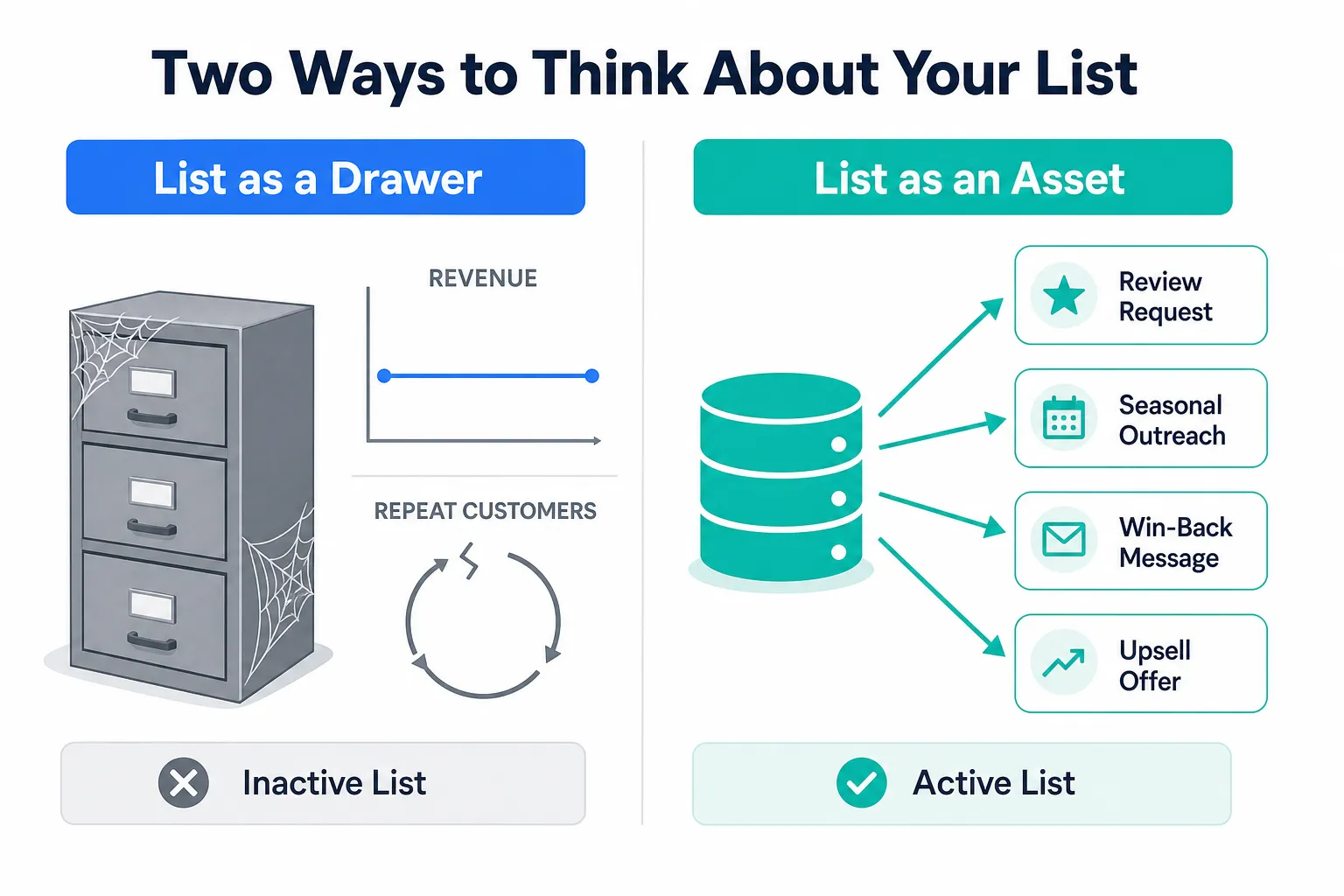
TLDR: A customer database for a small business is not a contact list you archive after the job closes. It is a revenue source you can tap repeatedly, and most contractors never do. This article shows you how to think about it differently, and what to actually do with it.
You have been in business a few years. You have done hundreds of jobs. Kitchens, roofs, HVAC installs, bathroom remodels, electrical panels. Every single one of those customers handed you their name, their address, their phone number, and their email. Maybe you have them in QuickBooks. Maybe in a spreadsheet. Maybe in a stack of paper invoices in a drawer in the shop.
That pile is worth money. Most trades never collect it.
What a Customer Database Actually Means for a Small Business
A customer database for a small business is any organized record of the people who have paid you money. That is the whole definition. It does not need to be fancy software. It does not need a CRM license or a dashboard.
What it does need is to be usable. You need to be able to answer three questions from it: Who hired me? When? For what?
If you cannot answer those three questions in under five minutes, you do not have a database, you have a graveyard.
Most trades fall into one of two camps. Either they have nothing organized at all, or they have records that live inside their accounting software and never get touched after the invoice is marked paid. Both situations leave money sitting on the table every single month.
Why Past Customers Are Your Best Sales Opportunity
Think about what it costs to get a brand new lead. You might be paying for Google ads, running a truck wrap, asking for referrals, posting on Nextdoor. All of that takes time and money to get someone to trust you enough to call.
A past customer already trusts you. They let you into their home. They wrote you a check. The sales cycle is a fraction of what it is with a cold prospect.
Homeowners also have recurring needs. The person who hired you for a water heater two years ago may now need their furnace serviced. The customer who got a new roof in one house may have moved and bought a different one. Life keeps happening, and properties keep needing work.
The contractor who stays in touch with past customers wins jobs without competing for them. The contractor who forgets them the moment the invoice is paid has to fight for every new lead.
This is exactly where reactivating your past customer list pays off in a way that almost no other marketing effort can match for the cost and effort involved.
The Classic Mistake: Treating the List as a One-Way Archive
Here is what most contractors actually do. They complete a job. They send the invoice. They get paid. They move on.
The customer's information goes into whatever system they use, and it sits there. Nobody looks at it again unless the customer calls back on their own. Which some will. But most will not, not because they were unhappy, but because they got busy, forgot your name, or found someone else when the next need came up.
A few specific things that go wrong because of this:
- Competitors pick off your repeat business simply by being more present.
- Customers forget who did the work. They genuinely cannot remember your company name.
- You never ask for a Google review, so your online reputation stays flat even after hundreds of successful jobs.
- You miss seasonal opportunities, the fall furnace tune-up campaign, the spring deck season, the pre-winter gutter clean.
None of this happens because you did bad work. It happens because you treated the list as storage instead of as an active tool.
The most common regret I hear from contractors is that they wish they had stayed in touch earlier, before a competitor got to their old customers first.
How to Start Organizing Your Customer Database Right Now
You do not need to overhaul everything at once. Start with what you have.
Pull your past invoices, from your accounting software, your email, wherever they live. For each job, you want: customer name, contact info, job type, and the date it was completed. That is your starting point.
A few things worth capturing if you have them, or if you can add them going forward:
- Property type (single-family, rental, commercial). This changes what you should offer them later.
- Whether they were a direct homeowner or a property manager. Property managers often control multiple units.
- Any notes about what they asked about but did not book. That is a warm lead for later.
You do not need a perfect database on day one. You need one that is good enough to act on.
Once you have something organized, even a basic spreadsheet, you can start segmenting. Not every customer gets the same message. A landlord with six rental units wants different things than a first-time homeowner who just moved in.
If you want to think more about how to split your list meaningfully, the section on building customer segments goes deeper on that.
What You Can Actually Do With the List
Once the list is in shape, even partially, you have real options.
Google reviews are the fastest win most contractors miss. You have dozens of satisfied customers who never left a review, not because they were unwilling, but because nobody asked. A simple message to your past customers asking for a review, sent at the right moment, will move your rating. This matters because most homeowners check reviews before they even call.
Beyond reviews, here is what contractors actually use their past customer list for:
- Seasonal outreach. Remind past HVAC customers before summer that you offer tune-ups. Remind past gutter customers in early fall.
- Upsell on related work. A customer who got a new water heater might need their pipes inspected. You already know the house.
- Win-back campaigns. Customers who used you once and then went quiet are worth a direct, personal message. Often a simple check-in is all it takes to get them back.
- Referral asks. A happy past customer is your best referral source. But again, you have to ask.
None of this requires a big budget. It requires a list and a habit of using it.
My Take
My advice: treat your customer database the way you treat your truck. You service the truck because it makes you money. You should service your customer list for the same reason.
Most contractors underestimate what they already have. After a few years in business, your past customer list is probably the most valuable marketing asset you own. More valuable than your website, more valuable than any ad you are running.
The mistake is not collecting the information. The mistake is collecting it and doing nothing with it.
You do not need to automate everything overnight. Start by picking five past customers this week and sending a personal message. Ask how the job is holding up. Ask if they need anything. Ask for a review. See what comes back. That is the habit. Build from there.
If you want a more systematic way to follow up with customers who have gone quiet, that is worth exploring once you have your list in decent shape.
Common Questions
How long should I keep customer records? This varies by state and by record type. For tax and accounting purposes, most states have their own retention rules, and federal guidelines apply separately. When in doubt, check with your accountant. For marketing purposes, keep the record as long as the person might reasonably hire you again.
What if my records are a mess and I am missing contact info for a lot of past customers? Start with what you have. Even a partial list is better than nothing. Going forward, make it a habit to capture complete contact info before every job starts, not after. It is much easier to ask when someone is excited about the estimate than to chase it down later.
Is it okay to email or text past customers I have not talked to in a while? Generally yes, if they gave you their contact information in a business context and the outreach is relevant. That said, federal rules around commercial email (CAN-SPAM) and text messaging (TCPA) do apply to small businesses. The rules around texting in particular have specifics worth knowing. If you plan to do volume outreach, it is worth a quick read on what those laws require, or working with a tool that handles compliance for you.