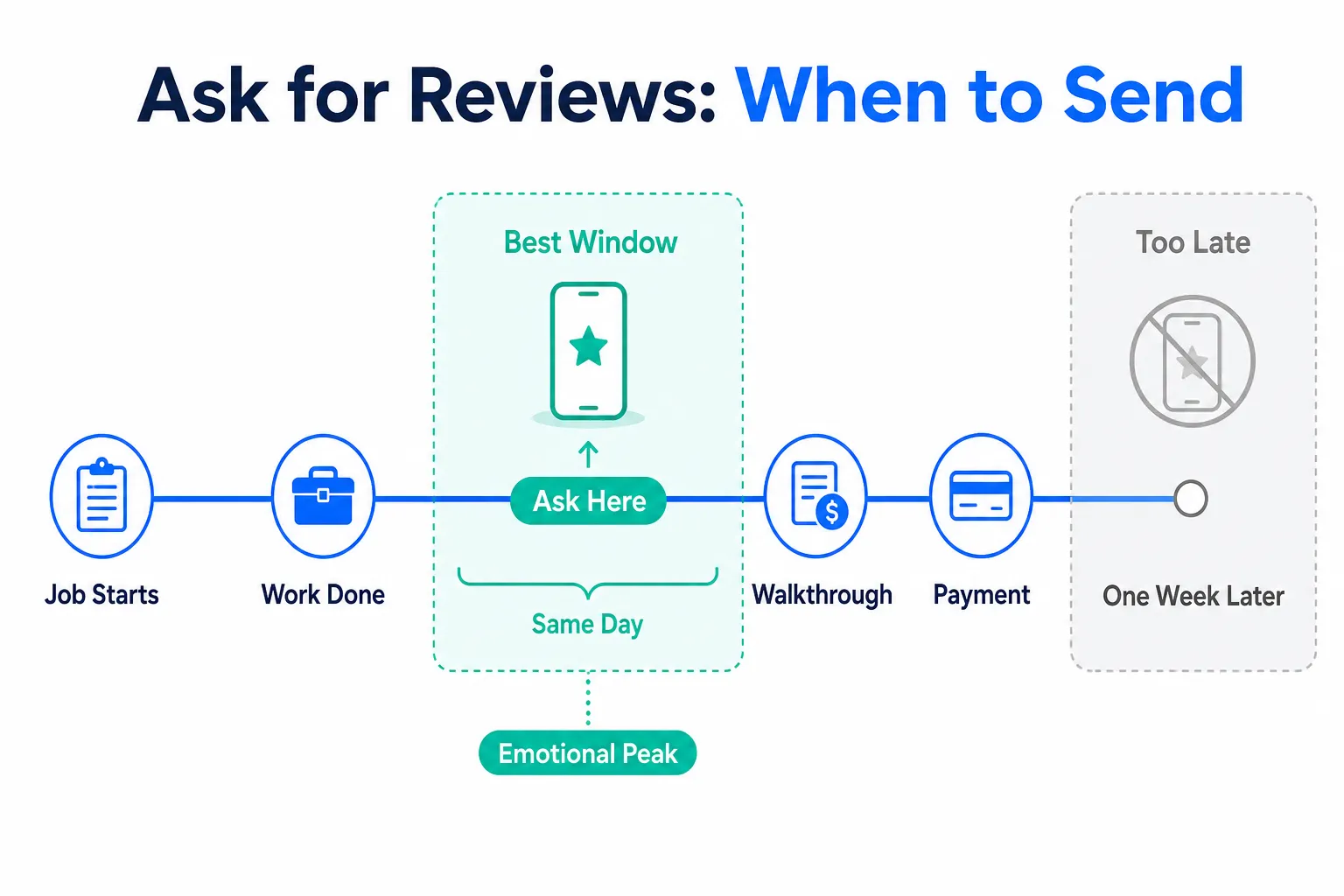
TLDR: When you ask for a Google review matters far more than the exact words you use. Ask too late and the goodwill is gone. Ask at the right moment and almost any polite request works. This post breaks down the timing logic so you can stop overthinking the script and start getting more reviews.
Why Most Contractors Ask at the Wrong Time
Most tradespeople wait until the invoice is paid. That feels logical. The job is done, the money cleared, now ask. But by then the homeowner has already moved on mentally. The excitement of the finished bathroom or the fixed roof has cooled. You are now just another vendor asking for a favor.
The emotional peak happens right after the work looks good, not after the paperwork clears. That window is short. Sometimes it is a few hours. Sometimes it is a day. After that, life gets in the way and your customer is thinking about their next problem, not your Google profile.
The classic mistake: sending a review request a week after final payment, with a long, carefully worded email nobody reads past the second sentence.
The Moments That Actually Work When You Ask for Reviews
There are a handful of moments in a job where a customer is genuinely happy and has their phone in their hand. Hit one of those and your ask practically writes itself.
Here are the moments worth targeting:
- Right after the walkthrough, when the customer sees the finished work for the first time and says something positive. That verbal compliment is your cue.
- The same day as project completion, not a week later. Same day.
- When a customer reaches out unprompted to say thank you, by text or call. Respond, thank them back, and ask right there.
- After you solve an unexpected problem cleanly. Customers remember when something went sideways and you handled it without drama.
None of these moments require a perfect script. A simple 'Hey, if you had a good experience, a quick Google review would help us a lot' is enough. The timing is doing the heavy lifting.
Text Beats Email for Field Trades
Email open rates are low for homeowners who are not in front of a computer. A text with a direct link to your Google review page removes every possible excuse. The customer does not have to search for you, log into anything new, or remember to do it later.
Short text, direct link, send it the same day as completion. That is the whole formula.
If you are wondering how to automate that without building anything yourself, the Google review request service at Lienzor handles the timing and the sending so you are not doing it manually after every job.
Wording Matters Less Than You Think, But Here Is What to Avoid
Contractors spend a surprising amount of time agonizing over the exact words. Should it be 'review' or 'feedback'? Should they explain why reviews matter? Should they say 'five stars'?
Here is what actually gets reviews removed or causes problems: asking customers to say specific things, offering any kind of incentive, or asking only customers you know will say something positive while skipping the rest. Google's policies are clear that review gating and incentivizing reviews are not allowed. The exact rules on solicitation also vary by platform and, in some professional contexts, by state licensing board rules, so check what applies to your license category.
Keep it honest, keep it short, and let the customer decide what to write. You want authentic reviews anyway. A hundred honest four-star reviews beat a dozen suspiciously identical five-star ones.
What you say matters just enough to not sound robotic. 'We'd really appreciate a quick Google review if you have two minutes' is fine. You do not need to spend an hour writing copy.
What to Do With Repeat Customers and Past Jobs
If you have a list of customers from the past year or two who never left a review, they are not a lost cause. A lot of them genuinely liked the work and just never got around to it. A single check-in message, not a form letter, can reactivate that goodwill.
Keep the message short and personal. Reference the job if you can. 'Hi Susan, hope the deck is holding up well heading into summer. If you ever have a minute, a Google review would mean a lot to us.' That is it. No pressure, no explanation.
Following up on past customers without it feeling like a mass blast is one of those things that is easy to put off. But the customers who already know your work are your easiest source of new reviews.
One thing to avoid: messaging customers who had a bad experience just hoping they forgot. They did not forget.
My Take
My advice: stop rewriting your ask-for-reviews message and start sending it faster. The version you have right now is probably good enough. What is killing your review count is the delay, not the wording.
Fix the timing first. If you want to fix the wording too, do it after you have sent fifty requests and seen what people actually respond to. Real data from your own customers beats anything you will read in a marketing blog, including this one.
The contractors I see getting a steady flow of reviews are not the ones with the best scripts. They are the ones who ask consistently, right after the job, every single time. Consistency is the whole game.
Common Questions
Can I ask for reviews on multiple platforms at once? You can mention that you are on Google, Yelp, or Houzz, but pick one to link to. Giving someone three links at once usually means they click none of them.
What if a customer agrees to leave a review but never does? One gentle follow-up a few days later is fine. After that, let it go. Pushing harder damages the relationship and rarely produces a review anyway.
Should I respond to reviews, including bad ones? Yes. Responding to every review shows potential customers that a real person is running the business. For negative reviews, respond calmly and briefly. Do not argue. Other people reading it care more about how you handle it than about the original complaint.