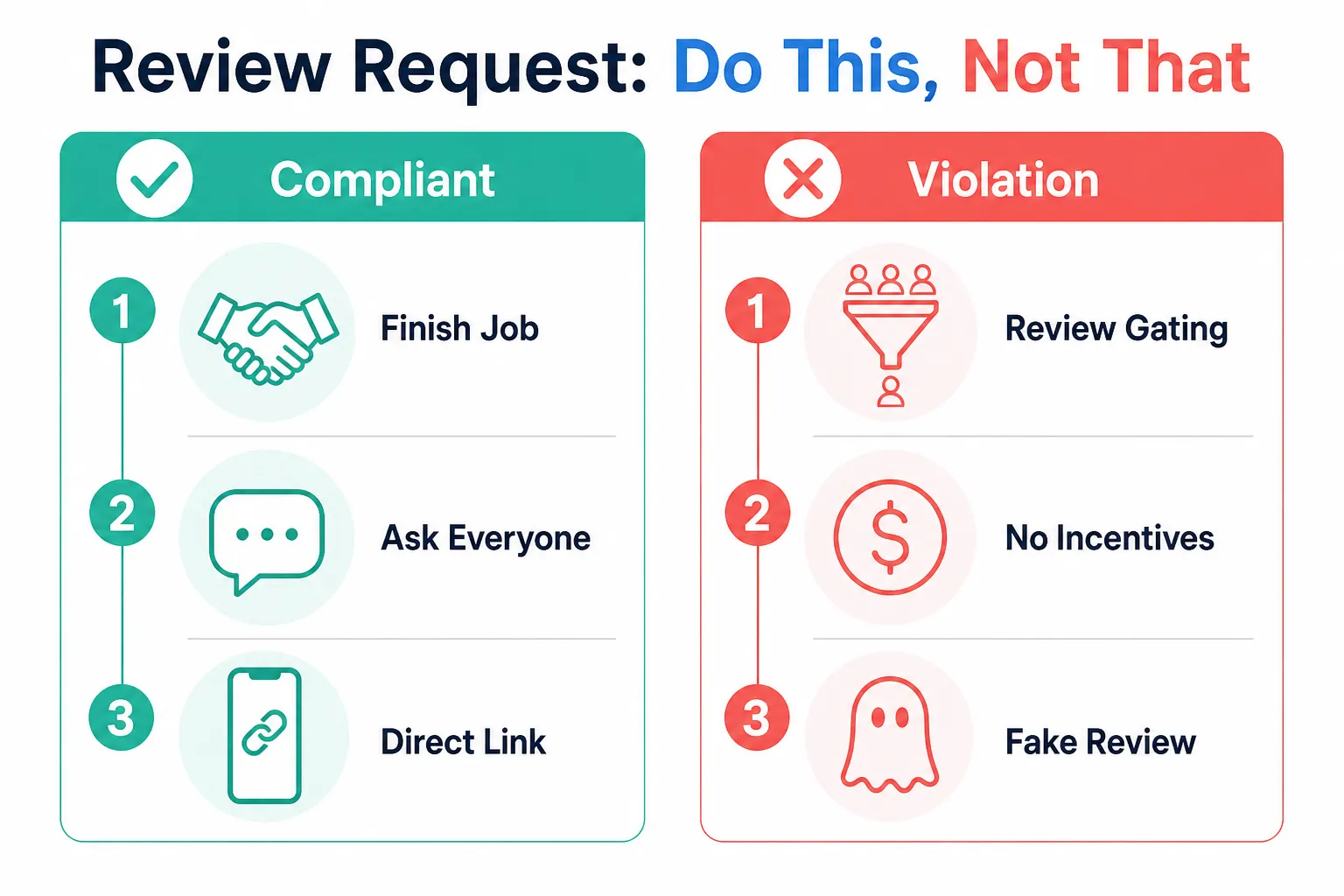
TLDR: You can ask customers for Google reviews, but you cannot pay for them, filter who you ask, or write them yourself. Do those three things right and you can build a steady stream of real reviews without putting your profile at risk.
Every contractor I talk to wants more reviews. Makes sense. A profile with a handful of reviews loses jobs to a competitor with forty, even if the competitor's work is worse. But Google's rules are stricter than most people realize, and the penalties for breaking them are real. Your listing can be suspended. Reviews can be wiped. Let's get into what you can and cannot do.
What Google Actually Allows When It Comes to Reviews
Google's review policy is publicly available, and the core rule is simple: reviews must reflect a genuine experience from a real customer. That sounds obvious. But a lot of common practices cross the line without contractors realizing it.
The clearest rule: you cannot incentivize reviews. No discounts, no gift cards, no 'leave us a five-star review and we'll knock something off your next job.' Google considers that manipulation, and so does the FTC. The FTC has its own rules around endorsements and disclosures that sit on top of Google's, and those rules apply at the federal level regardless of your state.
What you can do:
- Ask customers directly for an honest review
- Send a follow-up text or email with a link to your Google profile
- Ask at the close of a job when the customer is happy
- Have a QR code on your invoice or truck wrap
What you cannot do:
- Offer anything in exchange for a review
- Ask only the customers you know will leave five stars (that's called 'review gating' and Google explicitly prohibits it)
- Write or post reviews yourself, or have employees do it
- Use a third-party service that generates fake reviews
The Timing Problem Most Contractors Get Wrong
Here's what actually happens on a job site. You finish the work. The homeowner is happy, shakes your hand, says they'll leave you a review. You drive to the next job. They forget. You forget to follow up. A week passes. The moment is gone.
Asking at the right moment is the single biggest lever you have. That moment is right after the job is done and the customer has seen the finished result. Not a week later when they've moved on. Not months later when they barely remember hiring you.
The problem is that most contractors are running from job to job. Following up consistently feels like extra admin. That's exactly why so many good contractors have thin review profiles despite doing excellent work. The follow-up is the bottleneck, not the quality of the work.
A few habits that help:
- Ask in person before you leave the job site
- Send a text within 24 hours with a direct link
- Make it one tap, not a hunt through Google Maps
How to Get More Reviews for My Business Without Sounding Desperate
The wording matters. A lot of contractors feel awkward asking, so they over-explain or apologize for asking. Keep it short. Something like: 'If you're happy with the work, we'd really appreciate a Google review. Here's the link.' That's it.
You don't need to beg. You need to make it easy. Most customers who are genuinely happy will leave a review if the friction is low enough. The friction is usually the link. Without a direct link, customers have to search for your business on Google, find the right listing, and figure out how to leave a review. Many quit before they get there.
A direct review link solves that. Google's own tools let you generate one. Put it in your follow-up text, your email signature, and your invoice. If you want to see how automated requests handle this consistently, the page on automatic Google review requests shows one way to keep follow-ups from falling through the cracks.
One more thing: respond to every review, good or bad. It signals to Google that your profile is active, and it shows potential customers that you actually pay attention.
Review Gating: The Mistake That Can Get Your Profile Penalized
Review gating means only directing satisfied customers to leave a review while filtering out unhappy ones. It sounds reasonable as a business instinct. Why would you invite a bad review?
Google explicitly bans it, and the way most survey-based systems work triggers this rule without you knowing. If your process involves asking customers to rate their experience first, and then only sending happy customers to Google, that's gating. Google's policy says you cannot 'discourage or prohibit negative reviews or selectively solicit positive reviews from customers.'
The practical fix: ask everyone. If you did the job right, most feedback will be positive. The occasional bad review, handled professionally in your response, actually builds trust. Profiles with nothing but five-star reviews sometimes look suspicious to homeowners who know how the internet works.
If you're using any tool or service to collect reviews, check how it works. If there's a filter step before it sends someone to Google, you may be in violation of the policy without realizing it.
My Take
My advice: stop overthinking the strategy and fix the follow-up first. Most contractors already have happy customers who would leave a review if someone just asked them at the right time with a direct link. The system is broken at the follow-up step, not at the quality of the work.
The contractors I see with the strongest review profiles are not doing anything complicated. They ask, they make it easy, and they do it every time. Consistency beats a clever campaign.
Don't buy reviews. Don't gate. Don't have your cousin leave you three reviews from his phone. The short-term bump is not worth a suspended profile. Google's systems for detecting fake reviews have gotten much better, and a manual penalty wipes everything.
Build it slowly and honestly. Forty real reviews from real customers in your city will beat a hundred fake ones every time, especially as Google continues improving its detection.
Common Questions
Can I ask a customer to change a bad review? You can reach out, resolve the issue, and then let the customer know you've addressed their concern. If they want to update the review on their own, that's fine. You cannot pressure them or offer something in exchange for changing it.
Does responding to reviews actually help my ranking? Google has confirmed that responding to reviews is a factor in local search. It also gives you a chance to say something that reassures the next customer reading the thread. Do it for both reasons.
What if a competitor is leaving fake reviews on my profile? Flag each one through Google's reporting tool. Document them. If the problem is serious, Google's support process allows you to escalate, though resolution times vary and there is no guarantee of a fast fix. Keep records in case you need to escalate.