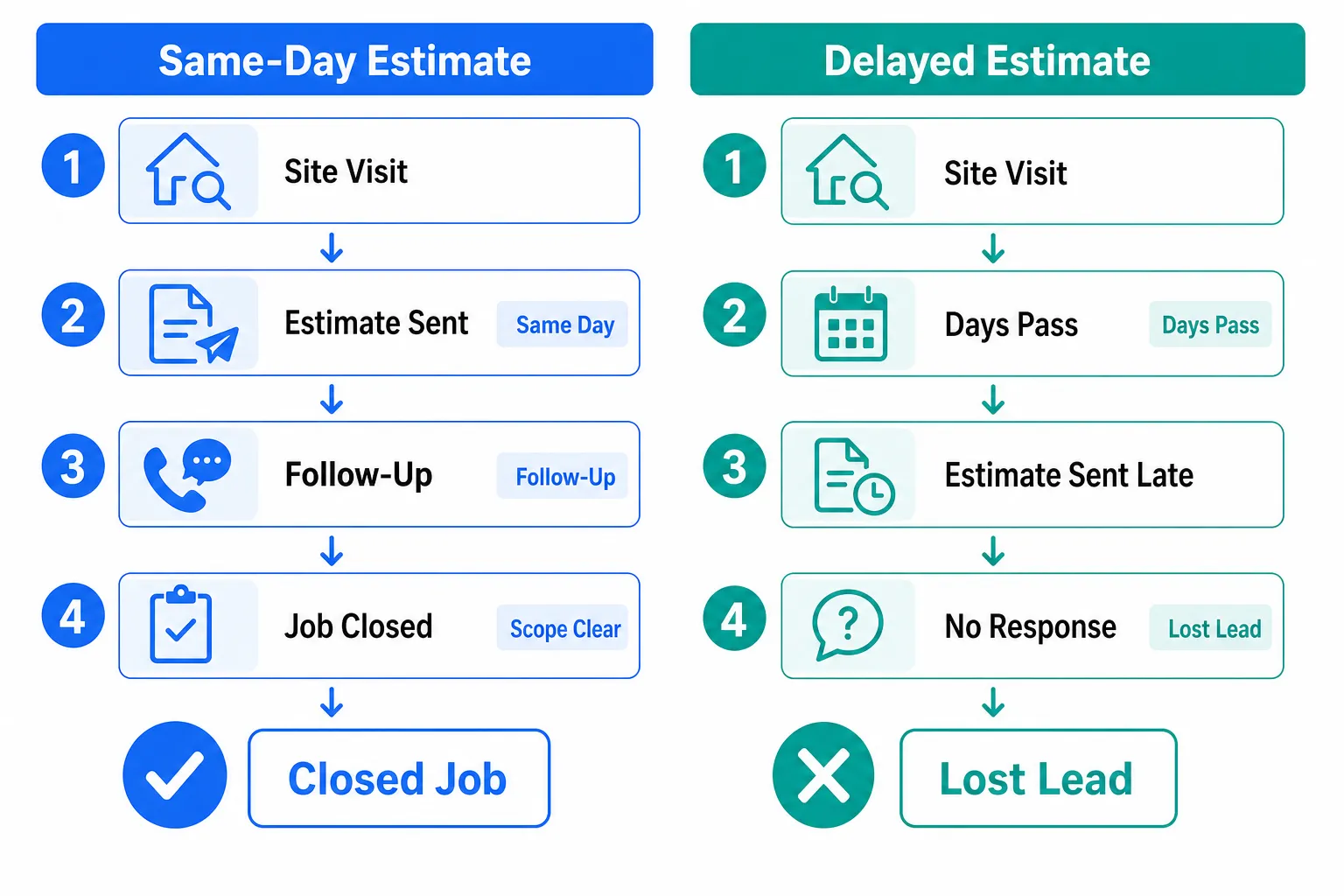
TLDR: A job estimate sent the same day you look at the work closes more jobs than a polished one sent three days later. Speed signals professionalism. Delay signals doubt. Here is what that means in practice, and how to build a habit around it.
Why Speed on a Job Estimate Beats Perfection
Most contractors lose the job before they ever send the estimate. The homeowner called three people. You showed up, said you'd get something over by end of week, and the other guy emailed a number that night. Guess who got the call back.
This is not about undercutting on price. It is about trust. When someone lets you walk through their home or stand on their property, they are already evaluating you. A fast response confirms you are organized. A slow one plants doubt.
The window between your site visit and the moment a homeowner mentally picks someone else is shorter than most contractors think. Same day is the target. Next morning is acceptable. After that, you are fighting momentum that already shifted.
What a Job Estimate Actually Needs to Include
There is a real difference between what makes an estimate feel thorough and what actually helps you close. You do not need a novel. You need clarity.
Here is what belongs in every estimate you send:
- Your business name, license number, and contact info
- A clear description of the scope, written the way you explained it on site
- What is explicitly NOT included, so there are no arguments later
- How long the work will take, roughly
- Payment terms and how you accept payment
- An expiration date on the price
That last one matters more than people realize. An open-ended estimate lets the homeowner sit on it for six weeks, then call you back when material prices have moved. Put a reasonable expiration window on it. What counts as reasonable varies, but two to four weeks is common in most trades.
A vague scope is the single biggest source of disputes, chargebacks, and bad reviews. Write down what you are doing, and write down what you are not doing.
The Real Cost of a Delayed Job Estimate
Contractors often delay because they want the number to be right. That instinct is good. But perfectionism on an estimate usually means you are re-measuring things you already know, second-guessing your labor rate, or just letting it sit in your drafts while you run a job.
Meanwhile, the homeowner has moved on. Or they took the cheapest bid out of impatience. Or they called the guy who does answer the phone.
There is also a subtler cost. Every estimate you delay is one more thing in your head at the end of the day. Contractors who batch their estimates on Friday night are not being efficient. They are creating stress and a backlog that almost guarantees some jobs will never get followed up on at all.
Getting the estimate out of your hands and into the customer's inbox is the job. Everything else is administrative.
If you want to cut the time between site visit and sent estimate, building estimates by voice is one way to do it on the drive back to the shop, without sitting at a desk.
Following Up Is Half the Game
Sending a fast estimate is step one. Following up is where most jobs are actually won or lost.
Here is what typically happens. You send the estimate. The homeowner opens it, gets distracted, means to reply, and forgets. That is not rejection. That is just life. But if you never follow up, you will read silence as a no and move on.
A single follow-up, sent a few days after the estimate, closes a significant number of jobs that would otherwise have gone cold. Not a pushy call. Just a short message checking whether they had any questions.
Most contractors stop at one follow-up, or never follow up at all, and that is where the money goes. A second touch, spaced out by another week or so, catches the people who were busy or waiting on a spouse or getting a second opinion.
This is the core of what estimate follow-up) is about. Not chasing. Just staying in the picture long enough for the customer to make a decision.
The Estimate Is Also Your First Impression
A homeowner who has never hired a contractor does not know what a fair price looks like. What they can evaluate is how you present yourself. A clean, readable estimate on a professional template says something. A Word doc with inconsistent spacing says something else.
This is not about buying expensive software. It is about consistency. Use the same format every time. Include your logo if you have one. Make the scope easy to read. Keep the language plain.
Property managers and repeat commercial clients care about this even more. They are comparing your paperwork against four other contractors. Presentation is part of the bid.
A job estimate that looks like you put five minutes of thought into the format suggests you will put five minutes of thought into the work. That is not fair, but it is how people think.
My Take
My advice: stop trying to send a perfect estimate and start trying to send a fast one.
The contractors who close the most work are not the ones with the most detailed line items. They are the ones who show up, give a number quickly, and follow up without being annoying. That is the whole formula.
If your current process means estimates sit in your head for two or three days, something needs to change. Whether that is a template, a voice tool, a checklist you run in the truck, or a habit of sending something before you even pull out of the driveway, find what works and make it boring and repeatable.
Speed on the estimate, clarity on the scope, and one or two follow-ups. That is what moves the needle for most small contractors. Everything else is noise.
If you want a faster way to get estimates written and sent without adding desk time to your day, take a look at building estimates by voice.
Common Questions
How fast is 'same day' realistically? If you do the site visit in the morning, send the estimate by end of that business day. If you visit in the afternoon, send it that evening or first thing the next morning. The point is not to rush a bad number. It is to stop letting days pass.
Should I include a breakdown of labor versus materials? That depends on your trade and your market. Some customers expect it. Others use it to shop your materials against a big box store and argue the price. If you are in a competitive residential market, a lump sum or simple section breakdown often works better than a full line-item breakdown.
What if the customer never responds to the estimate? Follow up twice, spaced a few days apart. After that, move on but keep their information. A customer who did not move forward on one job is still a warm contact. Reaching back out months later, especially around seasonal work, often converts.