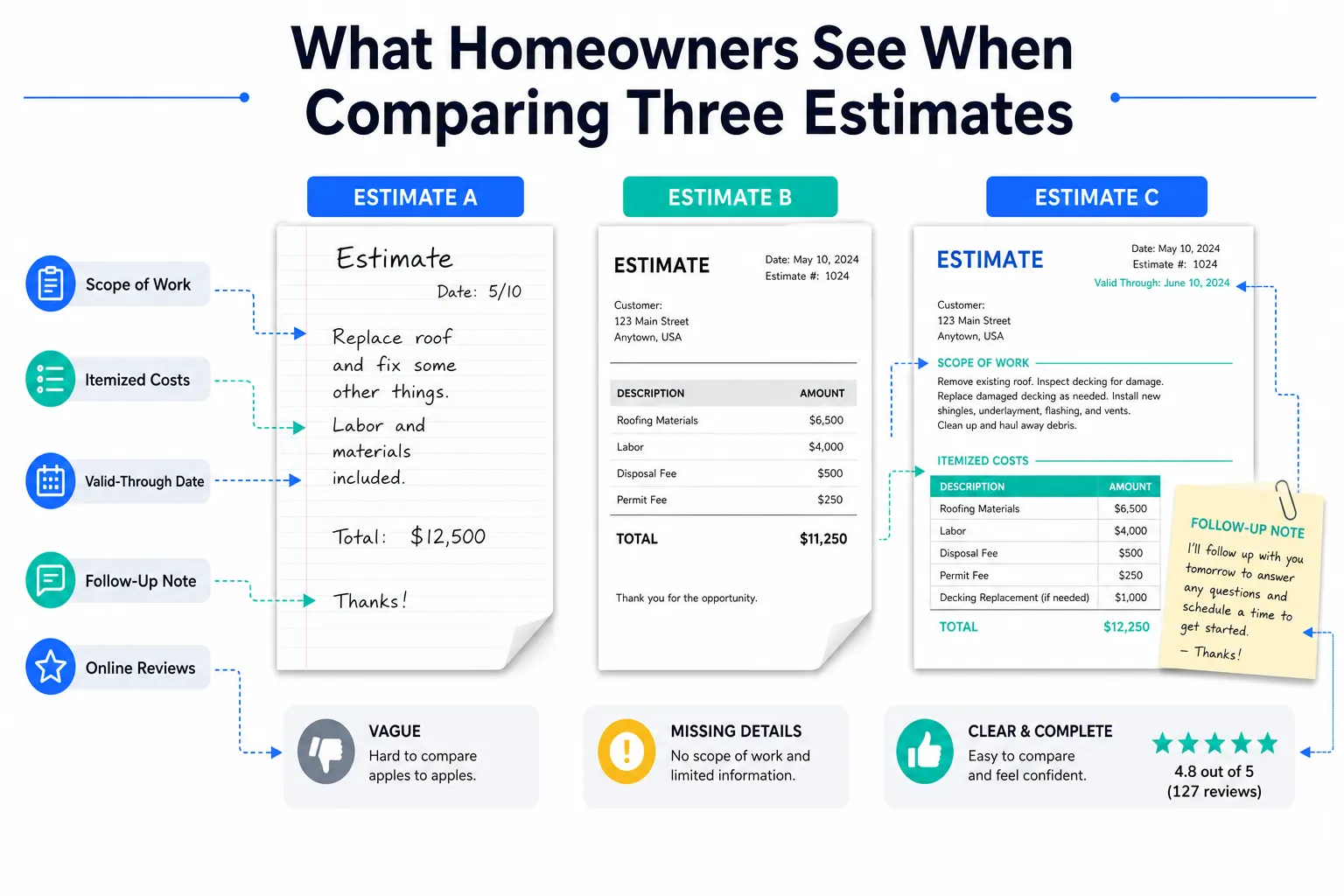
TLDR: Homeowners getting multiple contractor estimates rarely pick the cheapest one. They compare presentation, clarity, and how much they trust the person behind the number. If your estimate looks thin or arrives late, you lose before the conversation even starts.
You already know homeowners are told to get three quotes. What you may not know is what happens at the kitchen table when those three bids get laid side by side. Understanding that comparison changes how you write and deliver every contractor estimate you send.
Price Is the Starting Point, Not the Finish Line
Yes, price matters. But homeowners rarely understand the line items well enough to compare raw numbers directly. What they actually do is look for a number that feels explainable. If your total is higher, they want to see why.
A vague lump sum gives them nothing to work with. A competitor who broke out labor, materials, and disposal separately looks more credible, even if the total is similar to yours.
The moment your estimate looks like you did the math in your head, you lose credibility regardless of your actual price.
Break things out. Not to the point of confusion, but enough that a non-contractor can follow the logic. Line items signal that you measured, planned, and know exactly what the job involves.
The Contractor Estimate They Can Read Wins More Often
Homeowners are not contractors. They are reading your estimate the way they read a restaurant menu. They want it organized. They want to find what they're looking for without decoding it.
A handwritten number on a torn notepad, a PDF with no company name, a Word doc with misaligned columns: all of these send a signal. The signal is that your back office runs the same way your estimate looks.
A clean, professional-looking estimate does not just impress, it removes doubt at the exact moment doubt is most dangerous.
You do not need a complicated system. You need something consistent. Your name, your license number if your state requires it to be visible, a clear scope description, a total, and a valid-through date. That is the baseline.
Scope of Work: Where Most Estimates Fall Short
This is the section homeowners re-read the most, and the section contractors write the least carefully.
When three estimates land on the table, the homeowner starts asking: does each contractor plan to do the same thing? Often the answer is no. One includes haul-away. One does not. One primes before painting. One paints over bare drywall. These are real differences that affect the final result, but they only become visible if the scope is written out.
If your scope is vague and a competitor's is specific, the homeowner will assume the competitor is more thorough, even if you plan to do the same work.
Write what you will do, what you will not do, and what the homeowner is responsible for. That clarity protects you legally and wins trust upfront. Exclusions written down before the job starts prevent ugly calls later.
Using voice-to-estimate tools can speed this part up significantly, especially if you're writing scopes on the road between jobs.
Speed and Follow-Up Signal How You Run Your Business
Here is what nobody talks about enough. Homeowners are interviewing you on behavior before they ever sign anything. How fast did you send the estimate after the walkthrough? Did you follow up, or did you go silent?
A contractor who sends a polished estimate within 24 hours and then follows up a few days later looks organized and hungry for the work. A contractor who sends something a week later, or not at all, looks like someone who will be hard to reach once the job starts.
Most lost estimates are not lost because of price. They are lost because the contractor went quiet and the homeowner moved on.
This is the part of the process where a lot of contractors leave money on the table. The estimate goes out, the phone stays silent, and the job goes to whoever checked in. A simple follow-up message changes that outcome more often than any discount would.
The Lienzor home page covers exactly this problem if you want to understand how contractors are handling it now.
Trust Signals Homeowners Look For (That Most Pros Overlook)
By the time a homeowner is comparing three estimates, they have usually already looked you up online. What did they find?
Google reviews, a consistent business name, a real phone number that gets answered. These are the things that either back up your estimate or undercut it. A beautiful estimate from a contractor with no reviews online creates doubt. A simpler estimate from someone with forty solid reviews often wins.
Your online reputation is part of your estimate, even if it never appears on the document itself.
License and insurance documentation matter here too. Requirements vary by state and by trade, so check what your state actually requires you to carry and disclose. Homeowners who do their homework will ask. Having a current certificate of insurance ready to share before they ask makes you look prepared.
And referrals still close jobs. If you can mention a neighbor they know, or offer to connect them with a past customer, that matters more than any line item.
My Take
My advice: stop thinking about your estimate as a price and start thinking about it as your first day on the job.
The homeowner is deciding whether they can trust you in their house, around their family, with their money. The estimate is the first real look they get at how you operate. A late, vague, hard-to-read document tells them something. A fast, clear, organized one tells them something different.
The contractors who win the most bids are not always the best at the trade. They are the best at making homeowners feel confident before the job even starts.
Fix the estimate first. Then fix the follow-up. Those two things, done consistently, will change your close rate more than any other change you make to your business.
Common Questions
Do homeowners actually read the whole estimate, or just the total? Most read the total first, then go back and read the scope if they are seriously considering you. If your scope is blank or vague, that second read does not happen, and neither does the call.
Should I put a valid-through date on my estimate? Yes. Material costs move, your schedule fills up, and an open-ended estimate creates problems later. A clear expiration date is also a soft nudge for the homeowner to make a decision.
What if my price is genuinely higher than the competition? Explain why in the estimate itself. Not defensively, just factually. What are you including that others might not? What materials are you using? A higher price with a clear reason behind it is easier to accept than a lower price that feels like a guess.