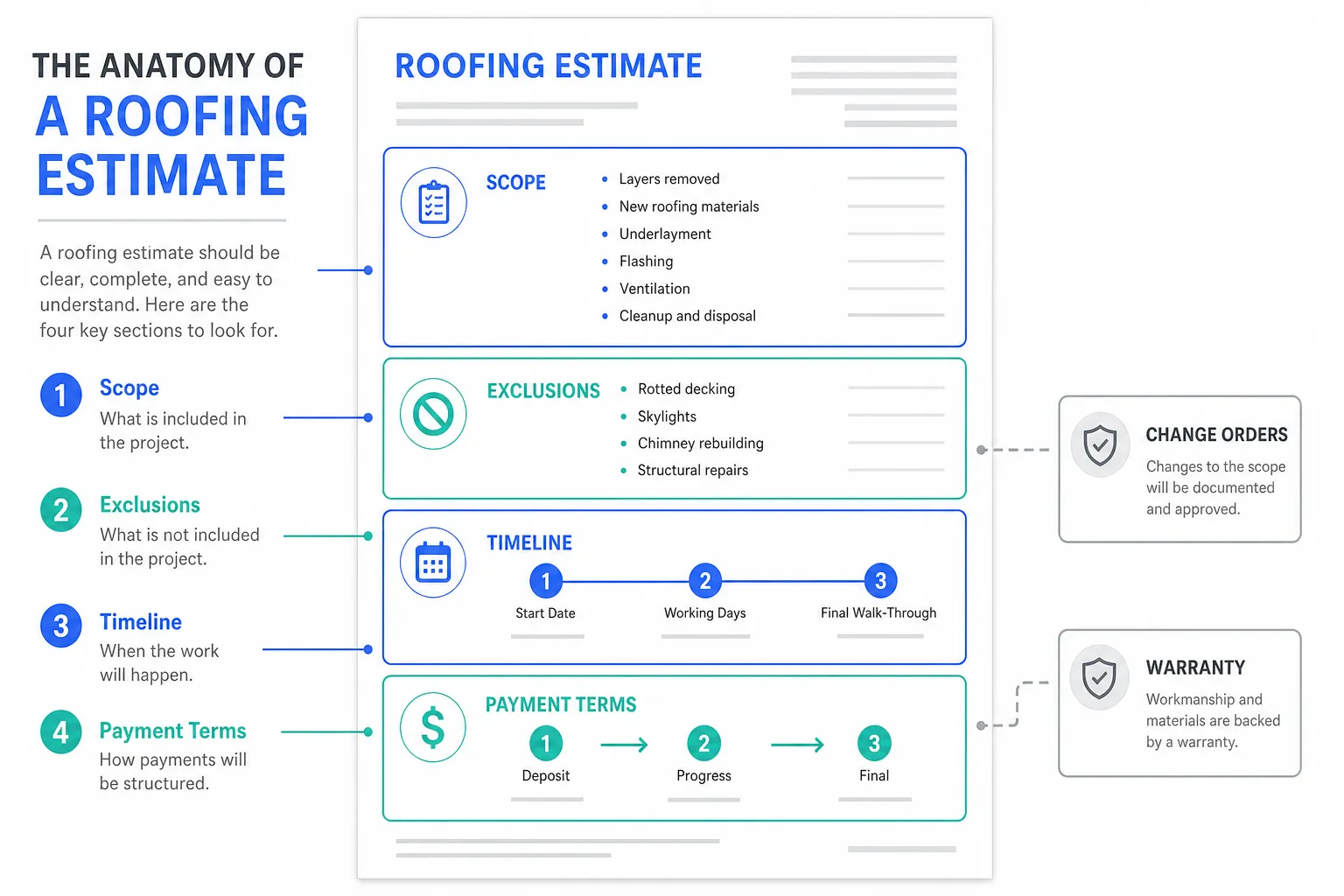
TLDR: A good roofing estimate template spells out exactly what you're doing, what you're not doing, and when you'll be done. Without those three elements, you're writing a blank check for disputes. This post walks you through each part, in the order that actually matters on a job.
Why Most Roofing Estimates Blow Up Later
The estimate looked fine when you sent it. Then the homeowner calls halfway through the job asking why you're charging extra for the rotted decking you found under the shingles. Sound familiar?
The root cause is almost always a scope that was written in contractor language, not homeowner language. You knew what you meant. They read something different. That gap is where the arguments live.
A roofing estimate template does not fix every problem. But it forces you to think through the job before you start, not during. That alone saves you hours of back-and-forth.
Building the Scope Section of Your Roofing Estimate Template
The scope is the heart of your estimate. Write it so a stranger can read it and know exactly what work will happen on their property.
For a roofing job, a solid scope block typically covers:
- Which sections of the roof are included (front slope, rear slope, garage, porch, all of them)
- Material type, manufacturer, and color if chosen
- Number of layers being removed
- Underlayment spec
- Flashing: what gets replaced versus what gets reused
- Ridge cap style and material
- Ventilation work if any
- Drip edge: included or not, and where
- Cleanup and haul-away
List every item separately. Do not write 'complete tear-off and reroof.' That phrase means nothing in a dispute. Write it so your apprentice could read the estimate and know exactly what to do without calling you.
One detail people consistently forget: nail pattern and fastener type. Some local codes or manufacturer warranties require a specific pattern. If that matters in your area, put it in writing.
The Exclusions Section: Your Single Best Protection
Exclusions are what your price does not cover. They are not fine print. They are not buried text. They belong in a clearly labeled section that the customer has to read before signing.
Common roofing exclusions worth spelling out:
- Rotted or damaged decking discovered after tear-off (price it as a per-sheet add-on rate)
- Structural repairs to rafters or ridge board
- HVAC curb flashing or skylights (unless specifically listed in scope)
- Gutter removal and reinstallation
- Interior damage caused by pre-existing leaks
- Permit fees if those are passed through separately
- Work on any section of roof not listed in the scope
The exclusion section is where you stop the 'but I thought that was included' conversation before it starts.
Some contractors resist writing exclusions because they think it looks negative. It does the opposite. A customer who sees you thought through every scenario trusts you more, not less. It signals professionalism.
One practical tip: after you write your exclusions, walk the job again and ask yourself what else could surprise you. On a reroof, the answer is almost always the decking condition and the flashing underneath a chimney or skylight.
Timeline: The Part Every Roofing Estimate Template Skips
Most roofing estimate templates on the internet say nothing useful about timeline. They leave a blank line that says 'estimated start date' and call it a day.
That is not a timeline. That is a placeholder.
A real timeline block should tell the customer:
- Approximate start date (or the condition that triggers scheduling, like permit approval)
- Number of working days for the job under normal weather
- What happens if weather delays the project
- When materials will be delivered, if there's a staging concern
- When the final walk-through happens
- When the job is considered complete for payment purposes
Weather language is especially worth getting right, because roofing is one of the most weather-dependent trades there is.
You do not need to write a legal contract. You need to write enough that both sides know what 'done' looks like and when to expect it. Keep the language plain.
If you struggle to write this section quickly on every job, it might be time to look at how voice-based estimate tools handle job details. Dictating conditions in plain language on the drive home from a site visit is faster than typing every field on a form.
What to Put in the Fine Print (and What to Leave Out)
Every roofing estimate template needs some standard terms. But there is a difference between useful terms and legal noise nobody reads.
Useful terms to include:
- Payment schedule (deposit, progress payment if any, final payment on completion)
- What constitutes a change order and that change orders require written approval
- Warranty: what you warrant, for how long, and what voids it
- Dispute resolution: some contractors specify mediation before litigation, some do not
- Permit responsibility: who pulls it, whose name it's in
Keep the payment schedule especially clear, because payment disputes on roofing jobs are common and the lien process, where it applies, has short deadlines that vary by state.
Do not try to copy legalese from a contractor forum into your terms. It usually does not apply to your state. If you want enforceable terms, have a local attorney review your standard template once. That investment pays for itself the first time a customer tries to stiff you.
One thing many roofers put in their fine print that causes more trouble than it solves: vague warranty language. 'Workmanship guaranteed' means nothing. Specify the term in years, what defects are covered, and how a claim gets made.
My Take
My advice: stop downloading generic roofing estimate templates and filling in the blanks. Build your own, once, based on the disputes you have actually had.
Every section of a good estimate exists because someone, somewhere, had a fight about that exact thing. The exclusions you write should come from real jobs that went sideways, not from a checklist someone made up in an office.
Start with scope, exclusions, and timeline as three separate labeled sections. Make sure your payment terms are plain. Have an attorney look at it once. Then use that template on every job and refine it when something new goes wrong.
The estimate is also your first impression. A clean, detailed document tells the customer you run a serious operation. Plenty of roofing contractors are competing on price. Fewer are competing on clarity. That gap is worth something.
If writing up that level of detail on every job feels slow, the estimate builder that lets you speak your scope out loud is worth a look. Less typing, same result.
Common Questions
Do I need a separate contract, or is the signed estimate enough? It depends on your state and the job size. In many states, a signed estimate with payment terms functions as a binding contract for smaller residential jobs. But for larger projects, or anywhere a contractor license bond is involved, a separate contract is often smarter. Check with a local attorney.
How detailed do exclusions need to be? Detailed enough to cover your three most common job surprises. For roofing, that usually means decking condition, chimney and skylight flashing, and anything structural. If you find yourself adding the same surprise to invoices repeatedly, it belongs in your exclusions.
What if the customer wants to start before the estimate is signed? Do not. A verbal agreement is hard to enforce and the details you spent time writing mean nothing if there is no signature. A short text confirmation is better than nothing, but a signed document is the only real protection you have.