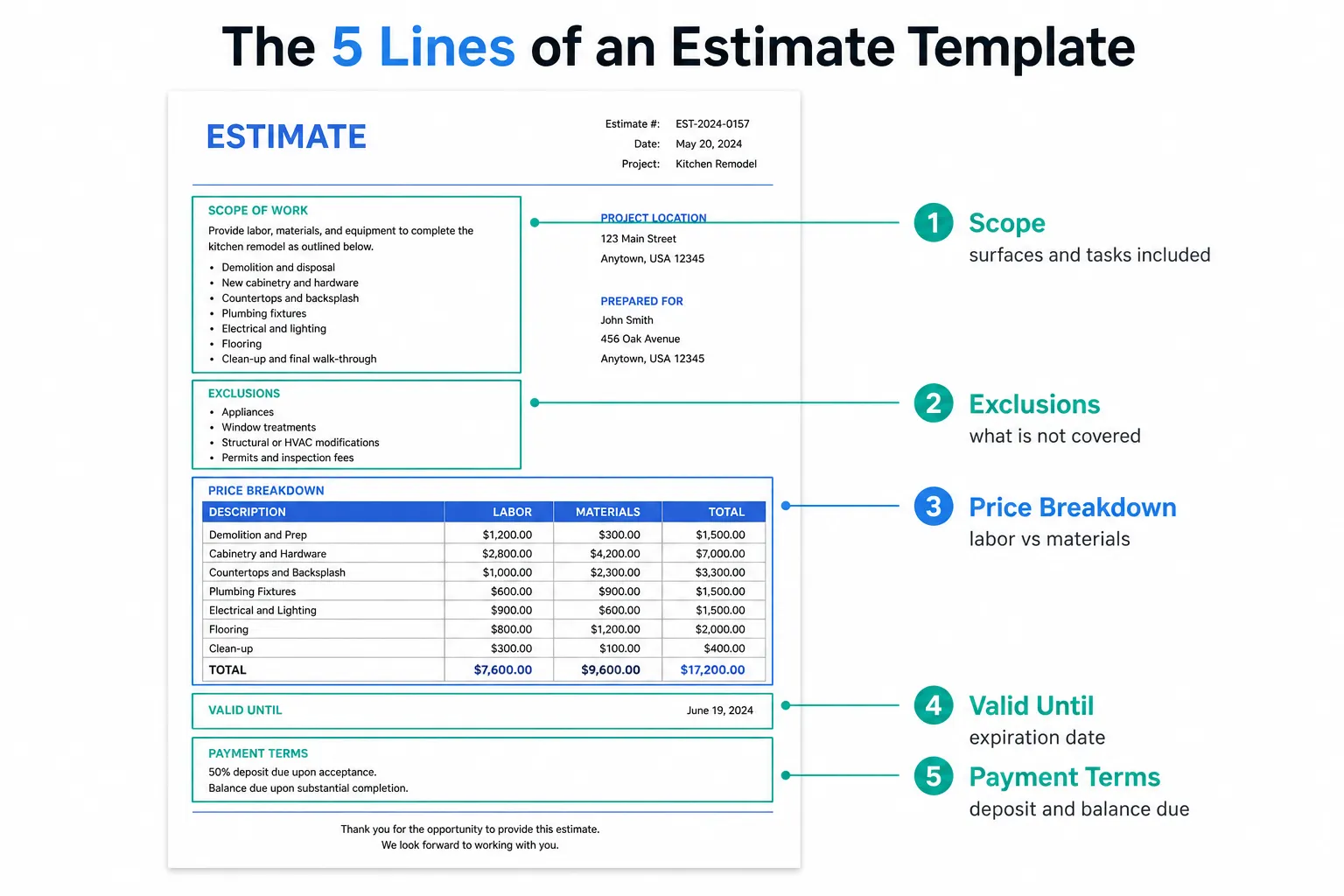
TLDR: An estimate template is only as good as the five lines most contractors either skip or write badly. Get those right, and you close more jobs, collect more reliably, and argue less. Get them wrong, and a perfectly priced job can still cost you money or a customer.
Every contractor has a template. Most of them are missing something. Not the company logo, not the job address. The stuff that actually protects you when a homeowner says 'that's not what I thought I was getting' or 'I thought that included the haul-away.'
Line 1: The Scope Description (Be Boring, Be Specific)
This is the line most pros write in fifteen seconds and regret for fifteen days. 'Paint living room, two coats' sounds fine. It is not fine. Which walls? Does that include the ceiling? The trim? The closet inside the room?
Write the scope like you are describing the job to someone who has never seen the house. Room dimensions, surfaces included, surfaces excluded. If you are not touching the trim, say so. If the price assumes the homeowner moves the furniture, say so. This single line prevents more arguments than any contract clause.
Property managers and repeat customers especially will test you on this. They compare your current estimate to the last one. Vague scope gives them room to ask for more.
Line 2: The Exclusions (What You Are Not Doing)
This is the line almost nobody writes, and it is the one that saves your margin. Exclusions are not about being difficult. They are about being clear.
Say you are doing a bathroom tile job. Your estimate covers demo and install. Does it cover drywall repair behind the old tile? Probably not. Does the homeowner assume it does? Almost certainly yes. A short exclusions line, right under the scope, kills that assumption before it becomes a fight.
Three or four bullet points is enough. 'Does not include: patching water-damaged subfloor, painting, permit fees.' That list is not long. But it earns its space every single time something unexpected shows up behind a wall.
Line 3: The Price Breakdown
A single lump sum makes homeowners nervous. It gives them nothing to react to except the total. And when the total surprises them, they have no way to understand why.
Breaking the price into labor and materials does not weaken your position. It shows your work. A homeowner who can see 'materials: $X, labor: $X' is much less likely to feel like you pulled a number from thin air. You do not need to itemize every tube of caulk. But a few logical line items build trust fast.
If the job has a big material cost, show it separately. It protects you when material prices shift. It also makes your labor rate look reasonable instead of mysterious. If you want to think through how to structure this before you send anything, building estimates by voice can help you move faster without skipping the details.
Line 4: The Validity Period
This one is short but non-negotiable. Your estimate has a shelf life. Material costs move. Your schedule fills up. A homeowner who calls three months after you sent the quote expecting the same price is not being dishonest. They just did not know.
Set a validity window and print it on the estimate. Thirty days is common. Some trades with volatile material costs go shorter. The exact number is less important than the fact that it is there, visible, in plain language.
'This estimate is valid for 30 days from the date above' is seven words that prevent a genuinely awkward conversation. Write them every time. This is also where a follow-up process matters. If you are not reaching back out before that window closes, you are leaving decisions to chance. Following up on estimates automatically is one of the simplest ways to stop losing jobs you already priced.
Line 5: The Payment Terms
This is the line contractors are most embarrassed to write, and it is the one that affects cash flow the most directly. When someone asks 'when do I pay?' and your estimate has no answer, the answer becomes 'whenever you feel like it.'
State your deposit requirement, if you take one. State when the balance is due. State what you accept. Some states have rules about how large a deposit a contractor can collect up front, and those rules vary, so check your state's contractor licensing laws before you set that number.
Clear payment terms on the estimate mean you are never surprising the customer at invoice time. They saw the terms before they said yes. That changes the dynamic completely. Once the job is done and you are ready to send the invoice, a tool like the free voice invoice generator can get that out the door before you even leave the driveway.
My Take
My advice: stop treating the estimate template as a formality and start treating it as the first document of the job. Because it is.
The homeowner reads your estimate more carefully than any contract you send afterward. That is the moment they are deciding whether to trust you. A vague, single-line estimate signals that the job itself might be just as vague. A clear, specific one tells them you have done this before and you know what you are doing.
The five lines above are not legal armor. They will not replace a proper contract when a job goes seriously wrong. But they handle ninety percent of the small arguments before those arguments ever start. Scope disputes, price shock, late payments, the 'I thought that was included' conversation. All of it traced back to something that was not written down.
Common Questions
Do I need a separate contract if my estimate already has all this detail? For small jobs, a detailed signed estimate often acts as the agreement. For larger jobs, especially anything structural or with subs involved, a separate contract gives you more protection. Rules and norms vary by state and job size. When in doubt, ask a local contractor association or attorney.
Should I include photos or measurements in the estimate template? Yes, when they add clarity. A photo of the existing condition before demo, or a sketch showing the scope boundary, removes ambiguity. It also shows the homeowner you were paying attention on the walk-through.
What if the customer wants to negotiate the price using my line items? That is a fair conversation to have. It is actually easier than negotiating a lump sum because you can talk about specific scope changes. 'If we skip the closet, here is what that saves' is a much cleaner discussion than 'can you just do it for less.'