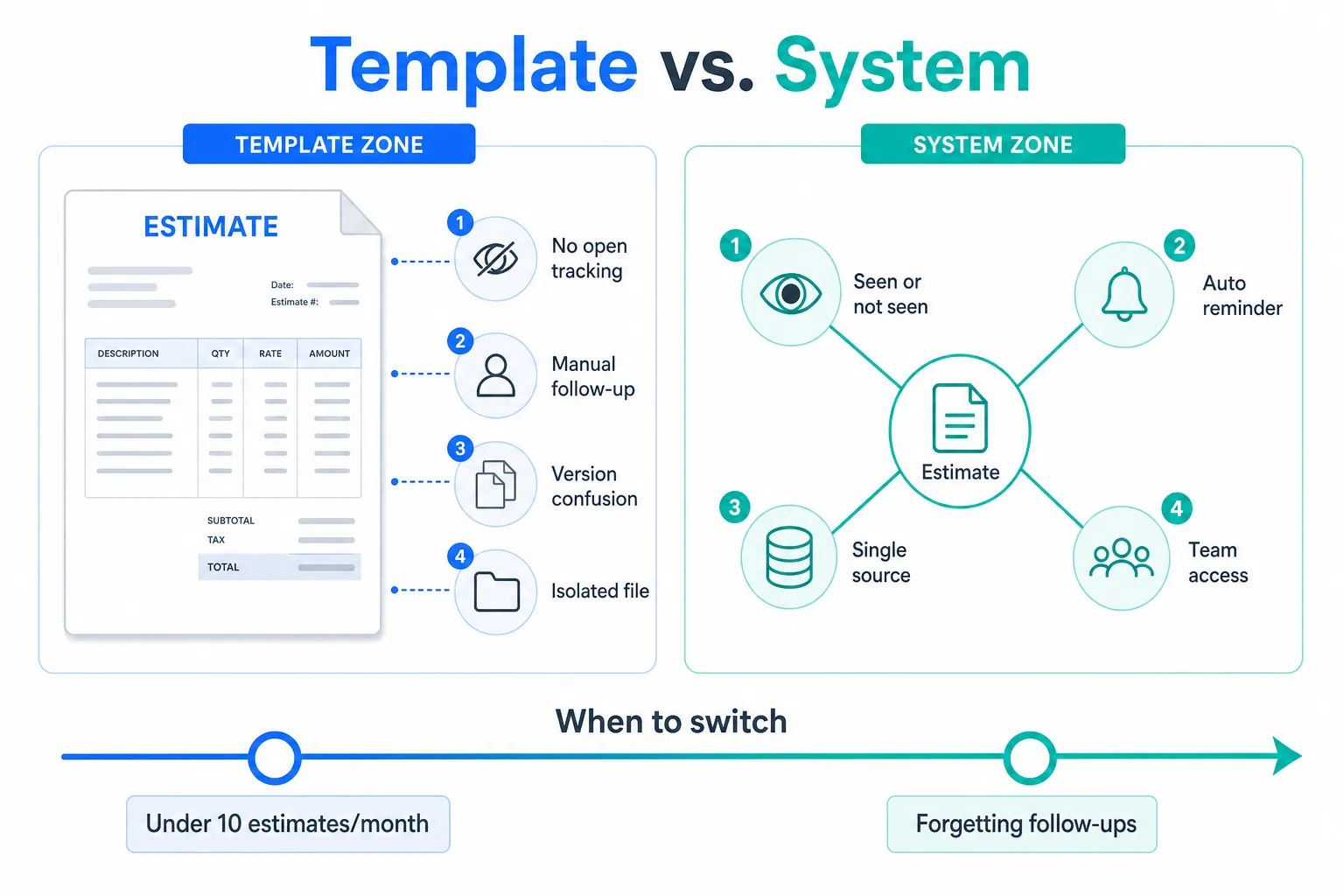
TLDR: A free estimate template works fine when you are just starting out or doing a handful of jobs a month. Once your volume grows or your pricing gets complex, the template becomes the bottleneck, not the solution. Here is how to think through it honestly.
What a free estimate template actually gives you
A free estimate template is exactly what it sounds like. A pre-built document, usually a Word file, a Google Doc, or a PDF, with blank fields for your company name, the customer's address, line items, and a total. You fill it in, save it, send it.
That is genuinely useful. Most new contractors waste early weeks reinventing a document from scratch. A template stops that. It forces you to think through what you are actually quoting: labor, materials, markup, exclusions.
The real value of a template is not the document itself, it is the discipline it creates around what you put in writing. A handshake estimate is always a dispute waiting to happen. A written one, even a basic one, is not.
The honest limits of a free estimate template
Here is where most guides go soft on you. They celebrate templates without telling you what breaks.
Templates break in predictable ways:
- You copy last month's estimate and forget to update the price, so you quote old material costs on a job that costs more now.
- You send a generic-looking document to a property manager who compares it against polished competitors and picks them instead.
- You have no idea whether the customer even opened it, so you do not know when to follow up.
- The file lives on your laptop. Your helper cannot access it. Your wife cannot invoice from it. Nothing talks to anything else.
None of these are catastrophic on job one, but by job thirty they are costing you real money, in margin leaks and in lost bids you never knew you lost. The template did its job. It just hit its ceiling.
What makes a good estimate, template or not
Before you upgrade anything, make sure your estimates contain the right things. The format is secondary.
A solid estimate for a contractor or tradesperson covers:
- Your full business name, license number (where required by your state), and contact information
- The customer's name and the property address
- A clear description of the scope, specific enough that a stranger could read it and know exactly what work is included
- What is explicitly excluded, because that is where disputes start
- A line-item breakdown of labor and materials, or at minimum a lump sum with enough narrative to justify it
- Your payment terms and deposit requirements
- An expiration date on the pricing
That last one matters more than people think. Material prices move. If you quote a kitchen remodel and the customer sits on it for two months, you may be locked into a price that no longer works. Put an expiration on every estimate, even if it feels awkward. Most customers respect it.
Rules around what an estimate must contain vary by state and sometimes by trade. Some states have specific requirements for home improvement contracts above certain dollar thresholds. Check what applies where you work, not what someone on a forum said.
When the free estimate template is still the right answer
If you are new to the trade, or working a side business on weekends, or doing fewer than ten estimates a month, a good template is probably enough. Spend your energy on the content, not the tool.
Download a clean one, customize it with your logo and your payment terms, save it as your master, and protect it from accidental edits. That is a thirty-minute project that will serve you well for a while.
Do not buy or build a complicated system before you have enough volume to actually need it. That is a classic early-business mistake, spending on infrastructure instead of on getting customers.
The signals that tell you it is time to move on
There are concrete moments that tell you the template era is over. You do not have to guess.
- You have sent estimates that you forgot to follow up on, and you found out later the customer went with someone else.
- You cannot remember, without digging through email, which estimates are still open and waiting for a decision.
- A customer calls asking about an estimate and you cannot find which version you actually sent them.
- You are quoting similar jobs over and over and rebuilding the same line items every time from scratch.
- You hired someone to help, and they cannot produce an estimate that looks like yours.
Any one of those is a signal. All of them together mean you are losing jobs and losing time every single week. At that point, the question is not whether to change, it is what to change to.
The right upgrade is not about fancier software, it is about a system that remembers what you forget and follows up when you are on the job site. If you want to see what that looks like in practice, the estimate software built for contractors is worth understanding.
My take
My advice: use the free template until it actually hurts you, then stop. Do not let anyone shame you into a complicated system before you need one.
But when the pain shows up, take it seriously. An estimate you send and never follow up on is not really an estimate. It is a wish. Most contractors do not lose jobs on price, they lose them on silence. The customer sent three requests, got two responses, and one of those two followed up. That is who got the job.
The template cannot follow up for you. That is the gap worth closing. Whether you use software that handles the follow-up automatically or you build a manual reminder system in your calendar, close the gap. The money is there.
Common questions
Is a free estimate template legally binding? An estimate is generally not a contract by itself. Once a customer signs it or accepts it in writing and you begin work, you may have the elements of an enforceable agreement, but rules vary significantly by state. A signed contract or proposal with clear terms is always stronger than a bare estimate. When the job size is significant, ask a local attorney what your state requires.
Should I charge for estimates? It depends on your trade, your market, and your customer type. Some trades charge for detailed written estimates, especially when a site visit is required. Others do not. There is no universal rule. Watch what your direct competitors in your area do, then decide whether you want to match that or differentiate on it.
How long should I keep my estimate records? Hold onto them. If a job goes sideways or a dispute surfaces later, your estimate is evidence of what was agreed. How long you should technically keep business records varies by state, by tax rules, and by the nature of the work. When in doubt, longer is safer.