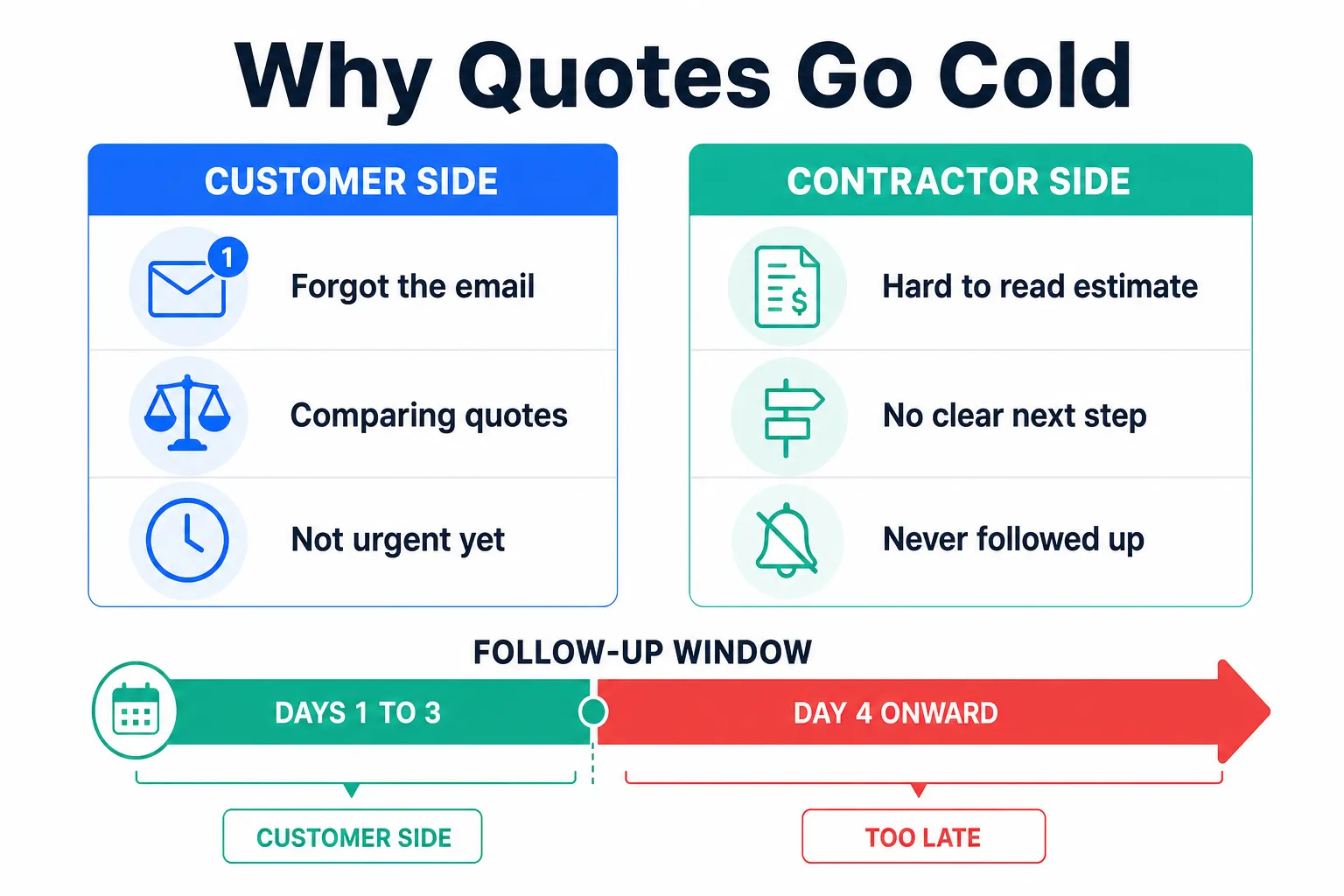
TLDR: Customers don't respond to quotes mostly because life got in the way, they got busy comparing options, or your estimate landed in a folder they forgot about. It is rarely about price. Understanding the real reasons helps you follow up smarter, not harder.
You send the quote. You wait. Nothing. You wonder if you should call, or if calling looks desperate. Meanwhile the job might be sitting there, ready to close, and the customer just needs a nudge. This happens to every contractor, every week.
The real reasons why customers don't respond to quotes
Most contractors assume silence means the price was too high. Sometimes that is true. But it is far from the most common reason.
Here is what actually happens on the customer's end:
- They got your estimate, meant to reply, and then a work deadline hit.
- They are waiting on a second quote from another contractor and feel awkward telling you that.
- The project is real but not urgent. It can wait a week, then two, then three.
- Your estimate went to an email address they barely check.
- A spouse or partner has to weigh in and that conversation keeps getting pushed.
- They lost the PDF in their inbox.
The customer is not ignoring you on purpose. They are just not as focused on your estimate as you are. You sent it and moved on mentally to the next job. They received it and moved on mentally to their own day.
Why the timing of follow-up matters more than the follow-up itself
There is a window after you send a quote when the customer still remembers the conversation, still feels the problem that made them call you, and has not yet committed to someone else. That window closes faster than most people think.
Wait too long and two things happen. One, a competitor follows up before you do. Two, the urgency the customer felt when they called you has faded. The leaky roof felt critical during the rainstorm. Three weeks of dry weather and it feels manageable.
The contractors who close the most estimates are not necessarily cheaper or better. They are faster and more consistent about following up. A follow-up sent the next morning is worth more than a perfect one sent five days later.
If you are sending estimates and losing track of who replied and who did not, a tool built around following up on unanswered estimates removes that mental load from your plate entirely.
What actually kills the response rate
Beyond the customer's side, there are things on your side that quietly kill the chances of getting a reply.
The estimate is hard to read. If you sent a wall of text, a scanned handwritten sheet, or a generic email with a PDF that looks like it was built in a spreadsheet, the customer has to work to understand it. Friction kills momentum.
There is no clear next step. A quote that ends with 'let me know if you have questions' gives the customer nothing to act on. They nod, close the tab, and forget it.
You sent it and never followed up at all. A lot of contractors send one email and wait. If the customer does not reply, they assume the job is lost. Many jobs are won simply by a second message, sent at the right time, with a clear and easy call to action.
You can also reduce friction upstream by building your estimates faster and more consistently, so the quote itself looks professional and is easy to act on.
The comparison shopping problem
Homeowners and property managers are often told to get three quotes. They call three contractors. One shows up fast, gives a clear estimate, and follows up promptly. The other two drag their feet.
Even if your price is fair and your work is good, slow follow-up signals something to the customer. It signals that this is how you run your business. If you are slow to respond before they hire you, what happens when there is a problem mid-project?
Speed and consistency during the quoting phase are a preview of you as a professional. The follow-up is not just a sales tactic. It is a demonstration of how organized and reliable you are.
This is worth keeping in mind when you feel like following up is pushy. It is not. Most customers appreciate it. They needed a reason to make the decision and you just gave them one.
My take
My advice: stop treating silence as rejection. Most of the time it is just noise, the customer's inbox, their schedule, their indecision.
The contractors I see struggle most with closing estimates have one thing in common. They send the quote and wait. No follow-up, or one follow-up so late that the customer already hired someone else. Then they blame the price.
Build a simple habit: follow up every estimate within 24 to 48 hours, then again a few days later if you still have not heard back. You do not need a script. A short, friendly message asking if they had any questions is enough. Most customers will reply.
The ones who do not reply after two or three follow-ups over a week or two are genuinely not moving forward. That is real feedback. But you should not write off a job before you have tried at least twice.
Common questions
How many times should I follow up before giving up? Two to three times over one to two weeks is reasonable for most residential projects. After that, a single check-in a month later is enough. Do not flood someone's inbox, but do not disappear after one message either.
Should I call or email? It depends on how you originally connected. If they called you, call them. If everything was by text or email, stay in that channel. Switching channels unexpectedly can feel jarring. Match their communication style.
What do I say in a follow-up message? Keep it short. Ask if they had any questions about the estimate. Mention you are still available to do the work and give a rough sense of your current schedule. That last part creates soft urgency without pressure. No need to apologize for following up.