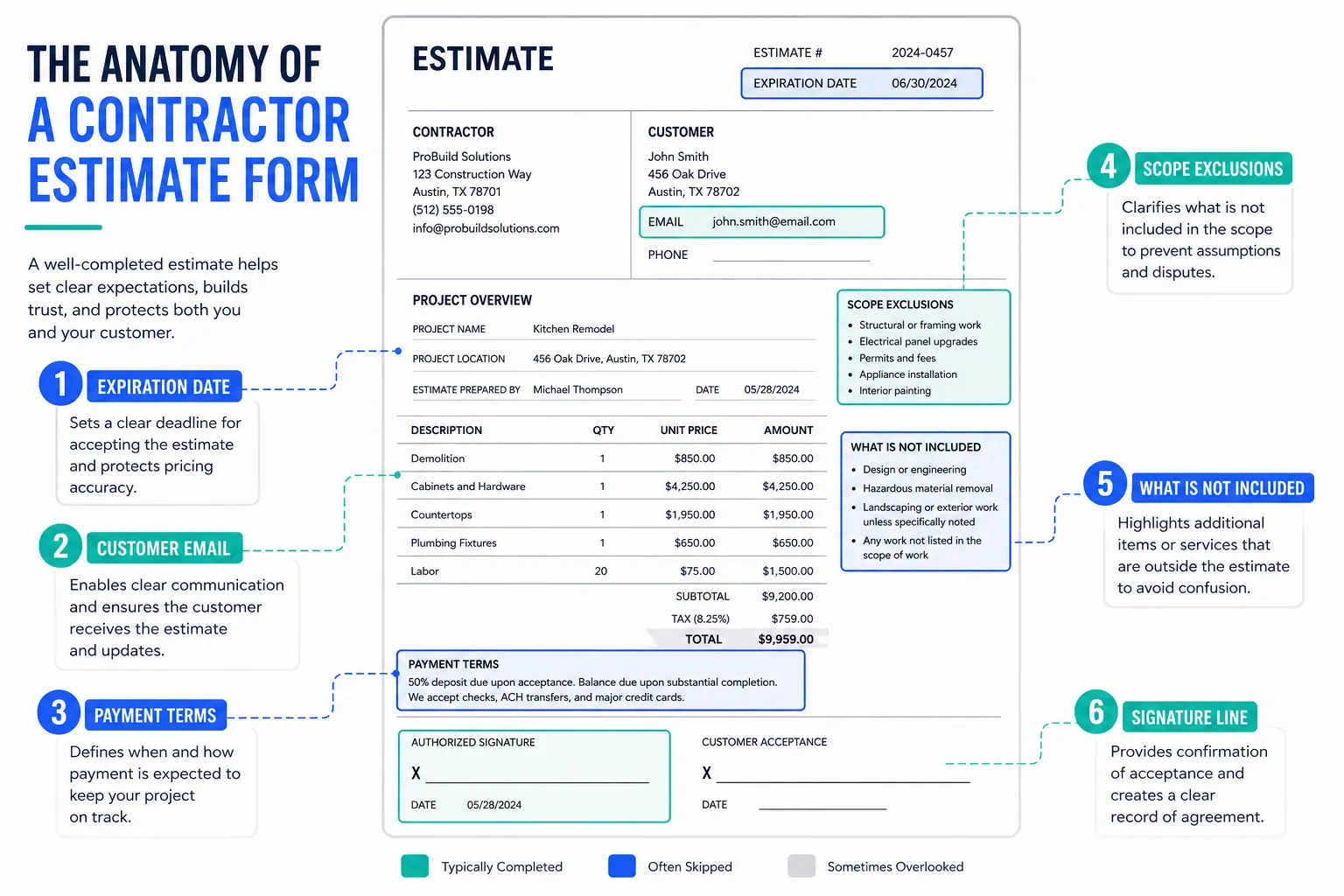
TLDR: Most contractors leave four or five estimate form fields blank on every job. Those empty lines are not just cosmetic. They affect whether you get paid, whether you can follow up legally, and whether a customer can hold you to something you never agreed to. Here is what you are skipping and why it matters.
The Fields Contractors Actually Leave Blank
Most estimate forms have a line for the customer's name, the address, and a dollar amount. Those three get filled in every time. Then the rest of the form stays empty because you are in a hurry to get back to the job site.
The blanks that cause problems later are almost always the same ones. Expiration date. Scope exclusions. Payment terms. Customer's email address. The field that says 'valid for X days.' And the line for the customer's signature acknowledging they received it.
None of these feel urgent when you are writing an estimate in your truck at 7 a.m. They feel very urgent six weeks later when a customer calls to say the price you quoted has to still stand.
Expiration Date: The Field That Actually Protects You
Material prices move. Labor availability changes. If your estimate has no expiration date on it, you have handed the customer an open-ended offer they can accept any time, including a year from now when lumber has doubled.
An expiration date is not aggressive, it is honest, and most customers respect it. You are telling them: this price reflects today's conditions. After this date, call me and we will revisit.
How many days is reasonable? That depends on your trade, your supplier relationships, and how volatile your materials are at the moment. There is no single right answer. Pick something and write it in. Leaving it blank is always the wrong answer.
Scope Exclusions: What You Are Not Doing
Every contractor knows the conversation. You bid roofing work and the customer assumes you are also handling the gutters. Or you quote a bathroom remodel and they think demo is included. Scope creep starts with an estimate form that only says what you will do.
A short exclusions section, even just two or three lines, closes that gap before the job starts. 'This estimate does not include removal of existing tile. It does not include electrical work behind walls. It does not include permits unless listed above.'
Writing exclusions protects you from doing unpaid work, and it protects the customer from surprises. Both of you benefit. It takes three minutes to write and it can save a full day of arguments mid-job.
If you are building estimates by voice or on a mobile form, this is the section most people dictate too fast and then never go back to fill in properly. Slow down here.
The Customer's Email Address and Why It Is Not Optional
You have the customer's phone number. You probably have their address. But a lot of estimate forms go out with no email address recorded, and that creates a problem the moment you need to follow up in writing.
Following up on an unanswered estimate by text is fine. But having a written record sent to an email address is a different kind of paper trail. It timestamps your follow-up. It shows the customer received the document. If a dispute ever ends up in small claims court, that trail matters.
Get the email address before you leave the site visit, not afterward. Once someone goes quiet on an estimate, they often go quiet on texts too. The email gives you another path to reach them, and it gives you documentation that you tried.
For contractors trying to collect Google reviews or re-engage past customers who never responded, the email address is often the only reliable contact point months later.
Payment Terms: Written on the Estimate, Not Just the Invoice
Most contractors write payment terms on the invoice. Far fewer write them on the estimate. That gap matters because the estimate is where the customer decides to say yes. If they are surprised by a 50% deposit requirement when the invoice arrives, you have already started the job relationship on a sour note.
Payment terms vary widely by trade, by job size, and by state. Some states regulate deposit amounts for certain kinds of work, particularly home improvement contracts. The rules differ from state to state, so do not assume what applies in one state applies in another. Check what your state requires for your trade.
Whatever your terms are, put them on the estimate so the customer sees them before they sign. No deposit terms. Net payment on completion. Progress billing at defined milestones. Whatever you use, it should not be a surprise.
My Take
My advice: treat your estimate form like a contract draft, not a pricing sheet. The price is only one piece of it. The other pieces, the expiration, the exclusions, the payment terms, the contact info, are what determine whether you actually get paid at the price you intended.
The contractors who have the fewest disputes are not necessarily the ones with the lowest prices or the fanciest trucks. They are the ones whose paperwork is clean. Clean paperwork sets expectations before the work starts, and it gives you something to point to when someone tries to change the deal after the fact.
If filling out a complete estimate form every time feels like too much friction, the answer is to make it easier to complete, not to skip sections. Voice-based estimate tools, saved templates, and auto-populated fields all cut the time it takes. The fields still need to be there.
Common Questions
Does a signed estimate count as a contract? In many states, a signed estimate that includes price, scope, and payment terms can function as a binding agreement. The specifics vary by state and by trade licensing rules. If you are doing home improvement work, your state may require a separate written contract with specific language. Check your state's contractor licensing board for what is required in your situation.
What if the customer refuses to give an email address? Some won't. That is their choice. Write down what they did give you, phone number and mailing address, and note it on the estimate. What you want to avoid is leaving the field blank and forgetting to ask at all. The ask matters.
How long should an estimate be valid? There is no universal standard. A week is common for fast-moving material markets. Thirty days is common for residential work where pricing is more stable. Pick a window that reflects your actual cost exposure and write it in every time. The number matters less than the habit of putting one down.