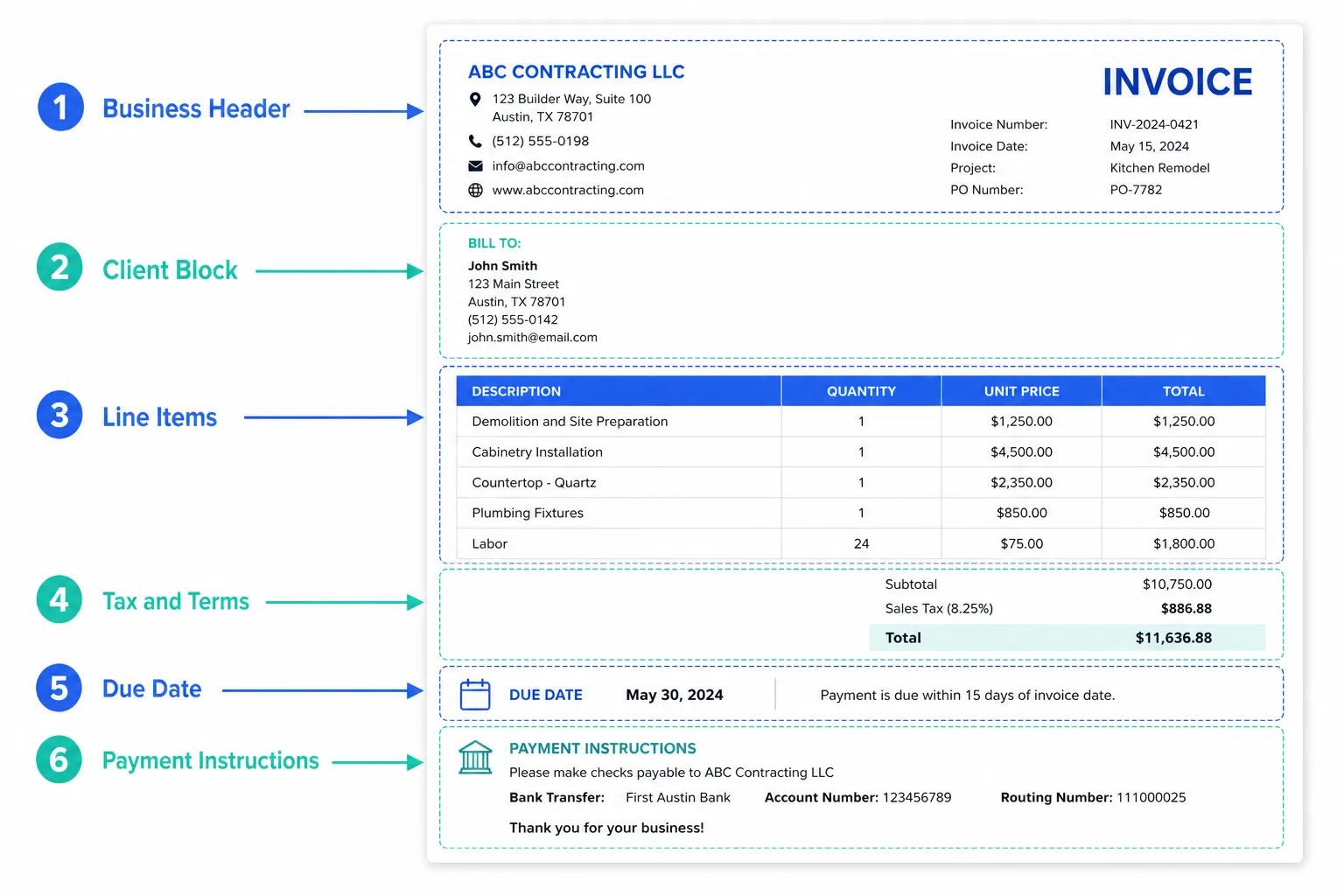
TLDR: A solid invoice names both parties clearly, itemizes the work, states the payment terms, and gives the customer exactly one way to pay. Get any of those wrong and you are chasing money instead of working. This article walks through a real invoice example, field by field, so you can audit your own template in ten minutes.
The Header: Your Business Identity
The top of the invoice is not decoration. It is the first thing a homeowner, property manager, or accounts-payable clerk looks at when they need to cut a check or file the document.
What belongs there:
- Your legal business name, exactly as it appears on your license or your state registration. Not a nickname, not just your first name.
- Your physical address or mailing address. Some states require this on contractor invoices. It also matters if a dispute ever goes to small claims.
- Your phone number and email. One point of contact is enough, but make it the right one.
- Your contractor license number, if your trade and state require it on billing documents. This varies, so check your state licensing board.
Leaving your license number off when your state requires it can flag the invoice as non-compliant and give a difficult customer a reason to delay payment. Do not give them that opening.
The Client Block and the Invoice Number
Right below your header, name the person or entity you are billing. Full name, address, and if it is a commercial job, the company name and the contact person who approved the work.
Then the invoice number. This is the part most small operators skip or do casually. A sequential, unique number on every invoice means you can track aging, reference documents in emails without confusion, and pull records fast if the IRS ever asks.
Also put the invoice date and the date the work was completed or delivered. Those two dates are not always the same, and both matter for payment terms and, in some states, for lien rights.
The invoice number and date are not bureaucracy, they are your paper trail. A handshake business runs on trust, but your books run on numbers.
The Line Items: The Heart of the Invoice Example
This is where most contractor invoices fall apart. Vague line items create disputes. Disputes delay payment.
Each line should carry:
- A short, plain-English description of the work or material. 'Install 200 sq ft of LVP flooring, master bedroom' beats 'flooring work'.
- The quantity. Hours, square feet, units, whatever the job calls for.
- The unit price.
- The line total.
Group the lines logically. Labor separate from materials. If you have subcontractor costs you are passing through, show them clearly. Some clients, especially commercial ones, want to see the breakdown. Others do not care. Either way, a clean itemized list protects you if someone disputes a charge later.
A detailed line item is your best defense in a dispute because vague invoices lose arguments and detailed ones win them.
If you bill for travel, mobilization, or a trip charge, name it explicitly. Do not bury it in labor hours. Transparency here builds trust, and it makes the invoice easier to approve quickly.
Taxes, Terms, and the Due Date
Sales tax on labor and materials for contractor work varies significantly by state. Some states tax materials but not labor. Some tax certain trades differently. A few have exemptions for specific project types. Do not guess. Check with your state's department of revenue or your accountant, and apply the correct rate consistently.
Payment terms are a line most contractors write in vague language, then wonder why they wait 60 days to get paid.
Be specific:
- 'Net 30' means payment is due 30 days from the invoice date. Write that out if your client is not a commercial buyer used to the shorthand.
- If you want a late fee, state the rate and when it kicks in. Whether late fees are enforceable and at what cap varies by state, so keep it reasonable and check your local rules.
- If you took a deposit, show the deposit amount, subtract it, and show the balance due. Never make a client do that math themselves.
The due date should be a specific date, not a vague phrase, because 'upon completion' means different things to you and to your client.
Payment Instructions and Notes
Tell the client exactly how to pay. One clear method is better than four confusing ones. If you take checks, say who to make it out to. If you take ACH or card, give the link or the account details.
A notes section at the bottom earns its space. Use it for:
- A warranty statement, if you offer one. Keep it short and clear.
- A reference to the original estimate or contract number. This connects the invoice to the approved scope and shuts down 'I didn't agree to that' conversations.
- A simple thank-you. It sounds small, but a one-line acknowledgment that you appreciate the business costs nothing and leaves a better impression than a cold document.
If you send invoices by email and want to follow up on unpaid ones automatically, the notes section is also a good place to remind the client how to reach you with questions, so small confusion does not turn into a stalled payment.
A payment link or clear check-payable line removes every excuse a slow payer has to wait another week.
My Take
My advice: treat your invoice the same way you treat your truck. Keep it clean, organized, and ready to work. A sloppy invoice is a signal to the client that the back office is chaotic, even if your work on site was spotless.
The contractors I see struggling with cash flow almost always have the same problem. They do great work, they send a vague invoice late, and then they do nothing for three weeks while the client forgets about it. The invoice itself is half the problem.
Fix the format once. Then build a habit around sending it the same day the job closes. That single discipline does more for your cash position than almost anything else.
The best invoice example is not the fanciest one, it is the one that gets paid on time because it gave the client every reason to pay and no excuse to wait.
Common Questions
Do I need to put my license number on every invoice? It depends on your state and trade. Some states require it on all contractor billing documents. Others only require it on contracts. Check with your state licensing board. When in doubt, include it. It only helps you.
What if I forgot to invoice for something after I already sent the bill? Issue a separate invoice or a corrected invoice clearly labeled as such. Reference the original invoice number. Do not just add a line in an email. A document with a number is trackable. An email thread is not.
Can I charge a late fee if the client pays past due? Generally yes, but the rules on how much and how you have to disclose it vary by state. Put the fee in writing on the invoice itself before the work starts, not after the payment is late. That is the part most people get backwards.