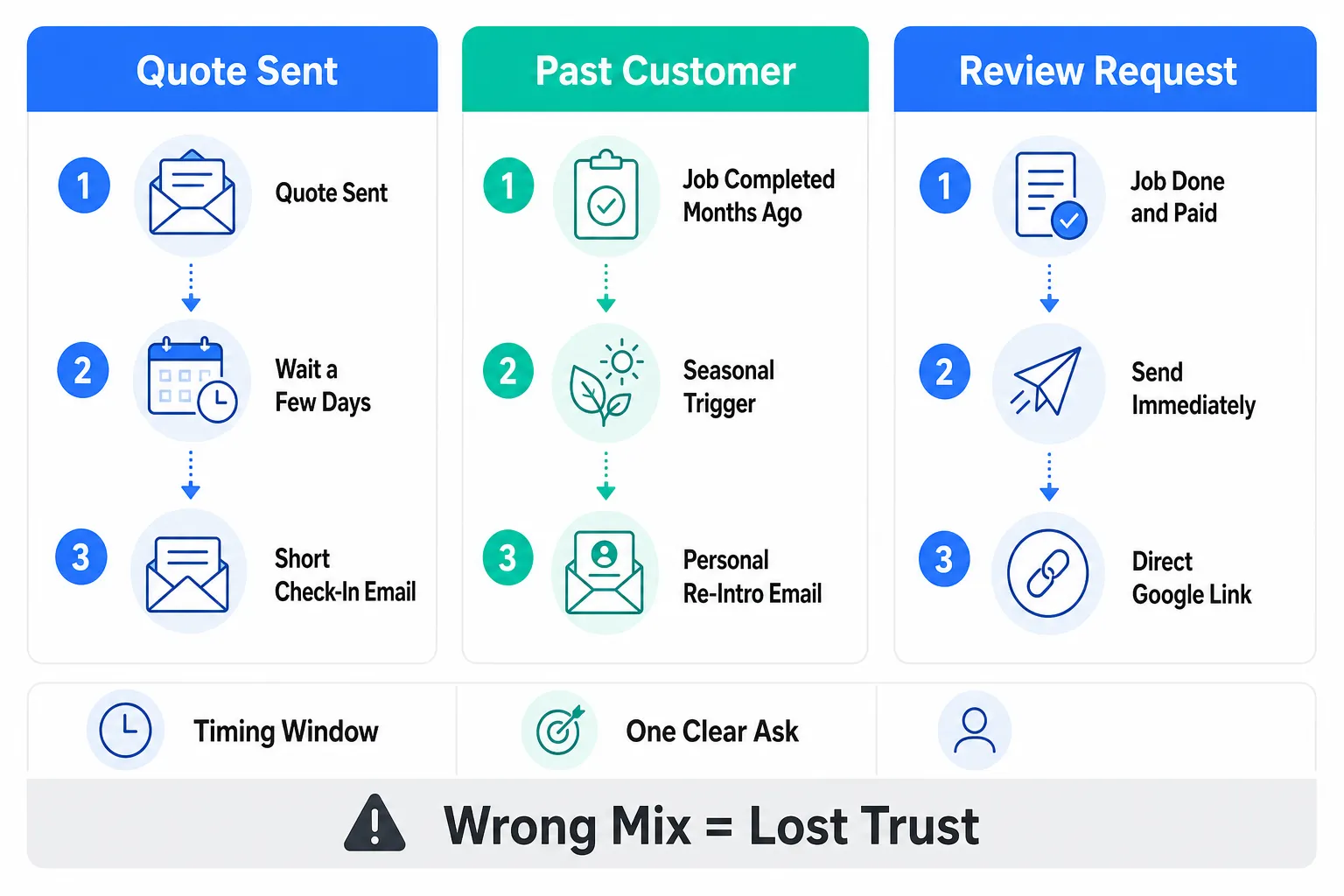
TLDR: A follow up email template saves time, but the wrong template at the wrong moment kills deals and annoys good customers. Match the template to the situation: estimate follow-up, past customer reactivation, or review request. Each one has a different tone, a different timing, and a different goal.
Most contractors send one generic follow-up and wonder why nobody responds. The truth is that a homeowner sitting on an estimate needs a completely different message than a customer you finished a bathroom for eight months ago. Lumping them together is the fastest way to sound like a robot and get ignored.
Why Template Choice Matters More Than Template Wording
A lot of advice online focuses on what to write inside a follow-up email. The better question is which type of email to send first. Get the category wrong and the best copy in the world will not save you.
Think about it from the recipient's side. A prospect who got your estimate last Tuesday is in decision mode. A past customer who you painted for last spring is in a completely different headspace. They have moved on. They are not thinking about you at all, which is fine, but your message needs to account for that.
The category of follow-up determines the tone before you write a single word. Estimate follow-ups are about momentum. Past customer emails are about relationship. Review requests are about a small, specific ask. Three different jobs, three different templates.
The Estimate Follow-Up Template
This is the one most contractors need first. You sent a quote. The homeowner went quiet. Days pass. You are on a job site and you do not have time to chase every open estimate by hand.
The goal of this template is simple: re-open the conversation without sounding desperate. A few things that actually work:
- Keep it short. One or two sentences is often enough.
- Reference the specific job, not a generic 'your estimate.' Say 'the deck project on Maple Street' or 'the HVAC replacement we quoted last week.'
- Give them an easy out. Something like 'if the timing has changed, no problem, just let me know' removes pressure and actually gets more replies than a hard push.
- End with a single clear question. 'Do you have any questions about the quote?' is better than a paragraph of options.
Timing matters here. One follow-up the day after you send the estimate is too soon for most jobs. A few days out is a reasonable window, but it depends on the project size. A big remodel has a longer decision cycle than a small repair. Sending too early signals impatience; sending too late means the homeowner already called someone else. You need to find the middle, and that window is shorter than most contractors think.
If you want to understand how automated estimate follow-up can handle this timing problem for you, the Lienzor home page explains the approach without requiring you to track every open quote manually.
The Past Customer Reactivation Template
This one gets neglected almost universally. Contractors spend money on ads to find new customers while ignoring a list of people who already hired them and were happy.
A past customer email is not a follow-up on anything pending. It is a check-in, a reminder that you exist, and an opportunity to surface a need they have not acted on yet. That is a softer sell and the template has to reflect that.
What actually works here:
- Open with something real. Reference the actual job. 'We wrapped up your kitchen remodel about a year ago' beats any generic opener.
- Mention a seasonal or practical trigger. 'Before winter hits' or 'spring is a good time for exterior work' gives them a reason to think about you now.
- Keep the ask small. You are not asking them to sign a contract. You are asking if they have anything on their list.
- Make replying easy. A direct reply to your email should be enough. No forms, no links to click through.
The biggest mistake with past customer emails is waiting too long to send them. Once a year is the floor. Twice a year is better for most trades. If a customer had a good experience, they want to hear from you. They just forget you exist if you disappear.
To think through which past customers to target first, the page on customer segments is worth a look. Not every past customer is equal in terms of reactivation potential.
The Review Request Template
Google reviews drive real business for contractors. A homeowner searching for a roofer or an electrician in their area is looking at star ratings and review counts before they call anyone. But most contractors never ask.
The review request template is the most specific of the three. It has one job: get the customer to leave a review. That is it.
A few things that make this work:
- Send it shortly after the job is done, while the experience is fresh. Waiting weeks or months tanks your response rate.
- Make the link direct. Sending someone to 'look us up on Google' is friction. Send them straight to your Google review page.
- Keep the message to three sentences or less. Thank them, tell them reviews help your small business, and give them the link.
- Do not ask for a five-star review. Just ask for an honest one. It reads better and it is the right thing to do.
One personal note on timing: right after you collect final payment is usually the best moment, because the customer just confirmed they were satisfied enough to pay. That satisfaction is at its peak. Asking a week later when they have moved on is harder.
Mixing the Three Up Is a Real Problem
This is where small contractors lose credibility fast. Sending a review request to someone who never responded to your estimate. Sending an estimate follow-up to a customer from two years ago. Sending a past customer email with pricing language that makes it feel like a cold pitch.
Each of these feels off to the person receiving it. And once you feel off to a homeowner or a property manager, they do not call you. They just move on.
The discipline is simple: know which bucket each contact falls into before you write a word. Open estimate, past customer, or completed recent job. Those three buckets cover almost every scenario in a contractor's contact list.
If you are managing this manually across a spreadsheet and a phone, it is easy to lose track. That is not a personal failing. It is just a volume problem that gets worse as your business grows.
My Take
My advice: stop looking for the perfect follow up email template and start being honest about which situation you are actually in. Most of the time, the template is fine. The problem is it is being sent to the wrong person at the wrong moment.
For estimate follow-ups, send sooner than you think you need to and make it short. For past customers, send more often than you think is appropriate and make it personal. For reviews, send immediately after the job and make it easy.
The contractor who follows up consistently and correctly, on every open estimate, every past customer, every completed job, will outperform the one with better ads every single time. It is not exciting advice. But it is the one that compounds over time.
If you are at the point where you want to stop tracking this manually, Lienzor handles the estimate follow-up piece specifically for contractors and tradespeople. Worth knowing it exists.
Common Questions
How many follow-up emails should I send on an open estimate? Two is reasonable for most jobs. One a few days after the estimate, one about a week later. After that, a brief phone call is often more effective than a third email. More than two emails without a reply starts to feel pushy.
Should I use the same template for email and text? No. Text messages need to be even shorter and more direct. The template logic is the same, the same three categories apply, but text tolerates almost no preamble. Get to the point in the first line.
What if the customer never responds to any follow-up? Let them go after a couple of attempts. Chasing someone who is not engaging wastes your time and can actually damage your reputation if they find it annoying. Move on and put your energy into the leads and past customers who do respond.